Tag: Skyroot Aerospace

  • From 51 Marks in Math to Building Indiaโ€™s First Private Rocket Company, Here’s the Story of Pawan Kumar Chandana

    From 51 Marks in Math to Building Indiaโ€™s First Private Rocket Company, Here’s the Story of Pawan Kumar Chandana

    Pawan Kumar Chandana grew up in a middle-class home in Visakhapatnam, struggled with academics, and once scored just 51 marks in mathematics. Two decades later, he co-founded Skyroot Aerospace, the first private space startup from India to launch a rocket, placing the country in a rare global club dominated by the US, China, and Japan.

    Chandanaโ€™s journey began far from launchpads and clean rooms. As a school student, he was known more for poor grades than promise. His father refused to give up and enrolled him in IIT coaching. Something clicked. Chandana developed a genuine interest in math and science, improved rapidly, and cleared the IIT entrance exam (JEE) on his first attempt. In 2007, he joined IIT Kharagpur to study mechanical engineering.

    While many of his peers chased consulting roles, foreign degrees, or high-paying jobs, Chandana fixated on rockets. In 2012, he joined ISRO straight out of campus. The pay was modest, but the work mattered to him. He performed well and imagined spending his entire career there.

    That plan changed when his long-standing interest in entrepreneurship returned. Chandana wanted to build a global space company from India. At the time, private rocket launches were not allowed, and funding for space startups barely existed. In 2018, he resigned from ISRO without a safety net.

    He had no startup background and no investor network. He searched online to understand how equity worked. After several dead ends, he cold-messaged Mukesh Bansal on LinkedIn. Bansal invested $1.5 million, giving Skyroot its first lifeline.

    The next few years were rough. COVID slowed progress. Cash ran low. Venture funds declined to invest. Support finally came from the founders of Greenko, a renewable energy firm. Policy reform followed soon after. In 2021, the Indian government opened the space sector to private players. Skyroot became the first startup to sign an MoU with ISRO and later raised $51 million, the largest check in Indian deep-tech at the time.

    On November 18, 2022, Skyroot launched Vikram-S, Indiaโ€™s first private suborbital rocket, reaching an altitude of 90 kilometers. The company now employs around 1,000 people, runs Indiaโ€™s largest rocket factory spanning 200,000 square feet, and is valued at about $527 million. Its first orbital launch, Vikram-1, is scheduled for 2026.

    Skyrootโ€™s rise shows that high-risk space technology can grow from India without inherited wealth or early policy support. If successful, it could reshape how the country participates in the global launch market and inspire a new generation to look beyond safe careers and aim higher, literally.

    Story Source: This man who grew up in middle class India literally built the only startup outside US/China/Japan that sent rockets to space.

  • Skyroot targets January 2026 launch as Vikram-1 prepares to carry private satellites to orbit

    Skyroot targets January 2026 launch as Vikram-1 prepares to carry private satellites to orbit

    Hyderabad’s Skyroot Aerospace

    plans to send Vikram-1, its first orbital rocket, into space in January 2026. The flight will take place from Sriharikota and will carry commercial satellites for Catalyx Space. If successful, it will mark India’s first privately built rocket to reach orbit, showing how fast the country’s space sector is changing after years of government dominance.

    Vikram-1 stands at about 20 meters, roughly the height of a mid-sized apartment block. It uses four stages to climb through the atmosphere and enter space. The first three stages run on solid fuel stored inside composite shells. This gives the rocket strong lift at liftoff and reduces the number of moving parts. Skyroot says the first stage can deliver up to 1,000 kilonewtons of thrust.

    The final stage uses liquid fuel. The pair of chemicals ignite as soon as they meet, so the engine can start and stop without a spark. This allows the rocket to adjust course once it reaches space. The complete vehicle can place about 480 kilograms into low Earth orbit, which suits clusters of small satellites and rideshare missions.

    Skyroot was founded in 2018 by two former ISRO engineers, Pawan Kumar and Naga Bharath Daka. The company started with a small team and basic equipment, focusing first on a suborbital test rocket. That rocket, called Vikram-S, reached 89.5 kilometers in November 2022. It demonstrated carbon-fiber construction and helped the company test its engines and electronics under real conditions.

    After that flight, engineers ran a series of ground tests. They pushed the engine casings to 82 atmospheres of pressure, verified fairing separation in a fraction of a second, and carried out repeated ignition checks. By mid-2025, most of the rocket’s parts were built across factories in India and then brought together for final assembly.

    The company is targeting the fast-growing market for small satellites. Traditional Indian rockets like the PSLV can carry large payloads, but they are often booked months in advance. Vikram-1 aims to support quicker launches with smaller payloads, offering access to orbit at a lower cost. CubeSats used for weather tracking, internet networks, or astronomy are among the likely customers.

    At about 500 kilometers above Earth, satellites circle the planet every hour and a half. Many commercial and research missions choose these orbits for stable lighting conditions and short communication delays. Vikram-1 can place nearly 300 kilograms into such a path, which is useful for space imaging and monitoring.

    If the January mission works as expected, Skyroot plans to move ahead with Vikram-II. The second model will include a cryogenic upper stage that uses liquid hydrogen and liquid oxygen. That change should allow the rocket to carry about 900 kilograms. It could support missions that need higher altitudes or longer travel times, including trips around the Moon.

    Private investment in Indian space companies has grown since 2020. Skyroot joins other startups, including Agnikul Cosmos, that are designing launch vehicles and engines. ISRO continues to run major missions, but private rockets like Vikram-1 may help reduce waiting times and open new business for smaller customers.

    For Skyroot, the next few months will focus on final assembly, checks on the guidance systems, and rehearsals at the launch range. A successful flight would mark a new stage for commercial space in India and give the country another way to reach orbit without relying only on government rockets.

  • Skyroot Aerospace brings in Former ISRO chief Dr. Somanath as technical advisor

    Skyroot Aerospace brings in Former ISRO chief Dr. Somanath as technical advisor

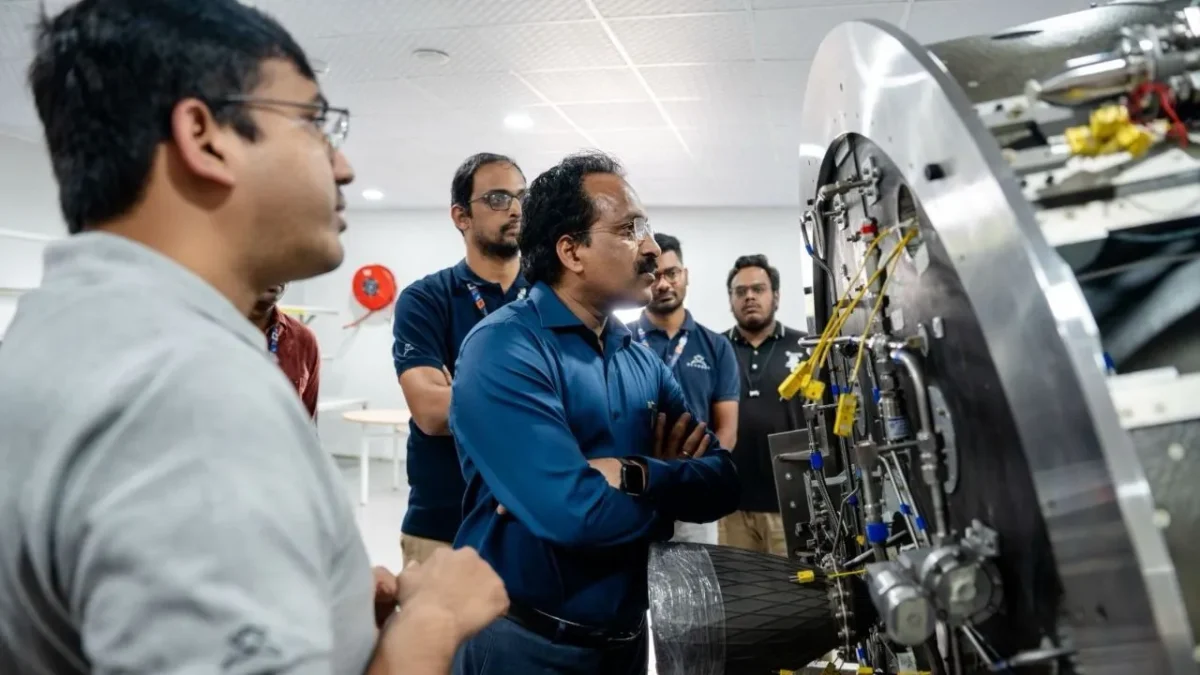
    In a bold move, a Hyderabad-based private space startup, Skyroot Aerospace, has appointed former ISRO chief Dr. S. Somanath as its honorary chief technical advisor ahead of its first orbital-class rocket launch, bringing decades of launch-vehicle expertise to the company.

    Dr. S. Somanath, known for directing ambitious projects like India’s Chandrayaan-3 lunar mission, has joined Skyroot Aerospace as its technical advisor ahead of its inaugural flight of its Vikram-1 satellite launch vehicle. The appointment, announced on 26 June 2025, is non-exclusive and unpaid, allowing him to pursue other engagements.

    About Skyroot Aerospace

    Skyroot Aerospace Private Limited is a private Indian aerospace manufacturer and commercial launch service provider headquartered in Hyderabad, Telangana. With launch vehicles like Vikram-1, a 23 m, carbon-composite, multi-stage orbital launcher featuring a liquid-engine Orbital Adjustment Module, the startup aims to enter the commercial satellite-launch business.

    Bringing in a veteran like Dr. S. Somanath, who led ISRO from January 2022 to January 2025 and oversaw major missions like Chandrayaan-3, Aditya-L1, SSLV, and RLV, gives Skyroot deep technical insight. His advisory support during this critical phase could prove decisive.

    The company quickly gained recognition following the re-entry tests of its Vikram-S rocket. Since then, it has raised approximately USD 95 million, including USD 27.5 million in late 2023, to develop a range of small satellite launch vehicles. These include the Vikram-I, II, and III, which are designed for flexible and rapid commercial launches.

    Additionally, the firm has recently secured a partnership with U.S.-based Axiom Space to explore opportunities for satellite deployment and low-Earth orbit missions, highlighting its global ambitions.