Tag: Starship

  • SpaceXโ€™s Starship Completes First Fully Successful Test Flight in Years

    SpaceXโ€™s Starship Completes First Fully Successful Test Flight in Years

    SpaceX achieved a milestone on Tuesday evening as its Starship rocket completed its 10th flight test with a successful launch from South Texas, marking the first time the system carried out all major mission goals without failure. The August 26 launch from Starbase came at 6:30 p.m. local time, following two days of delays caused by technical checks and stormy weather.

    The two-stage rocket, the largest ever built, lifted off with 33 methane-fueled Raptor engines on its Super Heavy booster. Engineers had struggled with leaks, fires, and engine damage in earlier attempts, but the latest flight showed those problems had been addressed with new shielding and better fuel management.

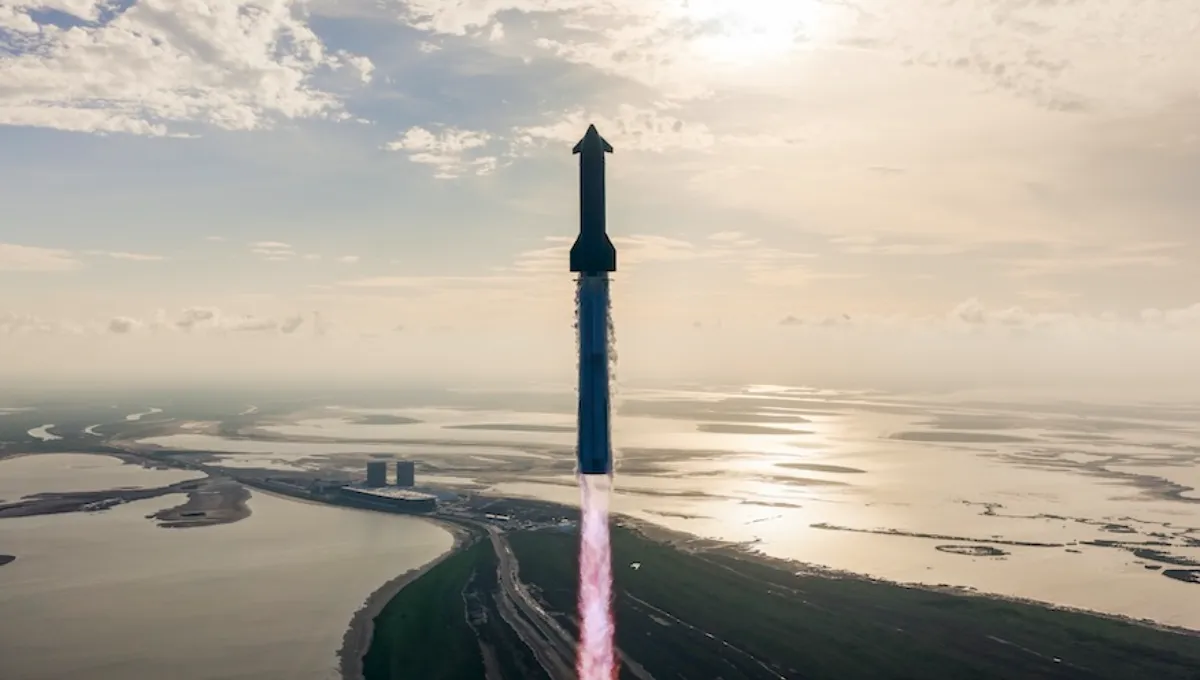
    In this test, Booster 16 and Ship 37 were loaded with more than 10 million pounds of propellant, producing over twice the thrust of NASA’s Saturn V, which carried astronauts to the Moon. After a clean separation, the Super Heavy booster carried out a controlled descent and splashed down in the Gulf of Mexico. It was the first time the company completed the recovery phase without a loss of vehicle.

    SpaceX Starship on the launchpad during a sunset.
    SpaceX’s Starship rocket at Starbase, Texas, at sunset on Monday, Aug. 25, 2025. Image credit: SpaceX

    The upper stage, Ship 37, continued on a suborbital flight path and released eight mock Starlink satellites to simulate cargo deployment. The vehicle then tested reentry procedures, reaching heating levels of about 1,400 degrees Celsius. Surviving this trial is essential for future missions that will return from orbit or beyond.

    Starship’s test campaign has been troubled since Flight 7, when vibrations damaged engines and triggered explosions. Investigators traced the failures to leaks and fires in the aft section. Engineers responded with hardware upgrades that were put to the test in this tenth flight.

    The launch has also generated excitement on social media. On X, one user wrote, “Incredible! Beautiful! Successful.” “Sorry, but what a beautiful launch, amazing vapor cones, booster sep and boost back complete, and Starship flying nominally. Just awesome. This is the only way to ensure the survival of life as we know it.” Another user expressed.

    The rocket’s development is central to NASA’s Artemis program, which plans to use a modified Starship as a lunar lander. SpaceX says the vehicle’s full reuse could reduce launch costs from millions to just thousands of dollars per ton, a change that could reshape how cargo and people are sent to space.

    Looking ahead, SpaceX intends to test booster catches using the launch tower’s mechanical arms, called ‘Mechazilla,’ a move that would cut recovery times. Data from this flight will also guide the design of future “Block 2” Starship models, expected to feature stronger structures and more reliable systems.

    With Flight 10 completed, the company showed it is moving closer to making Starship operational. For the first time, the rocket demonstrated the ability to launch, separate, land, and carry a payload in one mission, laying the groundwork for more ambitious goals, including missions to the Moon and eventually Mars.

  • SpaceX Starship Flight 7 Ends in Explosion: Debris Rains from the Sky

    SpaceX Starship Flight 7 Ends in Explosion: Debris Rains from the Sky

    The SpaceX Starship Flight 7 exploded on Thursday a few minutes after launch. The debris rained from the sky, leading to a change in flight courses above the area.

    X user @KingDomRedux shared a stunning video of the Starship debris falling from the sky:

    The Starship Flight 7 was launched from the Boca Chica, Texas, launch facility at 5:38 pm EST. The first stage of the flight test went smoothly, with the Super Heavy booster successfully caught by Mechazilla. However, communication was lost with the Starship a few minutes later, which ultimately resulted in an explosion.

    “Success is uncertain, but entertainment is guaranteed!” Elon Musk posted on X.


    What went wrong in Starship Flight 7?

    This next-gen starship was one of the most capable starships flown so far! Sadly, not everything went as planned. Communication with the upper stage was lost shortly after lift-off.

    SpaceX Communications Manager Dan Huot confirmed on a live stream that they had lost the starship, and a few minutes later, videos of the starship explosion were shared across social media by the witnesses confirming the Starship loss. Investigations are underway to determine the cause behind this loss of contact.


    What does a successful Starship Flight test look like?

    Below is the sequence of events that occur during a successful Starship Flight test:

    1. Lift off: The super heavy, powered by 33 Raptor engines, takes off from the launch pad. Taking the starship to the desired altitude
    2. Hotstage maneuver: This innovative technique ignites the upper stage engines while still attached to the booster, ensuring continuous acceleration.
    3. Mechzilla booster catch: the super heavy booster returns to the Starbase for a catch after the hot stage maneuver.
    4. Test satellite deployment: The starship continues to go into space, getting into its suborbital trajectory and deploying test satellites.
    5. Reentry of Starship: A raptor engine on the starship is reignited to put the starship into the reentry trajectory.
    6. Flip maneuver: As the starship reenters Earth’s atmosphere, the raptor engine will be reignited, and the spacecraft will perform a flip maneuver for a soft water landing in the Indian Ocean.


    Was Starship Flight 7 different from previous flight tests?

    Yes, the Starship Flight 7 was much different from the previous flight tests. Flight 7 aimed to test the next-gen starship with a number of structural and functional upgrades on the starship and the ground station.

    Here are some of the major upgrades that were done in the Starship Flight 7:

    • Redesigned forward flaps: The starship was redesigned to reduce reentry heating. The forward flaps of the spacecraft’s upper stage were reduced in size andย shifted upwards away from the heat shield.
    • Tile removal: like the previous flight, multiple tiles were removed from the entire vehicle to stress test the vulnerable areas.
    • Propellant capacity upgrade: The starship spacecraft was made 2 meters taller, which allowed the starship to carry 25% more propellant.
    • Propulsion Upgrades: Enhancements such as vacuum jacketing on the feed lines and a new feed line system improve overall performance.
    • Payload Deployment: The mission aimed to deploy 10 simulated Starlink satellites that would enhance Starlinkโ€™s global internet reach and conduct several re-entry tests. Each satellite is designed to simulate the next generation of Starlink, testing payload capacity.
    • Multiple Re-entry Experiments: To improve re-entry survivability, various metallic tiles with active cooling systems will be tested.
    • Radar testing: Several new radar systems were fitted on the tower catch arms to measure the distance between the superheavy booster and the catch arms, enabling efficient booster catch.


    Achievements of the Starship Flight 7

    The starship exploded during Flight 7; however, not everything was negative about this flight test.

    Mechazilla successfully caught the Super Heavy Booster. The super heavy booster returned to the launch site for a catch attempt, which proved to be successful once again. Thousands of catch-commit criteria had to be fulfilled to make the catch successful.

    This booster catch technology will be crucial for future space missions, as it enables the company to refurbish and reuse the booster in significantly less time.

    Despite the catastrophic end of this mission, we should remember that every flight offers lessons; understanding this anomaly is crucial for future success.