

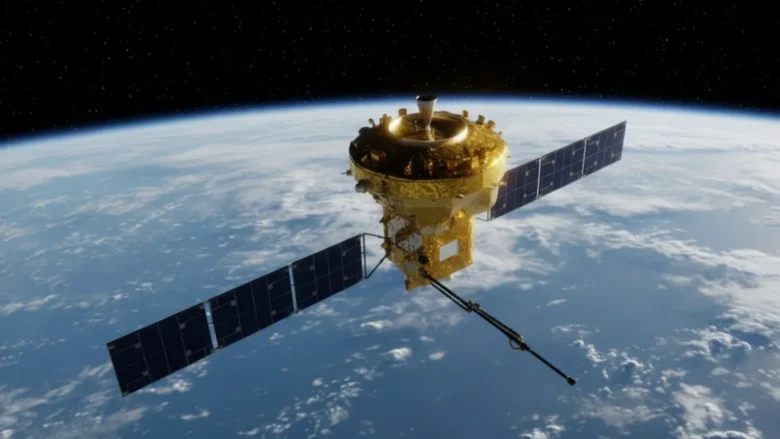
SMILE (Solar Wind Magnetosphere Ionosphere Link Explorer), a joint mission by the European Space Agency and the Chinese Academy of Sciences, will study how the Sun’s charged particles interact with Earth’s magnetic field. The spacecraft is set to launch from French Guiana on a Vega-C rocket between April 8 and May 7, 2026. It will capture wide images and direct measurements to improve space weather forecasts that affect satellites, GPS, power systems, and radio signals.
SMILE will orbit Earth in a long, tilted path that reaches more than 120,000 kilometers into space. From that distance, it will look back at Earth and record how the solar wind presses against the planet’s protective magnetic layer and how energy moves into the upper atmosphere.
Solar wind is a fast flow of charged particles released by the Sun. Earth’s magnetic field blocks much of it, but strong solar outbursts can disturb this shield. When that happens, bright auroras appear near the poles, and technology on Earth and in orbit can be affected.
SMILE is designed to fill gaps left by earlier missions that only studied small regions. The now-complete Cluster mission, run by ESA, tracked conditions close to Earth for more than two decades. SMILE will take a wider, global view and link what happens in space to changes seen in the sky above the poles.
The spacecraft carries four main instruments. One camera will map the outer edge of Earth’s magnetic field using faint X-ray signals created when solar particles strike atoms in space. Another camera will photograph the full northern aurora to show where energy enters the atmosphere. Two additional sensors will measure charged particles and magnetic fields along the spacecraft’s path.
During each 51-hour orbit, SMILE will spend up to 40 hours above Earth’s polar regions. From this position, it can continuously observe the areas where solar particles enter the system and where auroras form and change over time.
Scientists first proposed the mission in 2015. ESA built the section that carries the imaging instruments, while China built the spacecraft body and the sensors that take direct measurements. Engineers joined the two sections at ESA’s testing center in the Netherlands in January 2025.
After the final assembly, teams ran a long series of tests to check how the spacecraft handles strong vibration, extreme heat, and deep cold. In September 2025, SMILE passed its final reviews and was approved for launch.
The spacecraft will travel by ship to French Guiana in February 2026. From there, it will be sent into space on a Vega-C rocket, which has returned to regular service after earlier problems.
Once in orbit, SMILE will operate for at least three years. Data from the mission will be shared with research centers in Europe, China, and other countries. Scientists will also compare its results with data from NASA missions such as MMS and THEMIS to build a clearer picture of Sun-Earth interactions.
With the Sun currently in a more active phase, solar storms are expected to occur more often. SMILE will allow scientists to record these events in detail and improve early warning systems that protect modern technology on Earth and in space.