
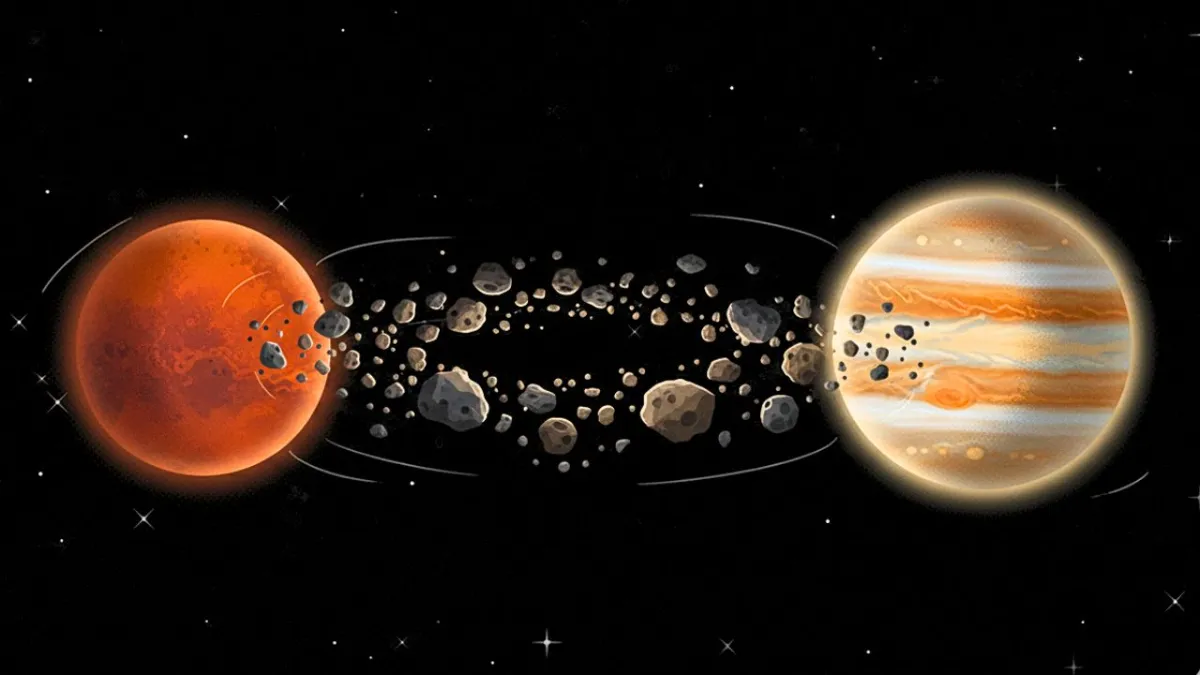
The inner and outer planets sit on opposite sides of a natural boundary in the solar system known as the asteroid belt. This region circles the Sun between Mars and Jupiter, and it marks where rocky worlds end and giant worlds begin.
Where Is the Asteroid Belt Located?
The asteroid belt lies at an average distance of about 2.8 astronomical units (AU) from the Sun. One astronomical unit equals the average distance between Earth and the Sun.
The belt stretches from roughly 2.1 AU to 3.3 AU. Jupiter’s strong gravity shapes the belt’s structure and prevents the material from forming a planet.
This location places the asteroid belt in a key position for studying gravitational interactions within the solar system.
How Did the Asteroid Belt Form?
Early theories suggested that the asteroid belt came from a destroyed planet. Modern science rejects this idea.
During the early solar system, dust and rock began clumping together to form planets. In the region between Mars and Jupiter, Jupiter’s gravity disrupted this process. The material never merged into a single planet.
Instead, repeated collisions broke larger bodies into smaller fragments. Over time, these fragments settled into the asteroid belt we observe today.
This explanation aligns with computer simulations and spacecraft observations.
What Are Asteroids Made Of?
Asteroids vary widely in composition. Scientists classify them into three main types based on their chemical makeup and reflectivity.
C-type (Carbon-rich asteroids)
C-type asteroids are the most common. They contain carbon compounds, clay, and silicate rocks. These asteroids appear dark and may resemble the building blocks of early Earth.
S-type (Silicate asteroids)
S-type asteroids contain silicate minerals and nickel-iron metal. They dominate the inner regions of the asteroid belt.
M-type (Metal-rich asteroids)
M-type asteroids consist largely of metallic iron and nickel. Some scientists believe they represent the exposed cores of early planetary bodies.
These classifications come from spectral analysis conducted by ground-based telescopes and spacecraft.
Notable Objects in the Asteroid Belt
Ceres
Ceres is the largest object in the asteroid belt and holds about one-third of the belt’s total mass. Scientists classify it as a dwarf planet. NASA’s Dawn mission revealed evidence of water ice and ancient brine deposits on its surface.
Vesta
Vesta is one of the brightest asteroids visible from Earth. It shows signs of volcanic activity in its past and has a differentiated interior.
Pallas and Hygiea
Pallas and Hygiea rank among the largest asteroids. Hygiea may also qualify as a dwarf planet based on its shape and size.
Is the Asteroid Belt Dangerous?
The asteroid belt does not pose a direct threat to Earth. Most near-Earth asteroids do not originate from the main belt itself. Gravitational interactions can occasionally nudge asteroids onto Earth-crossing paths, but such events are rare.
Space agencies continuously monitor near-Earth objects using advanced telescopes and tracking systems. These efforts improve planetary defense and risk assessment.
The Inner Planets
The inner planets are Mercury, Venus, Earth, and Mars. They orbit within about 1.5 astronomical units (AU) of the Sun and are made mainly of rock and metal.
Mercury
Mercury is the smallest planet and the closest to the Sun. It has almost no atmosphere, so temperatures change sharply. Days are extremely hot, while nights are very cold.
Its surface has craters, cliffs, and plains shaped by ancient volcanic activity. NASA’s MESSENGER spacecraft mapped Mercury and found water ice in craters at its poles, where sunlight never reaches.
Venus
Venus is similar in size to Earth, but its climate is very harsh. A thick carbon dioxide atmosphere traps heat and creates a strong greenhouse effect. This makes Venus the hottest planet.
Its surface has mountains, large volcanic plains, and many volcanoes. Radar images show signs that some volcanic activity may still be happening. NASA’s VERITAS and ESA’s EnVision missions will study Venus in more detail.
Earth
Earth is the only known planet with liquid water on its surface. Its atmosphere provides oxygen, protects life from radiation, and keeps temperatures stable. Plate tectonics slowly reshape the surface, forming mountains and oceans.
Earth also has a magnetic field that shields the planet from solar particles. These features make Earth the only confirmed world that supports life.
Mars
Mars is cold and dry today, but it once had flowing water. Its surface has dried riverbeds, minerals formed by water, and polar caps of frozen water and carbon dioxide. Rovers like Perseverance and Curiosity explore its surface, while orbiters map the planet from space.
Mars has Olympus Mons, the largest known volcano, and Valles Marineris, a massive canyon system. Scientists see Mars as a strong candidate for past or present life. Future missions aim to return samples to Earth.
Why the Inner Planets are Small and Rocky
The early solar system was hot near the Sun. That heat allowed only rock and metal to stick together. Gas escaped easily, so the inner planets grew slowly and stayed small. Their surfaces cooled over time and formed crusts with mountains, plains, and craters. Earth and Mars even kept thin atmospheres, though Earth’s is far more active.
Gravity also shaped their size. These planets did not have enough mass to pull in large amounts of gas before the young Sun blew it away.
The Outer Planets
Farther from the Sun, beyond 5 AU, are Jupiter, Saturn, Uranus, and Neptune. These planets are large and have thick atmospheres of hydrogen, helium, and ices.
Jupiter
Jupiter is the largest planet. Its atmosphere has long-lasting storms, including the Great Red Spot. Jupiter also has a strong magnetic field and faint rings.
It has more than 90 moons. Europa is one of the most important. It likely has an ocean beneath its ice surface. NASA’s Europa Clipper, launched in 2024 and scheduled to reach Europa in 2030, will study the moon and search for signs of habitability.
Saturn
Saturn is known for its ring system, made of ice and rock. The rings consist of many pieces that orbit the planet. Saturn has more than 140 moons. Titan, the largest, has a thick atmosphere and lakes of liquid methane and ethane.
NASA’s Dragonfly mission, planned for 2028, will land on Titan and travel across its surface. It will study its atmosphere, surface, and chemistry.
Uranus
Uranus rotates on its side, giving it long and extreme seasons. Its atmosphere contains hydrogen, helium, and methane. It also has faint rings.
In 2025, researchers confirmed that Uranus gives off more heat than it receives from the Sun, meaning it still has internal energy. Scientists believe an orbiter could reveal much more about Uranus, which has only been visited once by Voyager 2 in 1986.
Neptune
Neptune is the farthest major planet. It has strong winds and storms. It also has faint rings and several moons. Triton, the largest, has icy geysers that shoot nitrogen gas into space, showing it is still active.
Triton orbits in the opposite direction of Neptune’s rotation, which suggests it came from the Kuiper Belt.
How the Outer Planets became Giants
Farther out, the temperature dropped. Ice and gas could collect in thick layers. The outer planets grew quickly, pulled in more gas, and became giants. Jupiter and Saturn are gas giants. Uranus and Neptune formed with more ice mixed in. They now hold deep layers of hydrogen and helium and have many moons.
Their strong gravity also affected the asteroid belt. Jupiter’s pull prevented the belt from forming into a planet, leaving behind scattered rocky bodies.
Beyond the Outer Planets
The Kuiper Belt lies past Neptune. It contains icy bodies and dwarf planets such as Pluto. NASA’s New Horizons mission revealed Pluto’s mountains and glaciers in 2015.
In 2025, astronomers reported the discovery of dark comets in the Kuiper Belt. These may help explain past impacts on Earth.
Beyond the Kuiper Belt is the Oort Cloud, a distant region thought to supply long-period comets. In July 2025, astronomers detected 3I/ATLAS, the third known interstellar object. Hubble images captured its coma as it passed through the outer solar system at more than 200,000 kilometers per hour.
Why Scientists Study the Asteroid Belt
The asteroid belt acts as a time capsule from the early solar system. By studying asteroids, scientists gain insight into planet formation processes.
- The distribution of water and organic materials
- The history of impacts in the inner solar system
Meteorites found on Earth often originate from the asteroid belt, providing direct physical samples for laboratory study.
Space Missions to the Asteroid Belt
Several space missions have explored asteroids directly. NASA’s Dawn mission studied both Vesta and Ceres, offering unprecedented detail. The OSIRIS-REx mission, while targeting a near-Earth asteroid, provided valuable data relevant to main belt studies.
Future missions plan to explore metal-rich asteroids and binary systems within or near the belt. These missions rely on international collaboration and long-term research planning.
Common Myths About the Asteroid Belt
Many people imagine the asteroid belt as a tightly packed obstacle course. This image comes from science fiction rather than science.
In reality, the average distance between asteroids measures hundreds of thousands of kilometers. A spacecraft could travel through the belt without encountering a single rock.

Leave a Reply