
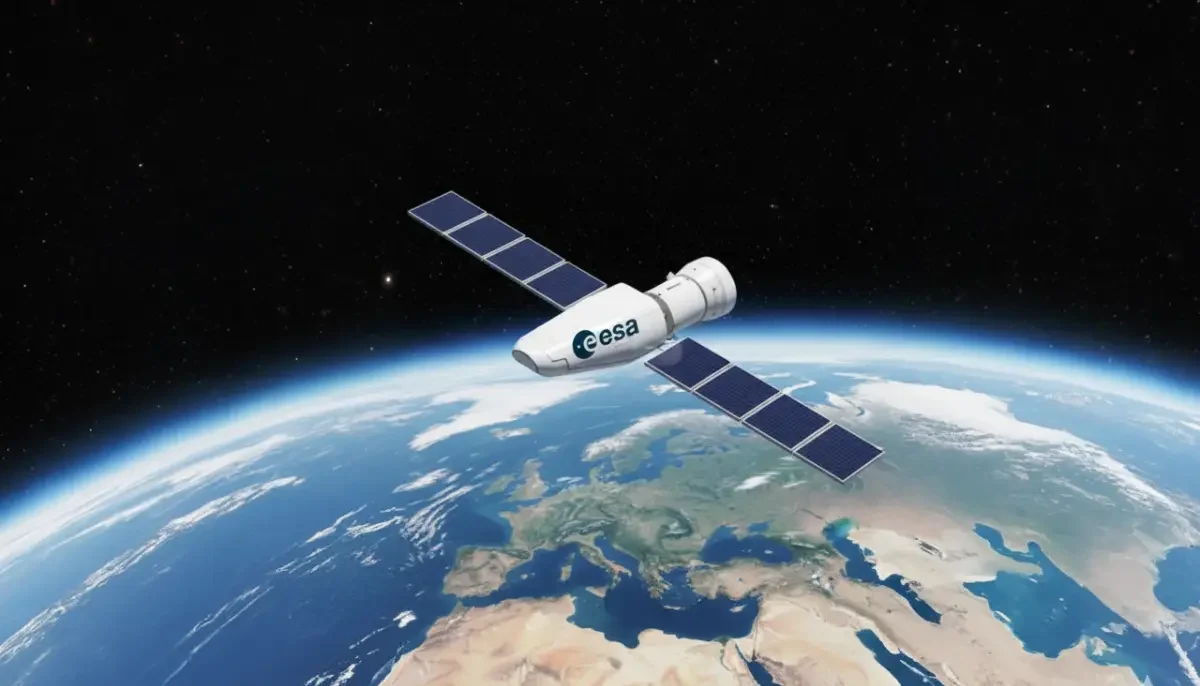
The European Space Agency is moving closer to the first flight of Space Rider, a reusable orbital spaceplane designed to carry research equipment into low Earth orbit and return to a runway.
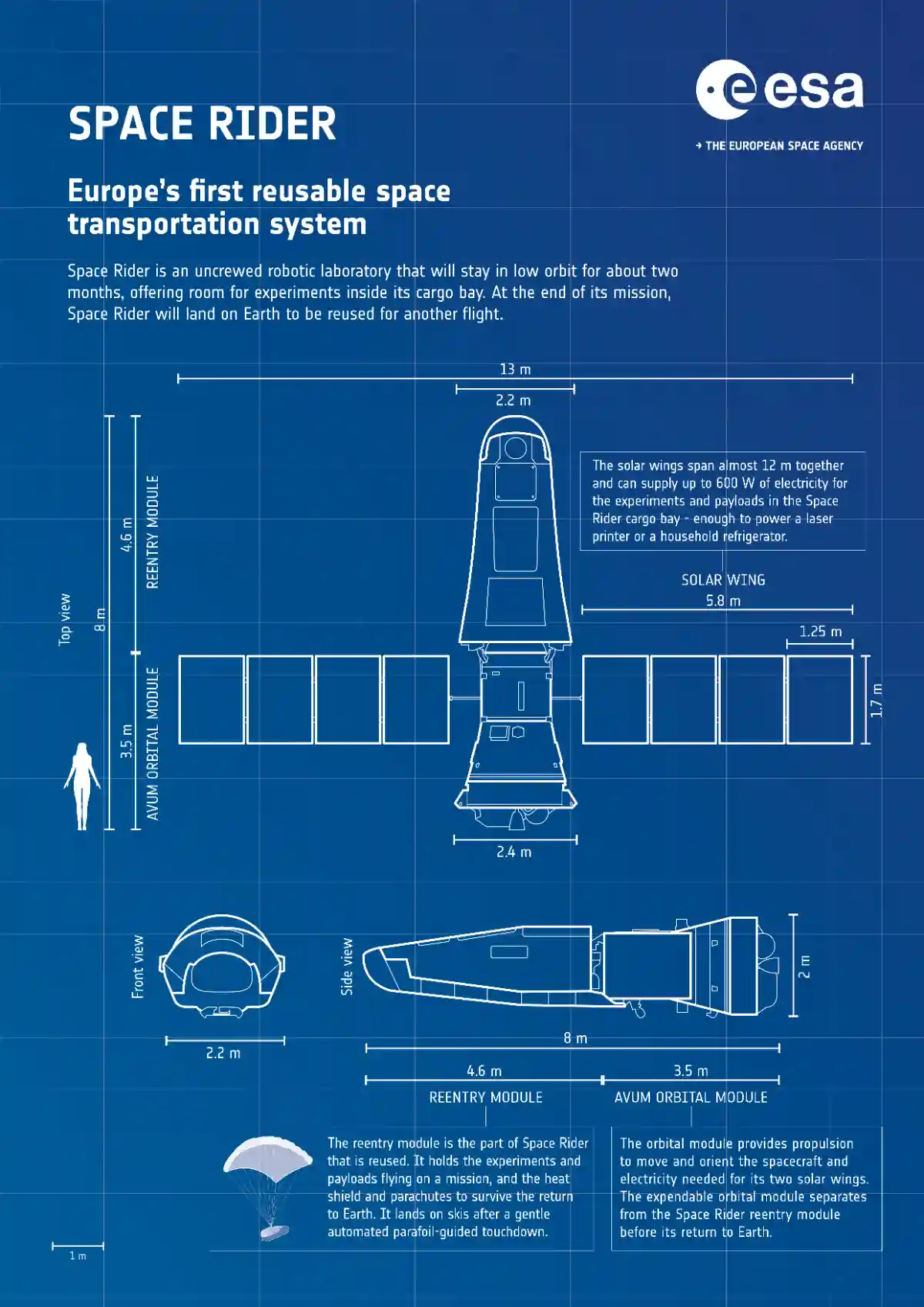
On November 5, ESA released a new set of design drawings that show updated wings, simplified outer panels, and easier access points for loading science packages. Work on the reentry module is in its final stages before teams connect it with the service module for full system tests.
The uncrewed craft will launch from French Guiana on a Vega-C rocket and aims for a mid-2026 debut after schedule adjustments. ESA says the program will give Europe a reliable and lower-cost way to place experiments in orbit for weeks or months before bringing them back for study.
The agency began developing Space Rider in 2015, building on experience from the Automated Transfer Vehicle that once carried cargo to the International Space Station (ISS). ESA partnered with Thales Alenia Space and Avio to produce a compact vehicle that can fly as many as five missions.
Engineers strengthened the structure to withstand repeated heating during reentry and designed a service module that supplies power, navigation, and maneuvering during the mission. By 2023 the project entered full production, and major hardware deliveries signaled the start of the final testing phase.
The spacecraft is about 11 meters long with a payload bay able to hold medium-sized scientific packages. It will operate around 400 kilometers above Earth, where weightlessness allows experiments that cannot be carried out on the ground.
Researchers plan to use the platform for material testing, small biology samples, combustion studies, and technology trials. Space Rider will run on solar power and hydrazine thrusters that help it maintain its position or turn toward new targets.
The return to Earth is one of the most demanding parts of the mission. A carbon-fiber heat shield will protect the craft as it reenters at orbital speed, and once temperatures drop, the vehicle unfolds a winged section and deploys parachutes to guide it toward a runway.
In June 2025, a full-scale test model completed autonomous drop tests over Sardinia, showing that the guidance system can handle changing wind and uneven air. ESA plans a complete drop test by the end of 2025 to rehearse the full descent sequence.
ESA previously aimed for a spring 2026 launch but now expects the first mission in the middle of the year to ensure enough margin for safety reviews.
Space Rider is expected to support a wide range of research. Compact telescopes could operate above the distortion of Earth’s atmosphere, while sensors could track solar activity or test new satellite hardware.
Past studies on the International Space Station showed how microgravity changes crystal growth and protein behavior, and the new vehicle offers a faster way to repeat and expand those experiments without waiting for crewed missions.
The program also reflects a broader shift toward reusable systems in Europe. Vega-C produces fewer emissions than older boosters, and a reusable craft reduces waste across multiple missions. Universities and small companies are expected to benefit from simpler access to orbit. ESA has also lined up potential landing sites in the Azores, including Santa Maria Island, to give the program more flexibility.
With final tests approaching, Space Rider has become one of ESA’s most closely watched projects. If the schedule holds, Europe will soon gain a reusable spacecraft capable of regular orbital missions and rapid turnaround for scientific research.

Leave a Reply