
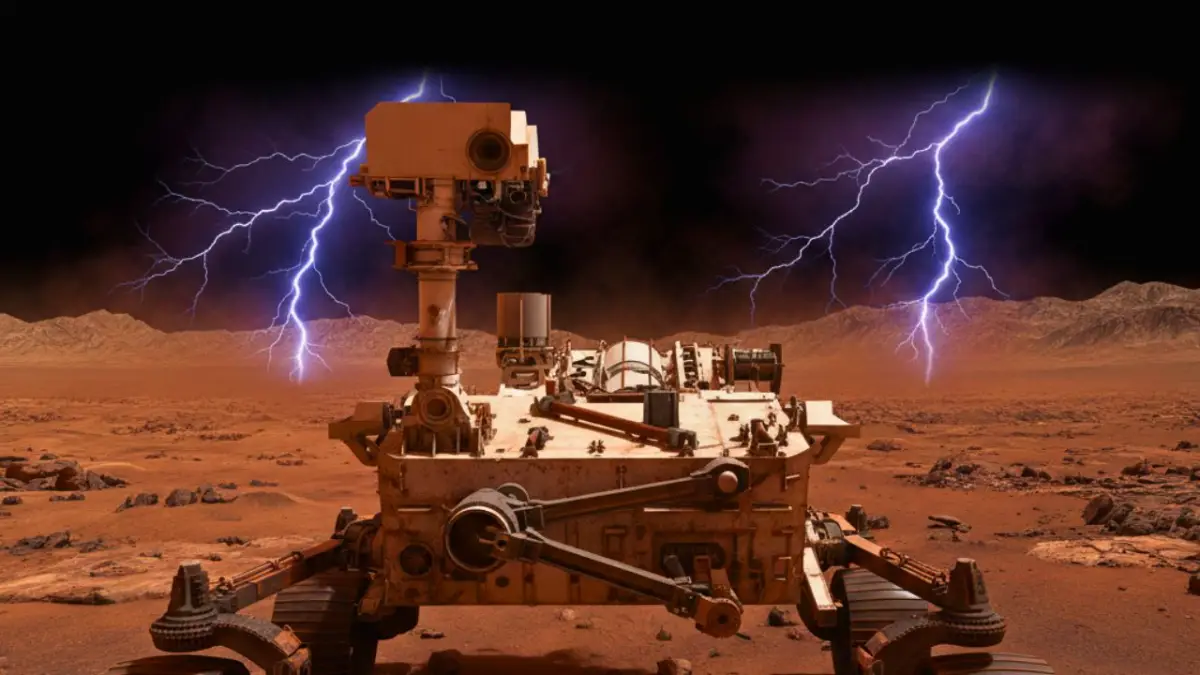
NASA’s Perseverance rover has picked up the first confirmed sounds of lightning on Mars while operating inside Jezero Crater over the past two Martian years, recording 55 electrical discharges during dust devils and storm fronts and proving that the red planet can produce small bursts of thunder.
The discovery came from the rover’s SuperCam microphone, which is mounted on its mast. While its main job is to study rocks, the microphone also stays on during windy periods. During these times, it captured sharp clicks followed by faint snaps. These short sounds lasted less than a tenth of a second and matched what scientists expect from small electrical sparks in Mars’ thin air.
Out of the 55 detections, seven were full events. Those included both an electrical signal and a small sound that followed. This confirmed that the discharges were real and not just background noise from moving dust or the rover’s parts.
On Earth, lightning carries massive energy. A single strike can hold around a billion joules. On Mars, the numbers were far lower. Most of the events measured between 0.1 and 150 nanojoules. One stronger discharge reached about 40 millijoules. Scientists believe this larger event happened when the rover itself built up charge and released it into the ground.
Even this stronger discharge was still around a million times weaker than a normal lightning bolt on Earth. The thin air on Mars limits how much energy can build up before it jumps between surfaces.
These sparks did not come from storm clouds filled with water. Mars has little water in its air. Instead, the charges formed when dry dust particles rubbed against each other. This happens most when winds rise sharply. The data shows that the discharges happened when wind speeds were in the highest 30 percent of all readings taken by the rover.
Sixteen of the detected sparks came from dust devils, which are fast, spinning columns of air filled with dust. The rest were linked to the front edges of larger regional storms moving across the surface.
To confirm the results, the team built a copy of the SuperCam microphone setup on Earth. They used a Wimshurst machine, which creates static electricity, to make controlled sparks near the device. The sound pattern it recorded was the same as what Perseverance picked up on Mars. This confirmed that the Martian signals were caused by real electrical discharges.
Mars’ atmosphere plays a big role in how this sounds. It is about 99 percent thinner than Earth’s and mostly made of carbon dioxide. Sound moves more slowly, and high tones fade quickly. That is why there is no deep rumble like on Earth. Instead, the sound is short and sharp, and then it stops.
These tiny sparks also matter for chemistry on Mars. When a discharge hits carbon dioxide, it can break the molecule apart. This can create reactive compounds such as nitrates and peroxides. On early Earth, similar reactions helped form basic building blocks for life. Scientists think the same process may have taken place on ancient Mars, when it had rivers and lakes.
Today, these reactions could still leave traces in the soil. Future missions may look for those signs to learn more about the planet’s past environment. The discovery also raises safety questions for future missions. Spacecraft and habitats could slowly build up static charge on the surface. A sudden discharge may not harm a person, but it could damage unprotected electronics. Engineers may need better grounding and shielding on equipment sent to Mars.
Perseverance continues to listen during each storm season. Thousands of hours of audio are already stored. As more storms pass over the rover, researchers expect to collect many more events. Combined with images from the rover’s cameras, this will create the first detailed audio and visual record of weather activity on another planet.
Mars is not silent. It produces quiet, brief sounds that carry real science and real risk, and they are now finally being heard.

Leave a Reply