
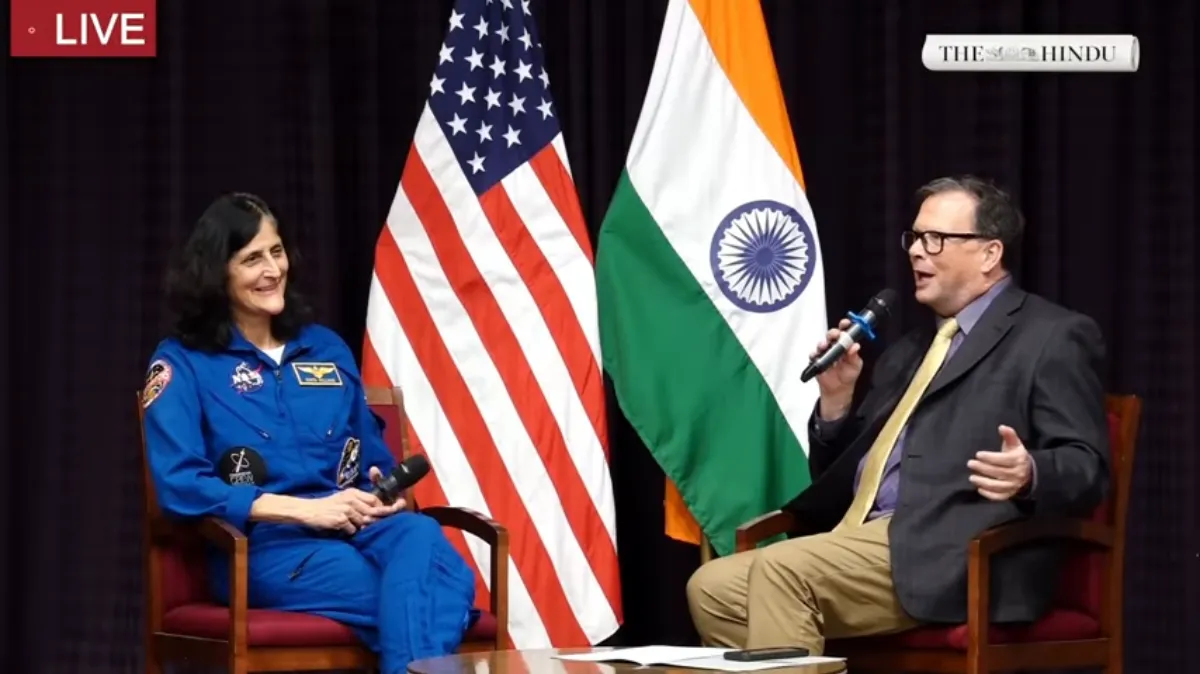
Sunita Williams came to New Delhi this week with a story that few astronauts can tell. What began as a short, eight-day test flight in June 2024 turned into an unplanned stay of nearly nine months aboard the International Space Station (ISS) after problems forced NASA to change how she and her crewmate would return to Earth. Speaking at the American Center, the veteran astronaut reflected on the mission, the risks involved, and why human spaceflight still matters.
Williams launched on Boeing’s Starliner spacecraft atop an Atlas V rocket, marking the first crewed flight of that system. During docking, five thrusters failed. The crew took manual control and worked with mission control to restart the engines. Engineers later decided the spacecraft was not ready to bring them home. As Williams put it, “All the tees were not crossed.” NASA chose a safer option. A SpaceX Dragon arrived at the station with only two astronauts, leaving open seats for Williams and Butch Wilmore.
The delay pushed the ISS close to its limits. At one stage, 12 people lived on a station built for about seven. Williams said daily life still ran smoothly. The crew ran experiments on stem cells, DNA sequencing, and microbes collected from open space. They also handled repairs themselves. “We’re our own IT guys,” she joked, recalling a spacewalk where a simple crowbar helped remove outdated radio gear.
Staying healthy remained a daily task. Astronauts trained on treadmills, bikes, and the Advanced Resistive Exercise Device to slow bone and muscle loss. Williams even ran the Boston Marathon in orbit, strapped to a treadmill. Holiday meals offered small comforts. Thanksgiving included smoked turkey and vegetables, though she admitted missing her husband’s grilled cheese and fresh bread.
Williams also spoke openly about mental health. Astronauts meet a flight surgeon weekly and a psychology support specialist every two weeks. Small gestures help. A care package once included 3D-printed figures of her dogs. “They can actually tell… if there’s something that’s going on,” she said.
Her path to space was far from planned. A former student athlete, she first aimed to become a veterinarian. She joined the US Navy, became a helicopter pilot, and later attended test pilot school, where she realized her skills fit future lunar missions.
Looking ahead, Williams warned about growing space debris, noting how often Starlink satellites now pass the station’s orbit. She also pointed to needs in long-duration missions, from better bathrooms to medical robots. With private companies playing a larger role, she said students will have more ways to work across the space sector.
Her visit struck a personal chord in India. “It’s really humbling to be here in India,” Williams said, thanking those who prayed for her safe return. From delayed spacecraft to crowded stations, her story showed how spaceflight still tests limits, demands patience, and connects people far beyond Earth.

Leave a Reply