
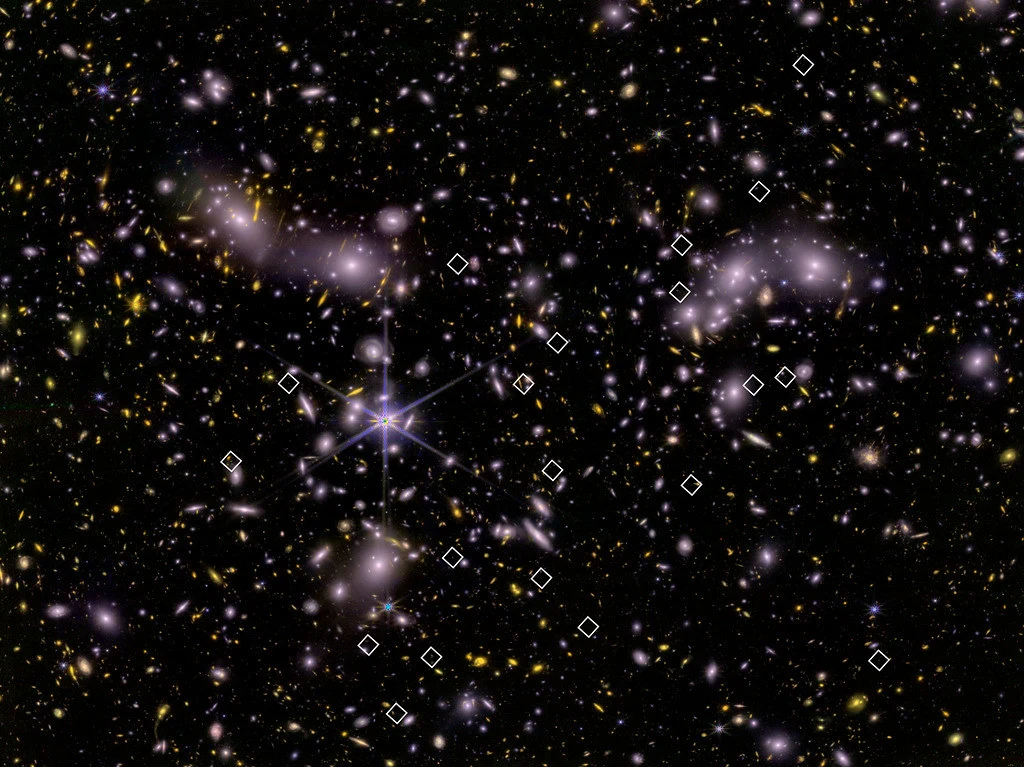
Using the James Webb Space Telescope (JWST), astronomers have uncovered a surprising group of 14 galaxies that paused their star-forming activity within the first billion years after the Big Bang. These “dormant” galaxies, found in a range of sizes, offer fresh clues about how galaxies grow and evolve in the universe’s infancy.
Galaxies form stars from cold gas clouds, but sometimes this process stalls. One cause is the intense radiation from supermassive black holes at a galaxy’s core, which can heat or deplete the gas needed for stars. Nearby larger galaxies can also strip away this gas or warm it, halting star formation.
Another factor is stellar feedback. When stars, through explosions like supernovas or powerful winds, push out or heat the gas, leaving the galaxy in a temporary quiet phase. “This pause usually lasts around 10 to 25 million years,” said Alba Covelo-Paz, a doctoral student at the University of Geneva and lead author of the study, in an email. Over time, the gas can cool and fall back, allowing star formation to restart.
Until recently, astronomers had only identified four dormant galaxies from this early period, with masses either below a billion times the Sun’s or above 10 billion. This small sample left gaps in understanding how common these pauses were across different galaxy sizes.
But JWST’s powerful Near-Infrared Spectrograph (NIRSpec) changed that. By analyzing light from about 1,600 galaxies in the DAWN JWST Archive, Covelo-Paz’s team found 14 dormant galaxies with masses ranging from 40 million to 30 billion solar masses. The findings, posted on the preprint server arXiv on June 27, 2025, are awaiting peer review.
These galaxies weren’t expected to be dormant so early in the universe’s history. Young galaxies are typically thought to form stars rapidly. A 2024 study had already surprised researchers by spotting one such galaxy, previously observed by the Hubble Space Telescope but only confirmed as dormant with JWST’s advanced capabilities. Unlike Hubble, JWST can detect the redshifted light from these distant galaxies and analyze its spectrum to reveal details about their stars.
The team focused on galaxies showing signs of older or middle-aged stars but no new star formation. They used a tool called Bagpipes to model the galaxies’ star-forming histories, finding that these 14 galaxies had paused star formation 10 to 25 million years ago.
This suggests a “bursty” pattern, where galaxies alternate between active star-forming periods and quiet phases, likely driven by stellar feedback. “We see these galaxies taking a breather,” Covelo-Paz said. “They’ve likely paused due to processes like supernovas pushing gas out, but they could restart star formation later.”
Still, questions remain. If these galaxies stay dormant for 50 million years or more, it might point to a permanent shutdown, possibly caused by black holes or other factors. For now, their properties support the idea of a temporary pause.
To learn more, astronomers are planning a JWST program called “Sleeping Beauties” to hunt for more dormant galaxies and study how long these quiet phases last.

Leave a Reply