
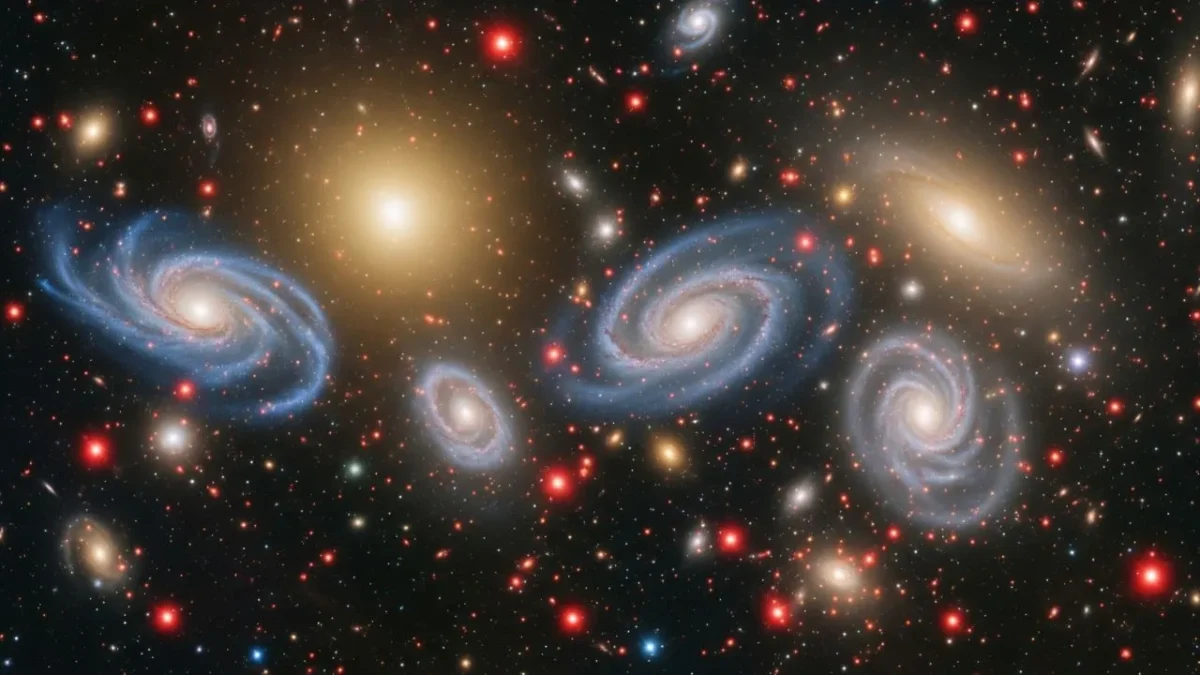
using the James Webb Space Telescope (JWST) have identified a rare class of compact, red galaxies in the early universe, nicknamed “little red dots.” A new study suggests these galaxies formed inside dark matter halos that spin unusually slowly, causing gas and stars to collapse into dense cores rather than spreading into larger disks.
Little red dots, or LRDs, appear between redshifts 4 and 8, meaning we see them as they were when the universe was 1 to 2 billion years old. They are smaller than most galaxies, measuring only about 80 to 300 parsecs across, but denser than typical star-forming regions.
Researchers Fabio Pacucci and Abraham Loeb propose that LRDs form in the slowest-spinning 1% of dark matter halos. Most halos rotate at a moderate rate, allowing galaxies to form with wide, extended disks. In low-spin halos, gravity pulls material inward, producing compact shapes. This rarity matches LRD numbers, which are about 1% of normal galaxies at similar brightness.
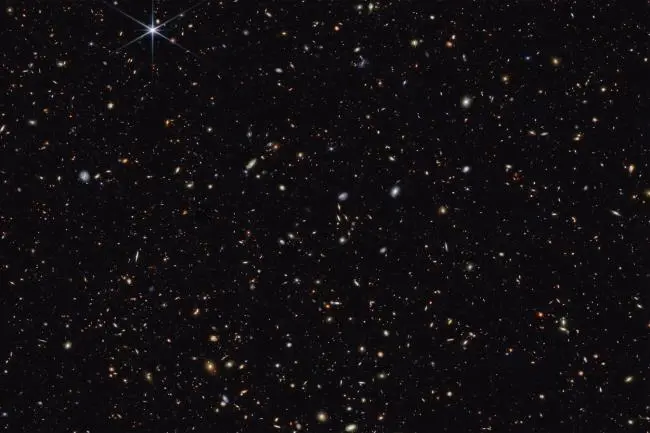
Modeling shows that a halo at redshift 5 with a mass of 100 billion Suns and a spin of just 0.0153 would host a galaxy smaller than 300 parsecs. Their abundance also matches predictions: rarer than ordinary galaxies but more common than bright quasars.
The pattern changes over time. At lower redshifts, larger halos would need even slower spins to stay compact, which is uncommon. At higher redshifts, more low-spin halos exist, but their galaxies are too faint for JWST to detect. This explains why LRDs peak around redshift 5 and are scarce at both earlier and later times.
Observations also show LRDs cluster more than expected, suggesting they form in quieter regions of space. Their dense cores could account for the broad emission lines seen in their light, whether powered by black holes or intense star formation.
The study concludes that LRDs are not a strange new galaxy type but an extreme outcome of familiar processes. Future JWST observations could test the theory by checking whether these galaxies lack rotation, a hallmark of low-spin origins.
The study was originally published in Astrophysical Journal Letters.

Leave a Reply