

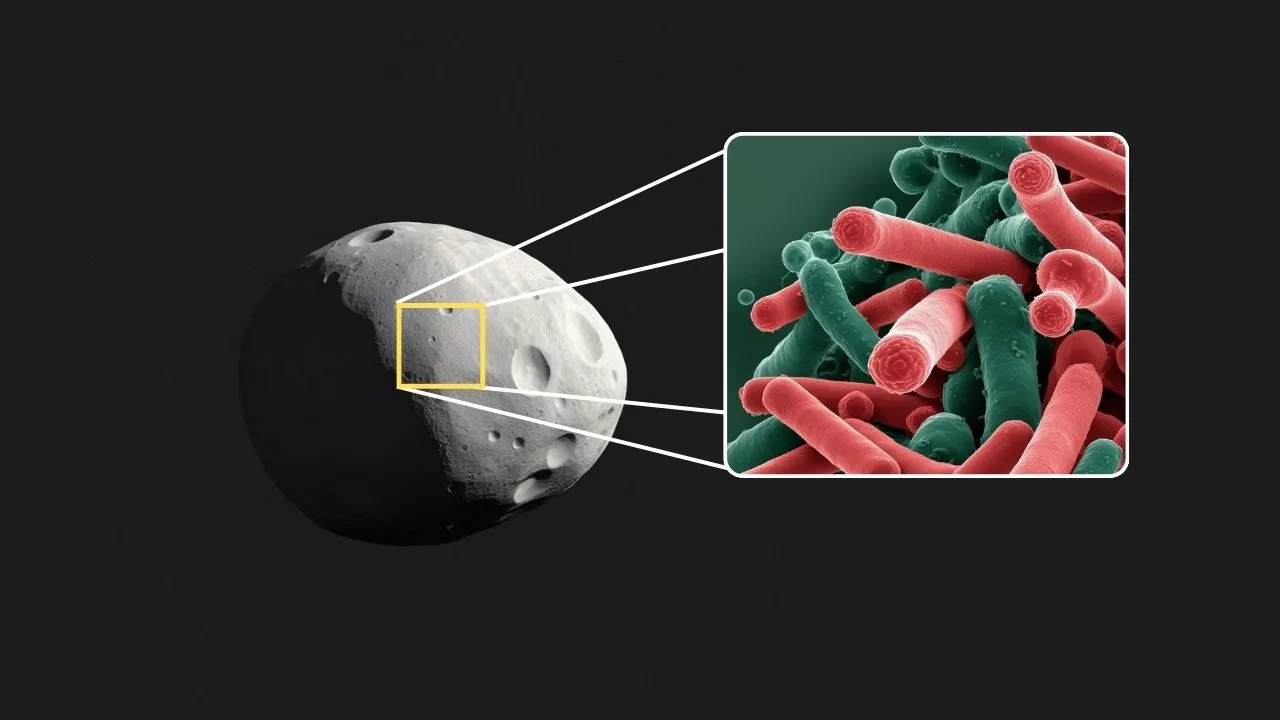
A rare asteroid sample brought back to Earth by Japan’s Hayabusa 2 mission has been found to contain Earth bacteria, raising questions about contamination risks in the study of extraterrestrial material. Researchers discovered filament-shaped microbes resembling the Bacillus genus inside a fragment of the asteroid Ryugu, despite strict controls meant to prevent such exposure.
The Hayabusa 2 spacecraft launched in December 2014 and landed on Ryugu in June 2018, collecting material from the asteroid’s surface. The samples were returned to Earth in December 2020 and distributed among international research teams for analysis. The contaminated fragment was examined using high-resolution microscopy, which revealed structures consistent with Earth-based bacteria.
According to one of the researchers, the bacteria took a filamentous form, suggesting they likely came from Bacillus, a common group of rod-shaped bacteria. The contamination likely occurred during handling or storage on Earth rather than during the mission itself, researchers said.
The finding was shared publicly after a user on X posted excerpts from the study, noting that the sample was “rapidly colonized by terrestrial microorganisms despite strict contamination control.” The revelation highlights the challenges scientists face in preserving the integrity of rare extraterrestrial material once it reaches Earth.
Asteroid samples are highly sought after because they offer a window into the early solar system. Unlike Earth, where geological processes erase ancient records, asteroids remain unchanged for billions of years. Examining their composition helps researchers understand how planets formed and whether asteroids carried organic molecules that may have seeded life on Earth.
Ryugu’s samples are not the only ones under study. NASA’s OSIRIS-REx mission recently returned material from the asteroid Bennu, which was found to contain carbon and water-bearing minerals. These discoveries support the idea that asteroids could have delivered the ingredients for life to Earth through impacts. Future missions, including Europe’s Hera spacecraft, aim to expand knowledge of these small but important bodies.