

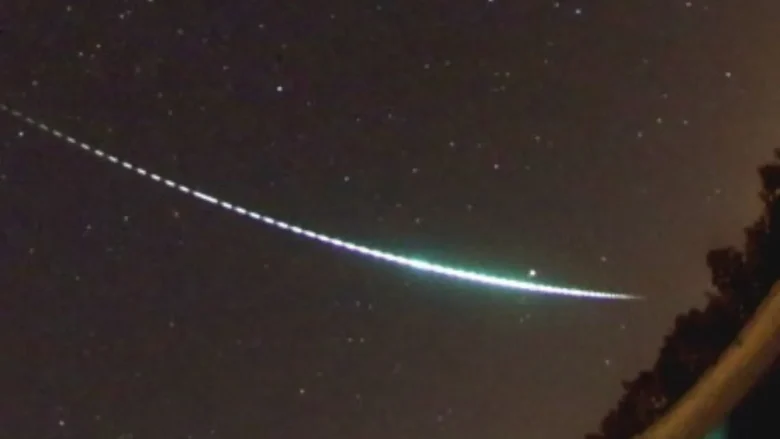
Every December, the Geminid meteor shower fills the night sky with bright streaks, but a new study explains why these meteors behave unlike almost any others. Scientists have found that Geminids begin cracking far higher above Earth than expected, not because of air resistance, but because sudden heating tears them apart from the inside as they plunge toward the planet.
The Geminids appear each year in mid-December, peaking with as many as 120 meteors per hour under dark skies. They seem to radiate from the constellation Gemini and trace back to asteroid 3200 Phaethon, not a comet. That detail has long puzzled researchers, since most meteor showers form from icy debris shed by comets, not rocky bodies.
A research team from the Czech Academy of Sciences analyzed 39 Geminid fireballs and faint meteors using detailed computer models matched to real camera and sensor data. They tracked brightness, speed, and paths to see how these space rocks fall apart as they enter the atmosphere. The results point to heat as the main trigger.
As Geminid meteors slam into the upper atmosphere at about 35 kilometers per second, their surfaces heat up in seconds. This rapid heating creates stress between the hot outer layer and the colder interior. The study shows that this stress alone can crack the rocks at altitudes near 120 kilometers, where the air is still extremely thin. In some cases, the rocks fail under pressures lower than those from air drag.
Size plays a major role. Small Geminids, lighter than a chocolate bar, often shatter completely from heat and turn into fine dust. Medium-sized pieces tend to glow evenly and lose material bit by bit. Larger chunks develop deep surface cracks early on, which later cause them to break apart lower in the atmosphere. The densest pieces match what scientists expect from carbon-rich asteroids like Phaethon.
These findings also help explain Phaethon’s strange behavior. The asteroid swings closer to the Sun than Mercury and releases dust during each close pass. Intense solar heating likely fractures its surface over time, feeding the Geminid stream without the icy jets seen on comets.
In 2029, Japan’s DESTINY+ spacecraft will fly past Phaethon and study its surface and dust up close. If it finds cracked, compact fragments, it will confirm what these Earth-based observations already suggest.
Source: Geminids are initially cracked by atmospheric thermal stress
