

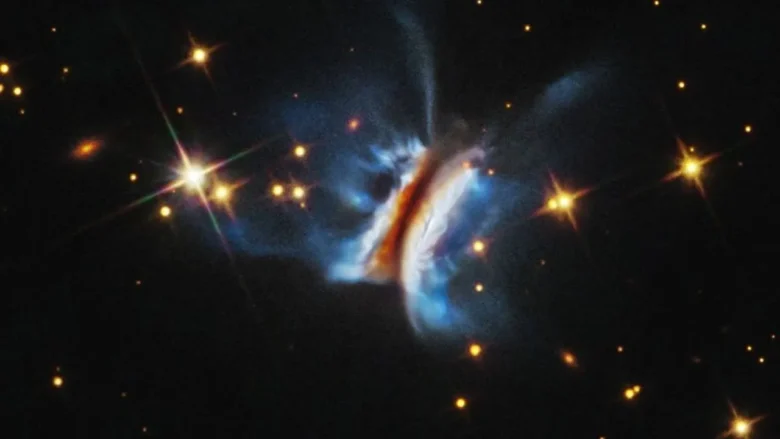
NASA’s Hubble Space Telescope has captured its sharpest visible-light image yet of the largest protoplanetary disk ever observed. The object, known as IRAS 23077+6707, lies about 1,000 light-years from Earth and hosts a disk nearly 400 billion miles wide, making it one of the largest ever observed. Scientists shared the findings in The Astrophysical Journal.
“The level of detail we’re seeing is rare in protoplanetary disk imaging, and these new Hubble images show that planet nurseries can be much more active and chaotic than we expected,” said lead author Kristina Monsch of the Center for Astrophysics | Harvard & Smithsonian (CfA).
The image shows a disk so large it dwarfs our own solar system. From edge to edge, it stretches around 40 times farther than the Kuiper Belt. Hubble captured the structure in visible light, which allowed researchers to see surface details that radio telescopes often miss. The disk blocks the star at its center, leaving a dark band flanked by glowing layers of dust above and below.
What caught scientists off guard was how uneven the disk looks. On one side, tall streams of dust and gas rise high above the main disk. On the other, the structure ends sharply, almost like it was cut short. Researchers say this imbalance likely points to recent activity, such as gas falling in from nearby space or a close pass from another star.
“We were stunned to see how asymmetric this disk is,” said co-investigator Joshua Bennett Lovell, also an astronomer at the CfA.
The disk also holds a huge amount of material. Estimates suggest it contains the mass of 10 to 30 Jupiters. That is more than enough to form several large planets. The central star itself may be heavy or even part of a pair, which could explain the strong motion seen in the disk.
Most known planet-forming disks appear calm and flat. This one looks busy and unsettled. Dust and gas swirl instead of settling into neat rings. That motion could affect how planets grow, where they form, and whether their paths stay stable. Some planets here could grow fast and large, while others may drift far from where they start.
The system is young, likely no more than two million years old. That puts it right in the early stage of planet formation, before much of the gas fades away. Observing a disk at this moment helps scientists test ideas about how planets begin.
The research team gave the disk a playful nickname, “Dracula’s Chivito,” a nod to their mixed backgrounds and the disk’s layered look. Future studies with the James Webb Space Telescope (JWST) will look deeper into the disk to study its dust and heat.