

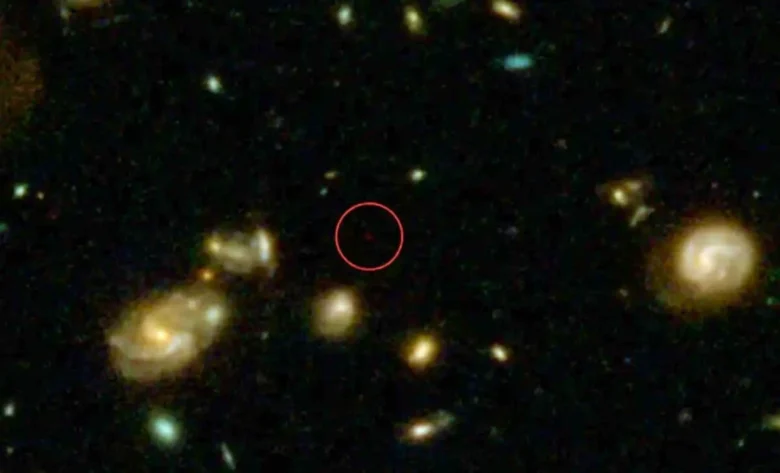
Astronomers say the James Webb Space Telescope (JWST) may have captured the most distant galaxy ever seen, an object nicknamed Capotauro. The discovery, led by Giovanni Gandolfi of the University of Padua, comes from JWST’s CEERS survey, which searches deep space for early galaxies.
The team shared its findings in a preprint posted to arXiv. If confirmed, the object would push cosmic history back to a time when the universe was only 90 million years old.
Capotauro shows up in JWST’s infrared data as a faint red speck. It is absent in shorter wavelengths but appears bright in longer ones, with a sharp drop in brightness between 3.5 and 4.5 microns. Astronomers say this drop, called a Lyman break, is a clear sign of light stretched by the universe’s expansion over billions of years.
The team used JWST’s NIRSpec instrument to study the object. Their analysis points to a redshift of about 32. That means the light left Capotauro when the universe was still in its first 100 million years of existence.
The current record-holder for distance is a galaxy called JADES-GS-z14-0, found at redshift 14.3, dating back to about 290 million years after the Big Bang. If Capotauro truly sits at redshift 32, it would extend the timeline of galaxy formation by 200 million years. That period is thought to be when the first stars, known as Population III stars, came into being.
These stars were massive and made only of hydrogen and helium. They later produced the heavier elements that formed later generations of stars and planets. A galaxy forming during this time would challenge existing models of how quickly cosmic structures could form.
Not all astronomers agree that Capotauro is a galaxy. The data could also fit a much closer object, such as a dusty galaxy at a redshift below 10. Another possibility is that it is not a galaxy at all but a cold brown dwarf star inside our own Milky Way, with a surface temperature below 300 Kelvin.
JWST’s early surveys have already produced several candidates for very early galaxies that later turned out to be either closer objects or noise in the data. While the evidence for redshift 32 is strong, the team estimates there is still a small chance (less than 1 percent) that the true redshift is under 25.
If Capotauro is confirmed as a galaxy, it would reshape ideas of how quickly the first galaxies formed. Current models assume it would take hundreds of millions of years for matter to clump into stars and galaxies after the Big Bang. A galaxy at 90 million years suggests matter collapsed much faster, possibly because of how dark matter influenced early structure.
The timing also overlaps with the so-called cosmic dawn, when ultraviolet light from the first stars cleared away the neutral hydrogen that filled the universe, making it transparent.
The team behind the discovery is calling for more observations. Deeper spectroscopy from JWST could confirm the object’s distance and composition. Only then can astronomers know whether Capotauro is a galaxy from the earliest days of the universe or something closer to home.
Whatever the result, Capotauro is now a target for further study. Whether it proves to be a faint brown dwarf or a galaxy from the dawn of time, it adds to the questions Webb was built to answer.
Source: Mysteries of Capotauro – investigating the puzzling nature of an extreme F356W-dropout