

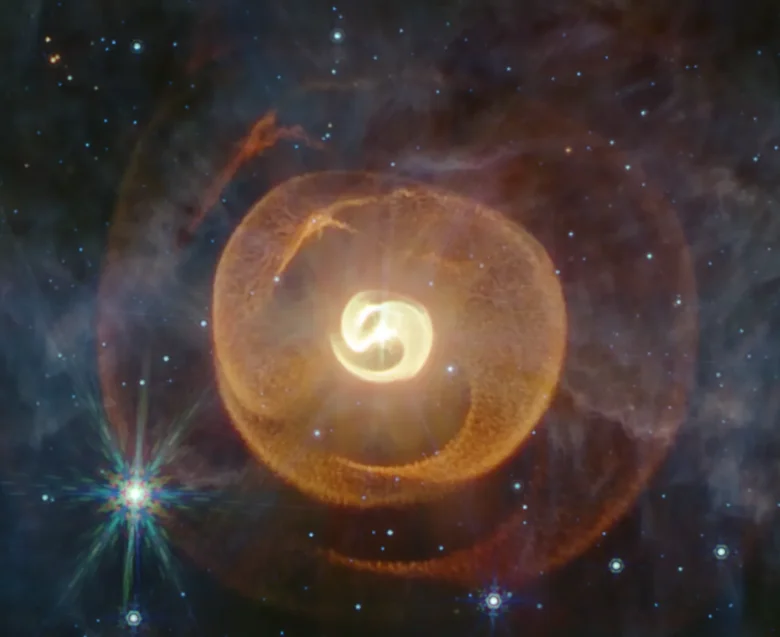
NASA’s James Webb Space Telescope (JWST) has revealed that the Apep star system, located in our galaxy, is made up of three massive stars forming four repeating dust spirals over a 190-year cycle, a pattern created by violent stellar winds and a sneaky third star that cuts a path through the dust each time it swings past.
Webb’s Mid-Infrared Instrument captured the clearest image ever taken of Apep. For the first time, scientists could see four thin, evenly spaced spiral shells wrapped around the center of the system. Each shell marks a period when two large, aging stars moved close enough for their winds to crash into each other and create thick clouds of carbon dust.
Those two stars are known as Wolf-Rayet stars. They are hot, heavy, and in the final stage of their lives. They orbit each other once every 190 years. During about 25 of those years, their winds collide hard enough to produce large amounts of dust. That dust expands and forms a new spiral. Webb’s image shows shells formed from events going back around 700 years.
In the center of the image is a bright point that earlier telescopes could not clearly explain. Webb confirmed that this point is actually three stars, not two. The third one is a large supergiant that circles the pair from far away. When it passes by, its wind cuts a clear V-shaped gap through the dust being released by the other two stars.
That same gap appears in every shell. This shows the third star has been taking the same path for centuries. This detail helped scientists confirm that the supergiant is truly part of the system and not just passing through space by chance.
Apep’s dust is made mostly of carbon. These tiny grains stay warm and glow in mid-infrared light. That is why Webb, which is built to see this type of light, could detect the faint outer shells that ground-based telescopes missed.
Apep stands out because of its long cycle. Most similar systems create dust every few years or few decades. Apep’s 190-year period is the longest of its kind known in our galaxy, which gives scientists a rare chance to study how powerful winds behave over long periods of time.
Over the next few hundred thousand years, both Wolf-Rayet stars are expected to explode as supernovae. Because of how fast they spin and how they lose material, one of those explosions could send out a narrow, powerful burst of energy through space.
Source: The Serpent Eating Its Own Tail: Dust Destruction in the Apep Colliding Wind Nebula