

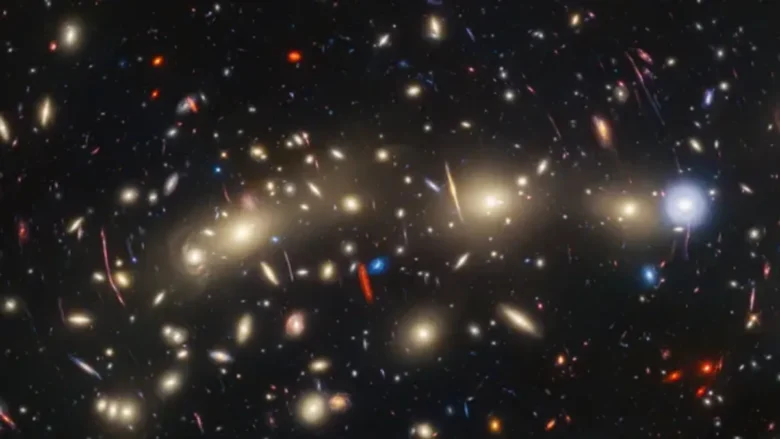
Using the James Webb Space Telescope (JWST), astronomers have identified a tiny, distant object that may be the strongest evidence yet for the universe’s first stars. The source, called LAP1-B, lies behind the massive galaxy cluster MACS J0416, which magnifies its light by about a factor of one hundred. JWST captured a detailed spectrum of the object this year, revealing almost no elements heavier than helium. That absence of heavier elements is a key sign of the very first generation of stars, known as Population III.
These stars formed when the universe contained only hydrogen and helium. With no heavier elements to help gas clouds cool, early stars grew extremely large, sometimes hundreds of times more massive than the sun. They lived for only a few million years before exploding and spreading the first carbon, oxygen, and iron.
None survive today, and any that did would be far too faint or distant for ground telescopes to detect. Their light also shifts deep into the infrared as it travels across the universe, which makes instruments above Earth’s atmosphere essential.
LAP1-B sits at redshift 6.6, so we see it as it was about nine hundred million years after the Big Bang. The galaxy cluster in front of it bends and boosts its light, making it bright enough for JWST to study. Without that natural lens, the object would be far too dim to detect. JWST’s observations revealed strong helium emission lines but almost no sign of heavier elements. That pattern matches what scientists expect if LAP1-B is dominated by hot, massive stars formed from untouched primordial gas.
A team led by Eli Visbal tested the data against the expected conditions for a Population III system. Their model suggests that LAP1-B formed inside a small dark matter halo with the right temperature for early star formation. The stars seem to follow a pattern in which many are very massive, and the entire cluster contains only a few thousand solar masses of material. Earlier candidates were rejected because they showed too many heavy elements or were far larger than theory allows.
The result is promising but not confirmed. The exact amount of magnification from the lensing cluster can shift, and those changes affect estimates of LAP1-B’s size and mass. Future JWST observations may help measure the metal content more accurately or detect signs of supernovae from massive early stars. JWST cannot isolate individual stars in the cluster; it can only record the combined light.
These first stars played an important role in shaping the young universe. Their explosions seeded space with the elements needed to form later stars, planets, and eventually life. They also contributed to reionization, the period when the earliest bright objects cleared the fog of neutral hydrogen and allowed light to travel more freely. Understanding when and how they formed helps explain how the first galaxies grew.
JWST is continuing to scan lensing clusters for faint, distant objects, and many of its targeted fields are ideal for this search. The upcoming Nancy Grace Roman Space Telescope will survey much larger areas and could uncover more candidates. If LAP1-B is confirmed, it could be the first solid glimpse of the universe’s earliest stellar generation and likely not the last.
Source: LAP1-B is the First Observed System Consistent with Theoretical Predictions for Population III Stars