

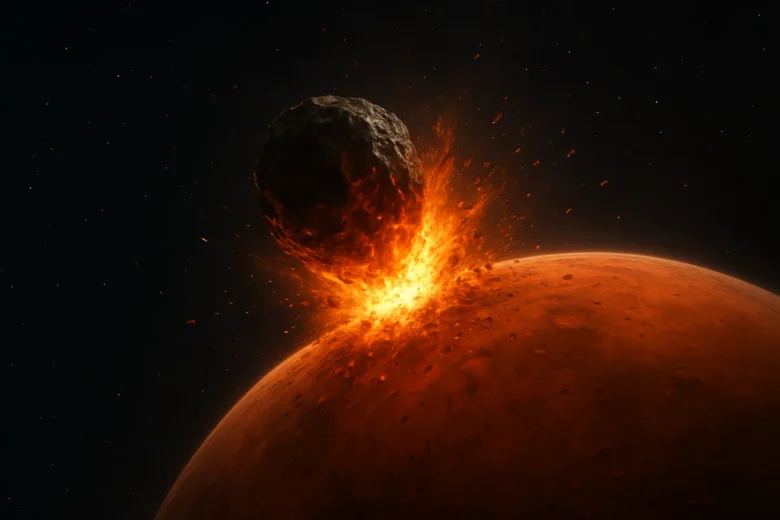
New research using NASA’s InSight mission has revealed that Mars’ mantle contains leftover fragments from massive collisions that shaped the planet about 4.5 billion years ago. The findings, published in Science on August 28, 2025, show that the Red Planet’s interior has preserved rocky debris from its violent past in a way Earth has not.
InSight landed on Mars in 2018 and operated until 2022. It recorded more than 1,300 marsquakes with its seismometer. Scientists studying those signals found unusual slowdowns in seismic waves that traveled deep into the mantle, a layer up to 960 miles thick beneath the crust. The waves scattered and delayed in ways that suggested the presence of dense, uneven patches within the mantle.
At first, researchers thought the changes came from the crust. But as the delays increased with depth, computer models pointed instead to lumps of rock within the mantle, some stretching up to 2.5 miles across. These chunks are believed to be remnants of ancient impacts from asteroids or protoplanets that struck young Mars, creating magma oceans where debris sank and became locked in place.
“We’ve never seen the inside of a planet in such fine detail before,” said Constantinos Charalambous of Imperial College London, lead author of the study. “The survival of these fragments shows that Mars’ mantle has changed very slowly over time, unlike Earth, where tectonics and convection erase features like this.”
The discovery suggests Mars has acted as a long-term archive of the early solar system. With no plate tectonics, the planet’s mantle retains records of catastrophic events that shaped it billions of years ago. Tom Pike, also from Imperial College and a coauthor, said the clarity of the data was unexpected, noting that what was first thought to be a crustal effect turned out to be mantle structure instead.
On Earth, mantle mixing and shifting tectonic plates erase traces of its early history. Mars, however, has remained far quieter, preserving evidence of massive impacts that shaped not only itself but also the solar system. The preserved lumps highlight the contrast between Earth’s active interior and Mars’ static one.
The findings build on InSight’s earlier mapping of the Martian interior, which outlined the structure of its crust, mantle, and core. They also point to what might be found inside other planets without plate tectonics, such as Venus and Mercury.
The InSight mission, managed by NASA’s Jet Propulsion Laboratory with support from partners in France and Germany, ended in 2022. But its data continues to deliver discoveries, offering new ways to study planets without drilling beneath their surfaces.
Source: Seismic evidence for a highly heterogeneous martian mantle