

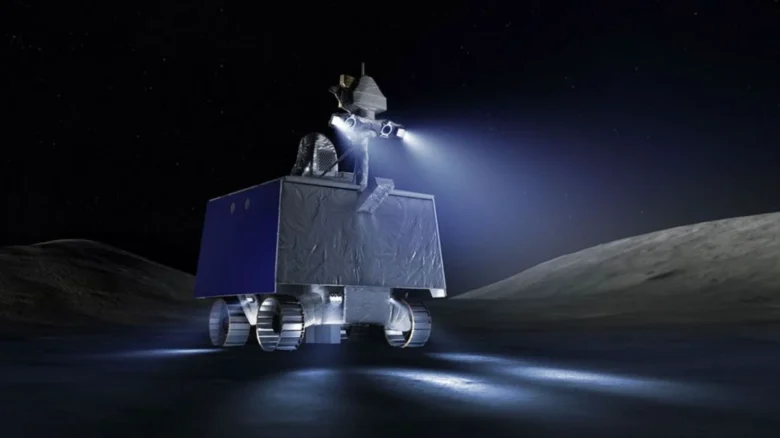
NASA confirmed that its long-delayed VIPER rover will finally head to the Moon’s south pole after awarding Blue Origin a contract to deliver it aboard the company’s Blue Moon Mark 1 lander. The decision secures a late 2027 launch for the rover, which has been in storage since costs and delays derailed its earlier ride.
VIPER’s mission is to search for water ice in permanently shadowed craters, a resource that could support future human bases.
The rover nearly met a permanent end in 2024 when NASA canceled its original deal with Astrobotic, which was set to launch VIPER on the Griffin lander. That contract started at $200 million for a 2023 mission but ballooned to $800 million after design changes and schedule slips.
Confidence fell further when Astrobotic’s Peregrine lander failed in its 2024 debut due to a fuel leak, raising doubts about Griffin’s reliability.
To revive the project, NASA awarded Blue Origin a $190 million task order under its Commercial Lunar Payload Services program. Blue Origin’s Blue Moon Mark 1 is designed to carry heavy cargo, with VIPER as its main payload for this mission.
The lander’s first flight is scheduled for late 2025 on a New Glenn rocket, delivering other NASA equipment to the lunar surface. A second lander is already in production for VIPER’s delivery two years later.
VIPER, short for Volatiles Investigating Polar Exploration Rover, is about the size of a golf cart and weighs 950 pounds. Unlike Mars rovers, it is built for the Moon’s harsh extremes, from 250°F in direct sunlight to -280°F in permanent shadow. Its headlights will allow it to enter craters that never see daylight. Over a planned 100-day mission, it will travel roughly 12 miles at a top speed of half a mile per hour.
The rover carries four main instruments. TRIDENT, a one-meter drill, will extract subsurface samples. Two spectrometers, NIRVSS and NIRS3, will study reflected light for water signatures.
A mass spectrometer called MSolo will analyze gas molecules released from the soil to confirm the presence of ice. Together, these tools will map how water and other frozen gases are distributed beneath the surface.
Scientists are particularly interested in the Moon’s south pole, where deep craters act as cold traps. At temperatures near -397°F, water ice remains stable for billions of years.
Estimates suggest that up to two percent of the soil’s top meter could be ice by weight. Researchers believe much of it came from comet impacts, with some possibly formed by ancient volcanic activity.
Finding ice matters because it could be turned into oxygen for breathing and hydrogen for fuel, reducing the need to transport supplies from Earth. Future Artemis crews could use local resources to support lunar bases. The results will also inform long-term exploration, including human missions to Mars, where similar methods may be applied.
Blue Origin will handle the landing and deployment of VIPER, while NASA will operate the rover from Earth. Unlike Mars missions, operators can send real-time commands thanks to the Moon’s close distance, improving precision and safety. If successful, the data collected by VIPER could help identify safe and resource-rich landing sites for astronauts in the 2030s.
VIPER’s revival shows NASA’s reliance on private industry to achieve its lunar goals. By combining commercial landers with agency science teams, the mission keeps Artemis on track to establish a lasting human presence on the Moon.
Source: NASA Selects Blue Origin to Deliver VIPER Rover to Moon’s South Pole