

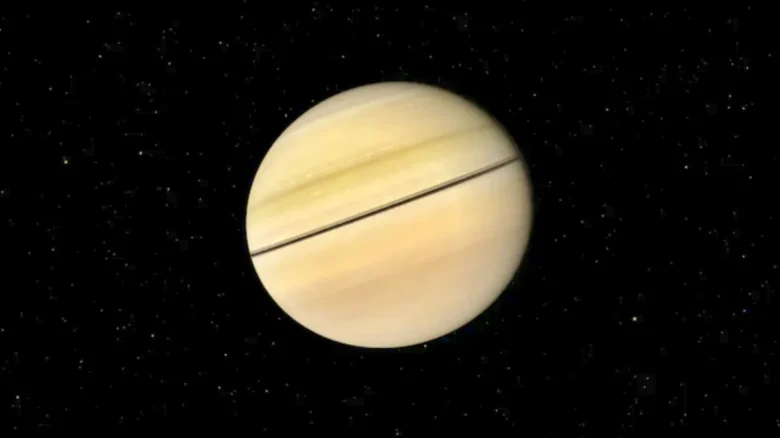
Saturn’s rings briefly disappeared from Earth’s view when the planet reached a rare edge-on alignment with our line of sight. NASA confirmed the event with new Hubble Space Telescope images released a few days earlier, showing the rings reduced to a narrow line. The alignment happens because of how Earth and Saturn move around the Sun. The rings will begin to tilt back into view in early 2026.
NASA’s image from November 23 shows Saturn as a pale yellow globe with a thin streak across its middle. Even Hubble struggles to detect the rings when they are viewed edge-on, as their thickness is tiny compared to their overall width. Hubble documented a similar alignment in 1995.
The rings look like they vanish because they are extremely thin. Although they stretch about 282,000 kilometers across, most of the material is packed into a layer only a few dozen meters thick. Saturn is tilted by about 27 degrees relative to Earth’s orbital plane, which causes the rings to swing in and out of view every 13 to 15 years.
This change in appearance confused early astronomers. Galileo first saw what he described as “handles” on Saturn in 1610. Two years later, he found that the features had disappeared. The actual structure of the rings was not understood until Christian Huygens studied Saturn in the mid-1600s.
The 2025 alignment happened twice. The first crossing occurred on March 23, but Saturn was too close to the Sun to observe. The second crossing in November offered a clearer view as the planet moved higher in the evening sky. Small telescopes now show Saturn as a round disk with only a faint line marking the ring plane. Saturn’s largest moon, Titan, remains easy to spot.
The rings will begin opening again in the first months of 2026. They will continue to widen throughout the year and reach their next full tilt toward Earth in 2032. When fully open, the rings show well-known gaps created by the gravitational pull of Saturn’s moons.
These periodic alignments also help scientists study how the ring system changes over time. Data from NASA’s Cassini mission indicate that particles from the rings slowly fall into Saturn. If that process continues at the same rate, the rings could disappear entirely within 100 to 300 million years.
People hoping to see Saturn during the alignment can look toward Aquarius after sunset. Binoculars will show a bright point, and small telescopes will reveal the thin appearance of the rings. Those who cannot observe directly can use NASA’s Eyes on the Solar System tool to simulate the event from home.
The temporary disappearance of the rings is a normal part of Saturn’s orbit, but it remains an uncommon event for observers. The next chance to see the rings edge-on will not arrive again for more than a decade!