
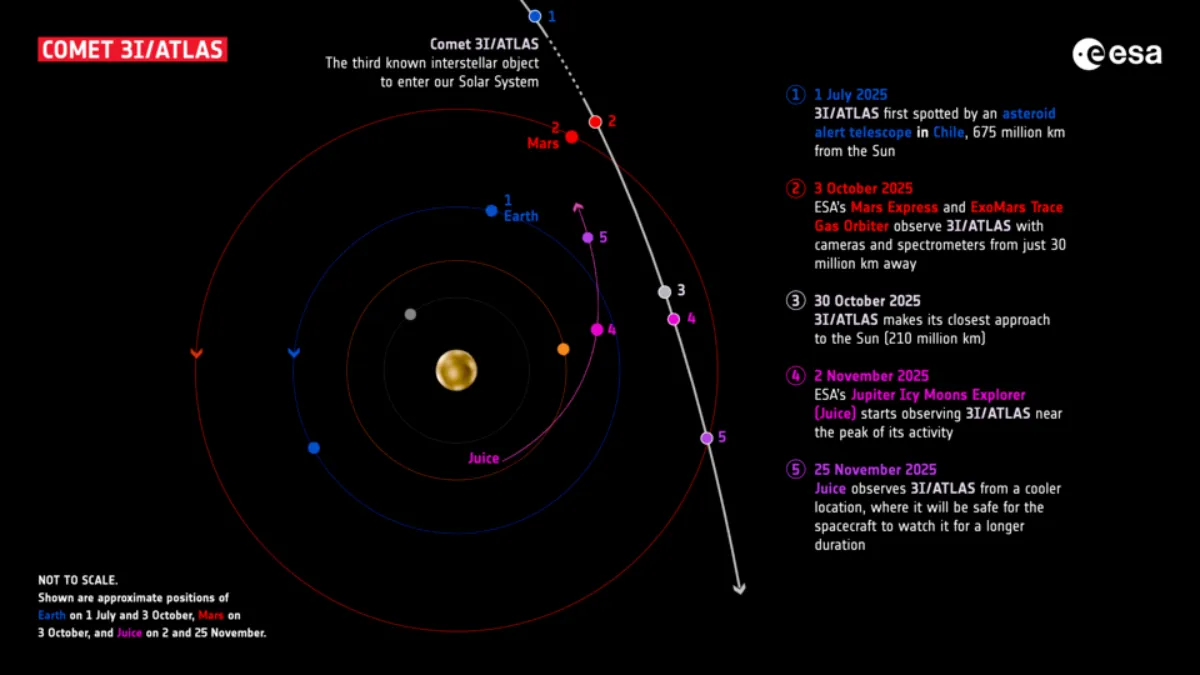
Scientists at ESA (European Space Agency) have produced the clearest tracking yet of comet 3I ATLAS, an interstellar visitor first detected in July 2025 as it entered the Solar System at high speed. The agency combined telescope data from Earth with images taken by spacecraft orbiting Mars, which improved the comet’s predicted course by ten times. The comet is the third confirmed object from outside the solar system and will leave the region later this year.
Astronomers first identified 3I ATLAS with the ATLAS telescope in Chile on July 1, 2025. Its speed and curved path showed that it was not bound to the Sun. Instead, it was passing through once before heading back into interstellar space. Only two similar objects have been confirmed before. One was 1I/Oumuamua in 2017, and the other was 2I/Borisov in 2019.
Unlike Oumuamua, which behaved more like a rocky body, this comet produces a cloud of gas and dust around its nucleus. Observations from Hubble and the James Webb Space Telescope confirmed water, carbon monoxide, and traces of nickel coming from its surface. Early findings suggest the comet may be several billion years old, possibly older than the Sun.

The comet passed about 29 million kilometers from Mars on October 3, 2025. The distance was close enough for ESA’s ExoMars Trace Gas Orbiter to capture a set of images that showed the comet moving across a field of stars. Mars Express also observed it during the same period.
These views from a different angle helped reduce the uncertainty in the comet’s position and improved predictions for its path. ESA said this was the first time measurements from a spacecraft orbiting another planet were added to the official Minor Planet Center database.
The comet does not pose any danger to Earth. Its closest approach is far beyond the orbit of Mars. Even so, the event served as a practical test for teams that monitor objects that could one day threaten the planet. If a hazardous asteroid ever appears, data from spacecraft around other planets could help confirm its trajectory.
The comet remained active as it passed the Sun on October 30, 2025. Telescopes have recorded long tails and narrow jets coming from its surface. Most researchers say the features match what they expect from an icy body heating up near the Sun. A few unusual details have drawn attention but do not change the overall picture.
More images will arrive in 2026 from ESA’s Juice spacecraft, which observed the comet soon after its closest approach to the Sun. ESA also plans to use its upcoming NeoMIR mission to detect objects hidden in sunlight and its Comet Interceptor mission to target future visitors from deep space.
Comet 3I ATLAS is already moving back toward the outer solar system, but the brief chance to track it from both Earth and Mars has given scientists a clearer look at material from another star system. The data shows how rare encounters like this can help identify and study objects that travel between the stars.
Source: ESA pinpoints 3I/ATLAS’s path with data from Mars

Leave a Reply