
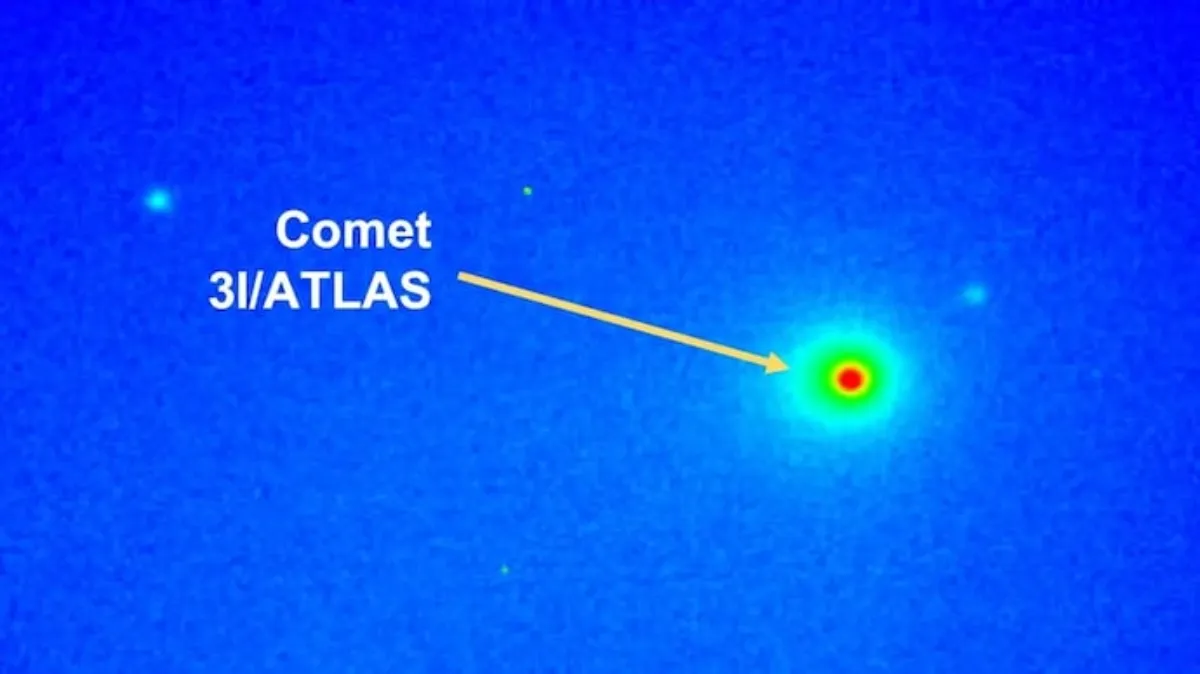
Indian astronomers have recorded one of the rarest visitors ever seen in the sky. Scientists at the Physical Research Laboratory used the 1.2‑meter telescope at Mount Abu in Rajasthan to image and study the interstellar comet 3I/ATLAS for four nights starting on November 12, 2025.
The object, which came from outside our solar system, had already passed its closest point to the Sun in late October and is now travelling outward on a one-way path into deep space.
This makes 3I/ATLAS only the third confirmed interstellar object ever observed in our solar system. The first was ‘Oumuamua in 2017, followed by Comet Borisov in 2019. Unlike most comets, which come from the outer regions of our own system, this object formed around a different star before drifting into our neighborhood.
The Mount Abu team captured images showing a faint but visible glow around the comet’s core. This glow forms when ice on the surface turns into gas and dust as it is warmed by sunlight. Even though the comet was already moving away from the Sun, it remained active enough to produce a clear cloud around its center.
Researchers also split the comet’s light into its basic components to study what it is made of. Their data shows a higher level of carbon dioxide compared to water, which is unusual when compared to many comets from our own system. At the same time, it also contains familiar gases such as cyanide and other carbon-based compounds commonly detected in local comets.
The comet was first discovered on July 1, 2025, by the ATLAS survey in Chile. Further tracking confirmed that it was moving far too fast to be held by the Sun’s gravity. Its stretched, open path shows that it did not originate here and will not return once it leaves.
At the time of its closest pass, the comet was about 1.5 times farther from the Sun than Earth. While that distance kept it out of public view, it was still close enough for large telescopes to study its behavior and composition. This is why observations from high-altitude sites like Mount Abu were so important.
Other observatories around the world, as well as instruments near Mars, also tracked 3I/ATLAS. By combining this data, scientists can compare an interstellar object to comets and asteroids formed around our own Sun. This helps them test how common certain materials may be in other star systems.
Over the coming months, the comet will grow dimmer as it moves farther away from the Sun. By early 2026, it is expected to fade beyond the reach of most telescopes. After that, it will continue its long journey through interstellar space.
For researchers, even a brief visit like this is important. Each interstellar object carries material from another part of the galaxy. Studying it, even for a short time, adds one more piece to the wider story of how planets and small bodies form around stars across the universe.

Leave a Reply