

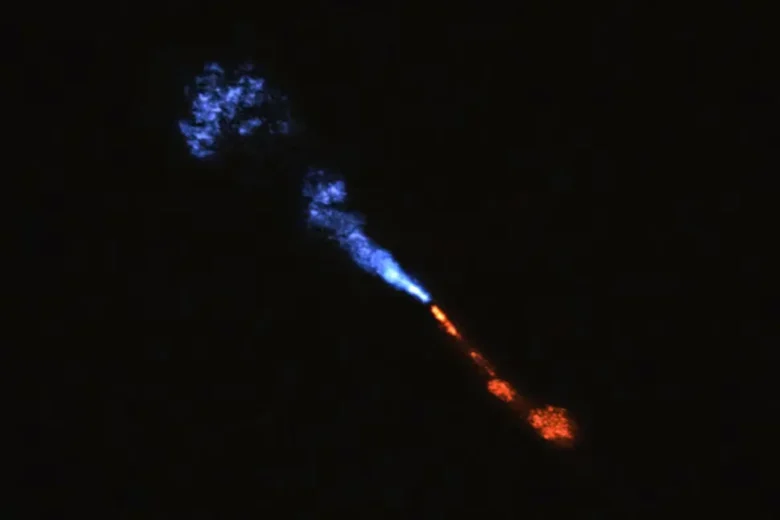
Astronomers have detected the earliest stages of planet formation around a young star named HOPS-315, located 1,370 light-years away. Using NASA’s James Webb Space Telescope (JWST) and the European Southern Observatory’s ALMA telescopes in Chile, scientists observed solid particles forming in the gas disk surrounding this star, which is only 100,000 to 200,000 years old. The findings were published in Nature on July 16, 2025.
“We’ve captured the moment when rocky planets like Earth start to take shape,” said Melissa McClure, who led the research team from Leiden Observatory in the Netherlands. The team identified silicon monoxide gas and crystalline silicate minerals (materials that were key to forming our own solar system over 4.5 billion years ago) in a region similar to the asteroid belt between Mars and Jupiter.
A gap in the star’s gas disk, combined with its tilt toward Earth, allowed astronomers to study this process closely. Images from ALMA show the system glowing brightly against the dark backdrop of space. “This is a major step in understanding how planets form,” said Fred Ciesla, a University of Chicago scientist not involved in the study. “We’re seeing evidence of processes we’ve long theorized about.”
The gas disk around HOPS-315 is massive, suggesting it could eventually form multiple planets, possibly as many as eight, over the next million years. McClure noted that this discovery indicates planet formation may be a common process around young stars. “We didn’t know if this was unique to our solar system or something that happens often,” she said.
Researchers, including Purdue University’s Merel van ’t Hoff, plan to study more young stars to compare their findings. “We want to learn if this process is typical and what it means for the chances of finding Earth-like planets elsewhere,” van ’t Hoff said. This discovery offers a new perspective on the origins of planets and our place in the universe.