

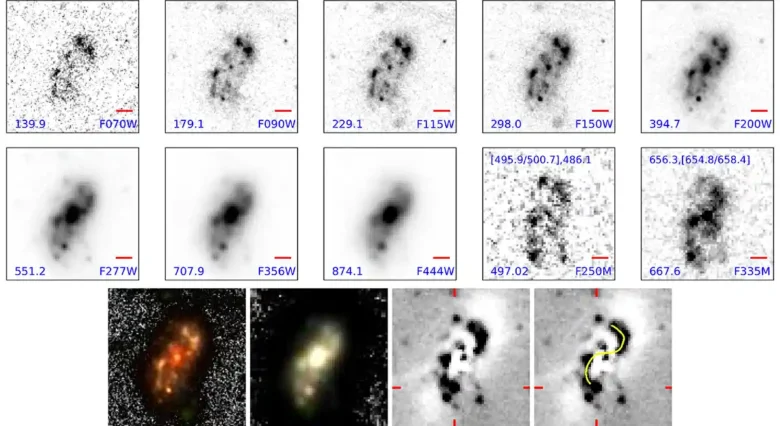
Astronomers have found a fully formed spiral galaxy from a time when the universe was only 1.5 billion years old. The galaxy, named Alaknanda, sits behind the massive cluster Abell 2744 and was spotted with help from the James Webb Space Telescope (JWST). Its clear spiral arms, bright center, and wide disk challenge ideas about when large, organized galaxies could first appear.
Researchers saw the galaxy through the natural magnifying effect of the Abell 2744 cluster. The cluster’s gravity made the distant light brighter and easier to study. Without this help, the spiral structure would have been hard to see. The light from Alaknanda began its journey when the universe was less than 12 percent of its current age. This places the galaxy at a time long before galaxies like the Milky Way were thought to have stable spiral forms.
Most galaxies from this early period look uneven and broken, with scattered regions of star birth. Many are still forming and lack clear structure. Alaknanda does not match that picture. It shows a smooth disk, a small central bulge, and two clear spiral arms.
In ultraviolet light, the arms show bright spots where stars are forming. In visible light, those areas blend into clean and continuous arms. These patterns match what astronomers usually see in nearby spiral galaxies today. The disk spans about 10 kiloparsecs, which is about 32,000 light-years across. Around 85 percent of its light comes from this flat disk, not from the center. That means the galaxy is already dominated by an organized structure rather than a growing core.
Alaknanda contains roughly 16 billion times the mass of the Sun in stars. That is around 15 percent of the current mass of the Milky Way. It is forming stars at a rate of about 63 suns per year, far faster than our galaxy does today.
Scientists estimate that most of its stars formed in the 200 million years before the light we now see was released. This shows that the galaxy built up its mass very quickly, yet still kept a clear and stable shape. A smaller nearby galaxy sits close to the edge of Alaknanda’s disk. Measurements show it lies at nearly the same distance. Researchers think it may be a satellite galaxy that is starting to interact with the larger one.
This nearby object could have affected the shape of the spiral arms. Gravitational pull between galaxies can change their structure and trigger star formation. It may have helped give Alaknanda its clean, detailed pattern.
For years, models suggested that spiral shapes take a long time to develop. They were thought to need calm conditions or special events that the early universe did not often provide. Alaknanda shows that this may not always be true.
Recent surveys using the JWST have found more disk-shaped galaxies at great distances. These new discoveries suggest that organized galaxies appeared much earlier than expected, not just in rare cases.
Astronomers now want to measure how the stars and gas within Alaknanda are moving. If the disk is rotating in a smooth way, it would support the idea that it is truly stable and settled. Future studies using Webb and radio telescopes on Earth will map how material moves across the spiral arms. These results will help explain whether the structure is long-lasting or still changing.
Alaknanda offers a clear view of a young universe that was already capable of forming ordered, mature galaxies. It is now a key target for learning how the first large galaxies grew so fast and took on such clean shapes.
Source: A grand-design spiral galaxy 1.5 billion years after the Big Bang with JWST