

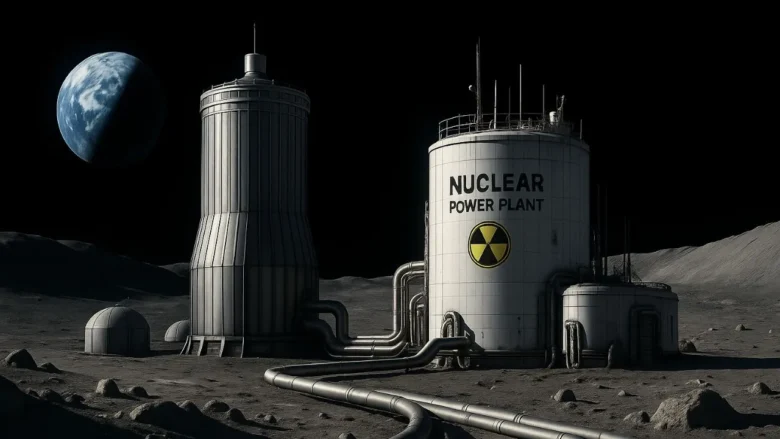
NASA is set to build a nuclear power plant on the moon by the early 2030s to support its ambitious human exploration plans as part of the Artemis program targeting the lunar south pole. The reactor, designed to generate at least 100 kilowatts of electricity, will provide a reliable energy source during the moon’s two-week-long nights, when temperatures drop drastically and solar panels become ineffective.
This move comes as China and Russia pursue similar lunar power projects, intensifying competition for strategic lunar sites.
The lunar south pole, rich in water ice, is a prime target for NASA’s Artemis missions, which aim to establish a sustainable human presence on the moon. However, the region’s prolonged darkness makes solar power unreliable.
“The lunar night is two weeks. It’s basically two weeks of light, two weeks of darkness. It’s cold and dark, so solar doesn’t work in all the regions that are of interest to explore,” John M. Olson, CEO of Axions Corporation and a retired U.S. Air Force major general, told Florida Today.
The proposed reactor will use nuclear fission to produce heat, which a closed Brayton cycle will convert into electricity powering life support, scientific tools, and water extraction. This technology builds on decades of research, with NASA investing $200 million since 2000. The U.S. government has now committed $350 million in President Trump’s 2026 budget, with an additional $500 million planned, to fast-track the project.
NASA aims to select commercial partners within the next eight months, with a launch targeted for 2030. A new Fission Surface Power Program Executive will oversee the effort starting next month.
The stakes are significant. China and Russia are developing their own lunar reactors, with plans to deploy them by the mid-2030s. If they succeed first, they could claim key lunar territories, potentially limiting U.S. access. The lunar south pole’s resources make it a focal point for international competition, raising concerns about geopolitical tensions in space.
Challenges remain. Budget constraints, including the planned phase-out of NASA’s Space Launch System after Artemis V, could strain funding. Cost overruns, a common hurdle in large-scale projects, also pose risks.
NASA emphasizes safety, drawing on its experience with nuclear-powered missions like the Mars rover and Voyager spacecraft, which used plutonium-238 to operate far from the sun.
A nuclear power plant on the moon would not only power life support and scientific experiments but also lay the groundwork for future Mars missions. As nations race to establish a foothold on the moon, the next decade will shape the future of space exploration.