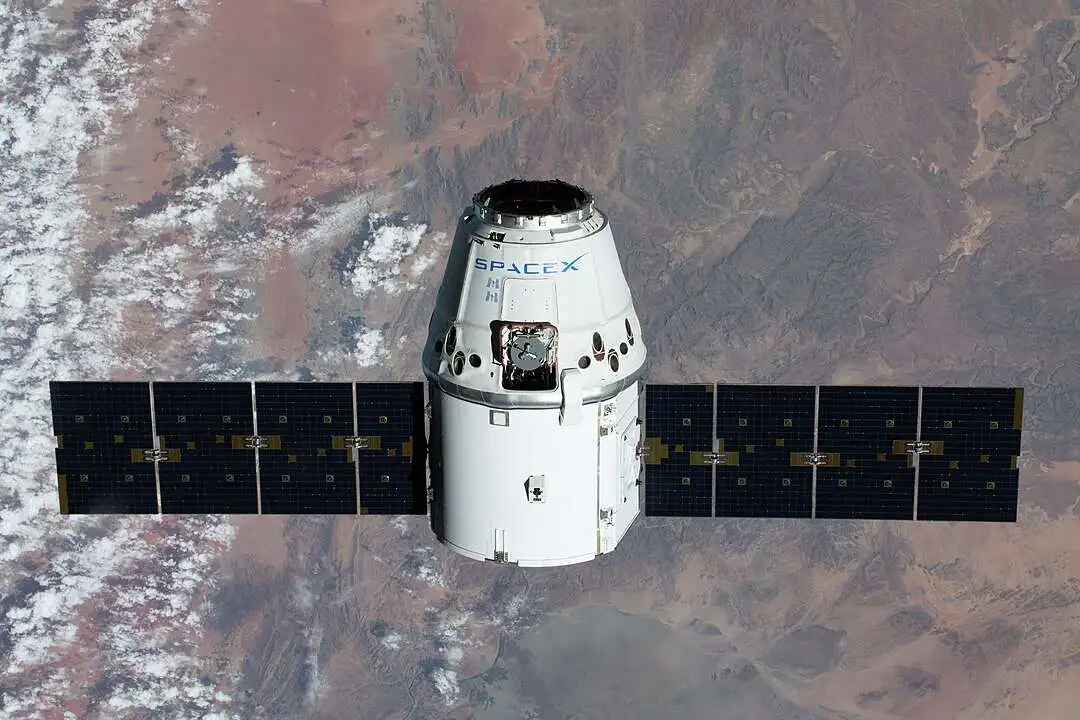
NASA and SpaceX have finalized plans for astronauts Butch Wilmore and Sunita “Suni” Williams to return from the International Space Station aboard a SpaceX Dragon spacecraft in March 2025, after their Boeing Starliner mission was grounded by persistent technical failures. Their return comes as Boeing engineers continue ground tests in New Mexico to fix helium leaks and thruster issues on the Starliner vehicle.
The two reached the ISS in June 2024 aboard Starliner, but multiple helium leaks and thruster malfunctions rendered the spacecraft unsafe for a crewed return. NASA ordered the capsule to return uncrewed, while Wilmore and Williams stayed aboard the ISS. Boeing and NASA have run continuous diagnostics and testing at White Sands, New Mexico, to resolve the faults.
NASA delayed the launch of the SpaceX Crew-9 mission, which was initially scheduled for August 18. The mission launched with just two astronauts aboard, leaving two seats open for Wilmore and Williams to come home via Dragon.
The SpaceX Crew-9 flight carried NASA astronaut Nick Hague and Roscosmos cosmonaut Alexander Gorbunov to the ISS in late September 2024 and splashed back down on March 18, 2025, with Hague plus Wilmore and Williams on board.
The switch to Dragon ensured the astronauts’ safe return despite Starliner’s delays. Boeing’s spacecraft remains under study, with more testing ahead before any future crewed flight can happen.
Indian Astronaut Shubhanshu Shukla selected for NASA-ISRO joint mission to the ISS. Image credit: Wikimedia Commons
The Indian Space Research Organisation (ISRO) is partnering with NASA and US company Axiom Space to send an Indian astronaut, known as the “Gaganyaatri,” to the International Space Station (ISS) as part of the AXIOM 4 mission.
The announcement came from Union Minister Dr. Jitendra Singh in a written reply to the Lok Sabha. The mission is planned to advance India’s human spaceflight program and strengthen international cooperation in space research.
The astronaut selected for the mission is Group Captain Shubhanshu Shukla, who is currently undergoing training alongside three international astronauts. He will join them aboard the ISS to conduct scientific experiments and participate in space outreach programs.
Shukla was chosen as the prime candidate by ISRO’s Astronaut Selection Board, which also named Group Captain Prasanth Balakrishnan Nair as the backup astronaut. The selection process involved oversight by the Multilateral Crew Operations Panel (MCOP).
The AXIOM 4 mission represents a major step for India’s human spaceflight ambitions. It follows the agreement between ISRO’s Human Space Flight Centre (HSFC) and Axiom Space Inc., a NASA-identified service provider.
This partnership allows ISRO access to the ISS via NASA and supports the ongoing development of India’s Gaganyaan mission, the country’s first independent crewed spaceflight project expected to launch by 2025.
Dr. Singh emphasized that this collaboration will enhance India’s capabilities in human spaceflight and deepen its cooperation with NASA. The mission will provide valuable experience for India’s future space missions and help build stronger ties in international space exploration.
This mission is a key milestone in India’s expanding role in space, reflecting its growing presence on the global stage and ambitions to contribute to international space research efforts.
NASA Plus: A Streaming Service for Space Enthusiasts. Image credit: NASA
NASA Plus was released on November 8, 2023. It is a streaming service that directly brings space and astronomy-related content to any device. NASA+ makes it easier for space enthusiasts to browse through NASA’s vast library of videos, documentaries, and live events.
What is NASA Plus?
NASA Plus is a streaming platform created by NASA that allows us to watch spacewalks, live broadcasts of rocket launches, and other significant events. It will also feature documentaries, educational videos, and original series. It is designed to make people of all ages learn about space and science.
What can you watch on NASA Plus?
NASA+ provides a wide variety of content. Here’s what you can experience on NASA Plus:
Live events: Watch rocket launches, spacewalks, and other significant events happen in real time.
Documentaries: The documentaries cover various other topics, such as the history of space exploration, current missions, and future plans.
Educational Videos: The videos section created for students and teachers features various topics to learn about in depth, such as black holes, the solar system, and the science behind space missions.
Original series: The NASA Plus original series will tell us the stories of NASA’s work and the people behind it.
How do I access NASA Plus?
NASA Plus is available on various devices. You can watch it on a smartphone, tablet, computer, or smart TV. NASA Plus is free to all users; there’s no subscription or paywall.
To access NASA Plus, download the NASA Plus app from the Play Store or visit the NASA website.
What’s next for NASA Plus?
NASA plans to continue expanding the content available on NASA Plus. As NASA carries out more missions, all the content will be added to the platform, making it wholesome for space lovers. NASA Plus will also likely see more partnerships with other organizations in the future. This could lead to even more exciting content for viewers.
Indian astronauts selected for the Gaganyaan mission. Image credit: The Indian Express
The Indian Space Research Organization (ISRO) has joined forces with NASA and the US private aerospace company Axiom Space to send an Indian astronaut to the International Space Station (ISS) as part of the Axiom Mission 4 (AX-4). Scheduled for launch no earlier than August 2024 from NASA’s Kennedy Space Center in Florida, this mission will mark a key milestone for India’s space program.
The selected astronaut, called a “Gaganyaatri,” will be one of four candidates currently training under the Gaganyaan Mission, India’s first manned spaceflight program expected to launch by 2025.
Union Minister Dr. Jitendra Singh, Minister of State for Science and Technology, confirmed the collaboration in a written response to the Lok Sabha. He explained that the astronaut will be chosen by ISRO’s Astronaut Selection Board from the four Gaganyaan trainees, all of whom are Indian Air Force test pilots undergoing intensive training at the astronaut facility in Bangalore.
The AX-4 mission will carry the Indian astronaut alongside three international crew members to the ISS. This partnership represents not only a significant step in India’s human spaceflight ambitions but also a broader push for international cooperation in space research. The collaboration with Axiom Space provides ISRO with access to new technologies and expands opportunities for scientific research and resource sharing.
ISRO’s engagement with NASA and Axiom Space also signals a growing trend of public-private partnerships in space exploration. The Gaganyaan program aims to build on this momentum, preparing India for future independent human space missions while fostering international ties. This mission is expected to enhance India’s capabilities in human spaceflight and contribute valuable experience for upcoming projects.
Image of the fascinating arrowhead-shaped rock found by NASA's Perseverance rover. Image credit: NASA/JPL-Caltech/MSSS
NASA’s Perseverance rover has discovered a rock on Mars that may hold fossil evidence of ancient microbial life. The arrowhead-shaped, vein-filled rock, nicknamed “Cheyava Falls,” was found in the northern part of Neretva Vallis, an ancient river valley on Mars, on July 21, 2024. Scientists believe this rock could contain some of the earliest signs of microbial life that existed billions of years ago when the area possibly had flowing water.
Instruments aboard Perseverance analyzed the rock’s chemical makeup and structure, finding qualities that match those expected from ancient microbial fossils. The rock contains large veins of calcium sulfate and reddish-brown bands, indicating the presence of hematite (a mineral linked to Mars’ rusty surface).
Closer inspection revealed dozens of irregularly shaped, off-white spots surrounded by black rings, resembling patterns sometimes seen in fossilized microbial life on Earth. Perseverance’s PIXL (Planetary Instrument for X-ray Lithochemistry) found that the black halos contain iron and phosphate, elements often connected to microbial fossils.
Ken Farley, Perseverance project scientist at Caltech, described Cheyava Falls as “the most puzzling, complex, and potentially important rock yet investigated by Perseverance.” David Flannery, an astrobiologist on the mission team, noted that these features are commonly linked to ancient microbial life found beneath Earth’s surface.
This discovery could represent a major step toward finding evidence of life beyond Earth. However, confirming this will require more detailed study of samples returned to Earth in future missions. Until then, Cheyava Falls remains one of the most promising clues in the search for past life on Mars.
Two interacting galaxies together known as ARP 11. Image credit: NASA, ESA, CSA, STScI
NASA has released a striking new image from the James Webb Space Telescope (JWST), marking the observatory’s second anniversary. Taken on July 12, 2024, the photograph shows two galaxies in the process of merging, officially known as ARP 142 and nicknamed “the Penguin” and “the Egg” for their shapes.
Captured in unprecedented detail, the image reveals how gravity is slowly pulling the galaxies together, setting the stage for them to combine into a single, larger galaxy.
The Penguin, cataloged as NGC 2936, is a warped former spiral galaxy now stretched into an arc-like form. The Egg, NGC 2937, is a rounder, compact galaxy seen to the left of the frame. JWST’s infrared observations show the pair locked in a slow gravitational interaction about 100,000 light-years apart. Over time, their mutual pull is drawing them closer, compressing clouds of dust and gas, and igniting bursts of new star formation.
The image was shared by NASA on X as part of celebrations marking two years since JWST began delivering scientific data. The telescope, launched in December 2021, is the largest and most powerful space observatory in operation. While the Hubble Space Telescope observes mainly in visible and ultraviolet light, JWST specializes in the infrared spectrum. This allows it to see through thick clouds of cosmic dust, revealing objects that are too faint or obscured for other instruments.
According to NASA, this capability is key to studying galaxy mergers like ARP 142. Infrared imaging can expose the dense, dust-covered regions where stars are forming, helping astronomers understand how such interactions shape galaxies over billions of years. The Penguin and Egg are currently in an early stage of their merger, but simulations suggest they will eventually combine into one elliptical galaxy.
JWST’s anniversary image not only highlights its scientific power but also underscores its mission: to deliver sharper, deeper, and more revealing views of the universe than ever before. More images from its second year of operation are expected to be released in the coming months, offering further insight into the origins and evolution of galaxies.
Artist’s concept of the full Gateway configuration. Image credit: NASA
NASA is moving closer to the launch of Artemis II, with several key milestones reached in recent days. On August 10, the Orion spacecraft was fueled and transferred to its next processing site at Kennedy Space Center.
The four-member crew has also begun training aboard Orion, marking a significant step toward their planned lunar flyby. At Marshall Space Flight Center, NASA showcased the final piece of flight hardware for the Artemis II Space Launch System (SLS) rocket before delivery.
Meanwhile, preparations extend beyond the rocket and spacecraft, with the program’s next-generation spacesuits now featuring Oakley-style gold-plated visor technology to reduce glare and protect astronauts from radiation during moonwalks.
International partners are also contributing to the mission. South Korea has sent a radiation-measuring CubeSat, named K-RadCube, to be flown on Artemis II as part of its scientific payload.
Looking further ahead, NASA is planning for long-term lunar infrastructure, including a nuclear reactor expected to be built on the Moon by 2030. This power source would ensure reliable energy for habitats, rovers, and experiments, particularly during the long lunar night or in permanently shadowed craters where solar power is not an option.
Everything about NASA’s Artemis Program
NASA’s Artemis program is a series of missions designed to return humans to the Moon for the first time since 1972. Conducted with international and commercial partners, the program will use advanced spacecraft, rockets, and a planned lunar space station to explore the Moon, test new technologies, and prepare for future missions to Mars.
Artemis I launched in 2022, Artemis II will carry a crew around the Moon in 2025, and Artemis III aims to land astronauts on the lunar surface, marking a major step toward long-term lunar exploration.
NASA’s SLS Rocket Carrying Orion Spacecraft Test Flight Launch on November 16, 2022. Image credit: NASA/Bill Ingalls
Artemis I
Launched on November 16, 2022, Artemis I was an uncrewed test of NASA’s Space Launch System (SLS) rocket and the Orion spacecraft. The mission sent Orion into lunar orbit and back to Earth, testing its systems over several weeks to ensure readiness for crewed flights. It confirmed the safety and performance of the hardware before moving to human missions.
Artemis II
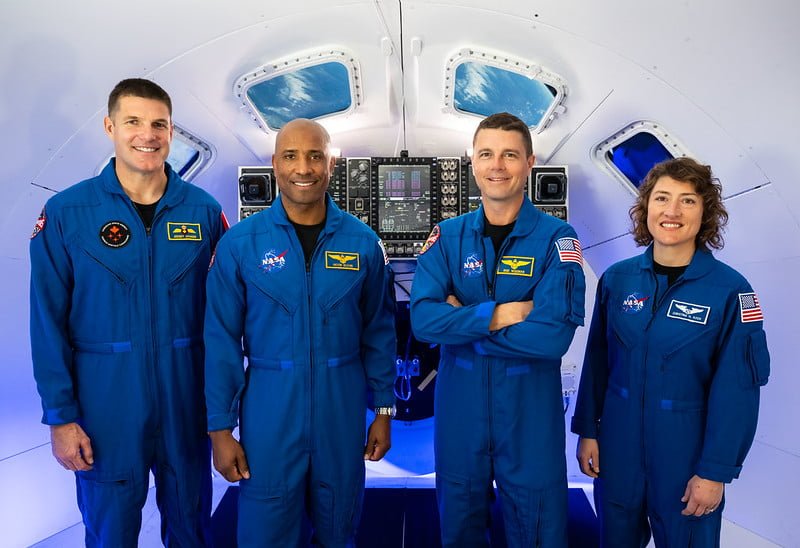
Crew from left to right: Jeremy Hansen (CSA), Victor Glover (NASA), Reid Wiseman (NASA), and Christina Koch (NASA). Image credit: NASA
Artemis II will be the first crewed flight of the SLS and Orion. Four astronauts will test systems in Earth orbit before Orion travels around the Moon on a free-return path to Earth. Originally set for late 2024, launch is now targeted for September 2025.
Artemis III
Planned for no earlier than April 2025, Artemis III will attempt the first crewed lunar landing of the program. The mission depends on a Starship Human Landing System (HLS) being placed in lunar orbit ahead of time. Once in orbit, Orion will dock with HLS, and two astronauts will land on the Moon for about 6.5 days, conducting surface activities before returning to Orion for the trip back to Earth.
Spacecraft, Rockets, and Landers
The Lunar Gateway
A major difference from Apollo is the Lunar Gateway, a small space station that will orbit the Moon. It will serve as a communications hub, science lab, and temporary living space for crews.
The Gateway is an international collaboration involving NASA, the European Space Agency (ESA), the Japan Aerospace Exploration Agency (JAXA), the Canadian Space Agency (CSA), and the Mohammed Bin Rashid Space Centre. It will be the first crewed outpost beyond Earth’s orbit and a model for future Mars-bound infrastructure.
Space Launch System (SLS)
The SLS is NASA’s most powerful rocket, designed to carry astronauts and cargo far beyond Earth. Standing 98 meters tall, it produces about 8.8 million pounds of thrust at liftoff—more than the Saturn V.
It uses four RS-25 engines (upgraded versions from the Space Shuttle) and two solid rocket boosters to send Orion on its way to the Moon. Future SLS upgrades will carry heavier payloads and support Mars missions.
Falcon Heavy
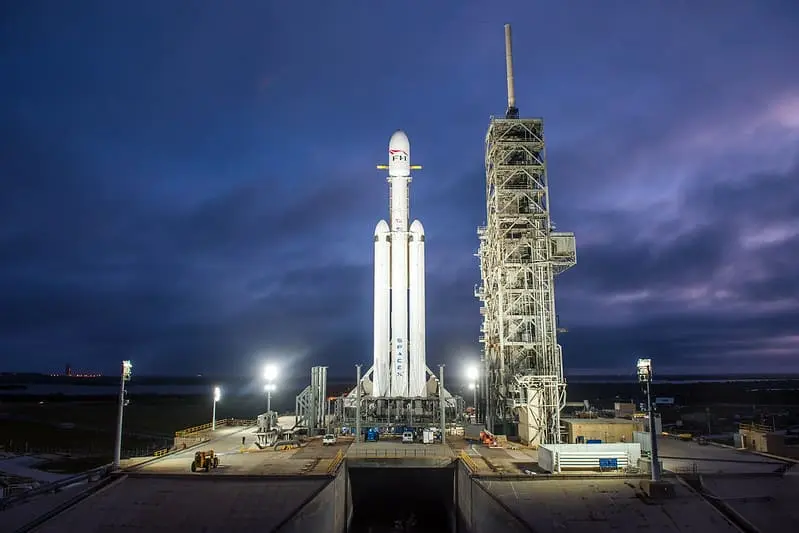
Falcon Heavy Rocket. Image credit: SpaceX
Built by SpaceX, Falcon Heavy is a partially reusable rocket capable of lifting heavy cargo to orbit and beyond. While it is not launching a crew for Artemis, it will deliver components of the Lunar Gateway and other hardware. Its three booster cores can generate over 5 million pounds of thrust, and two of them can land back on Earth for reuse
Orion Spacecraft
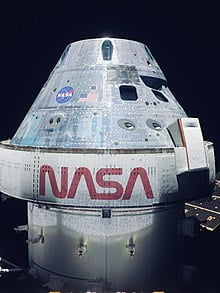
Selfie Taken by Orion Spacecraft. Image credit: NASA
Orion is NASA’s crew spacecraft for Artemis missions, designed by Lockheed Martin with a European Service Module built by Airbus. It can carry four astronauts beyond low Earth orbit for up to 21 days undocked, or six months when docked.
Orion’s crew module provides 316 cubic feet of habitable space, roughly equivalent to a large walk-in closet. The spacecraft’s life support systems can recycle air and water, generate oxygen through electrolysis, and scrub carbon dioxide from the atmosphere. Backup systems provide redundancy for every critical function, ensuring crew survival even if primary systems fail.
Solar panels on the European Service Module generate up to 11.1 kilowatts of electrical power, enough to supply an average American home. The service module also provides propulsion, using 33 thrusters fueled by toxic but reliable hydrazine and nitrogen tetroxide.
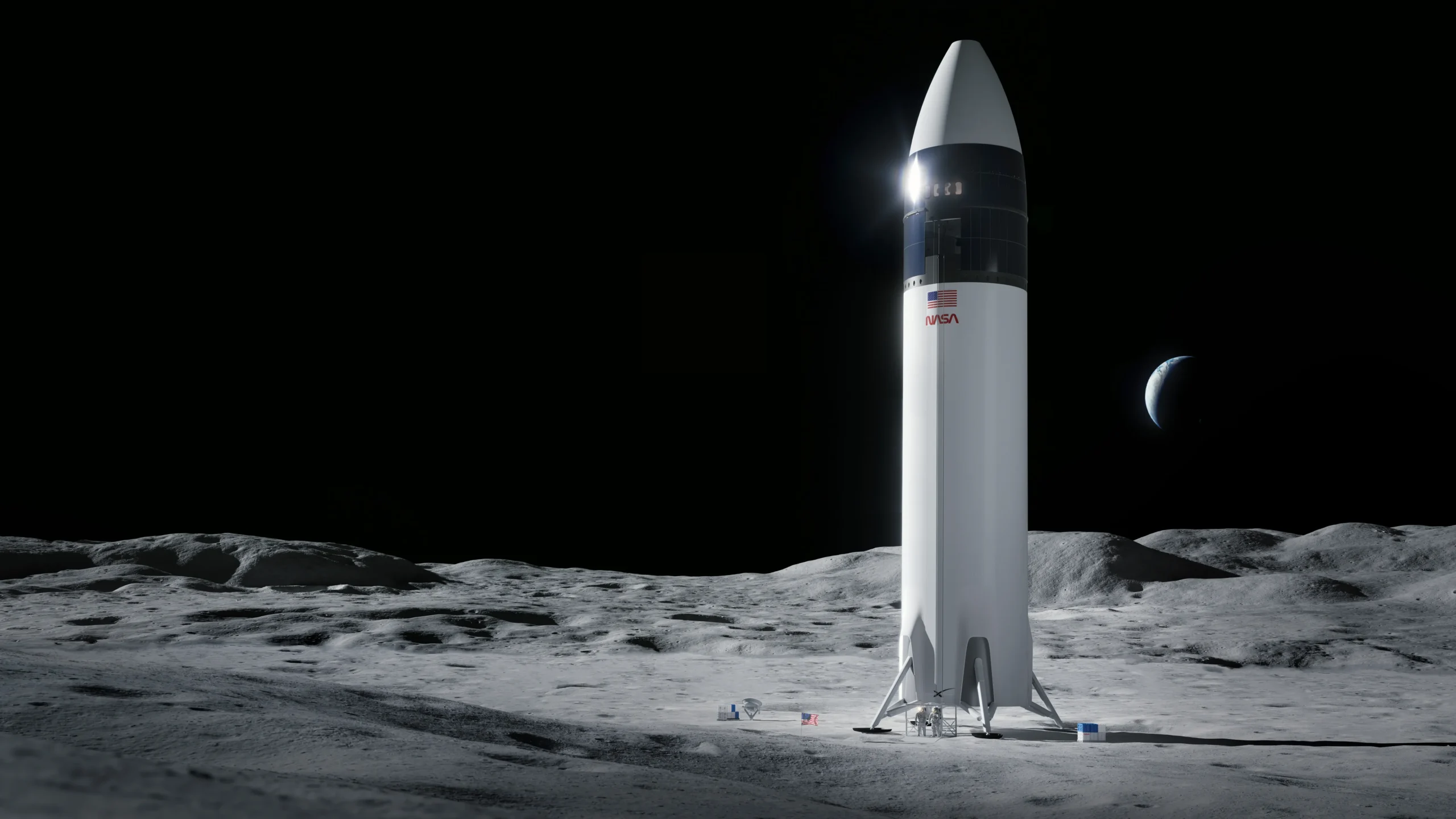
Starship HLS
The image illustrates the Starship HLS on the Moon. Image credit: NASA
SpaceX’s Starship HLS will carry astronauts from lunar orbit to the surface and back. Unlike Orion, it will not return to Earth. Instead, it will remain in space for reuse on later missions.
The lander will feature spacious interiors, airlocks for lunar surface access, and storage for science equipment. It is being designed to operate in low-gravity environments and support extended surface stays.
International and Commercial Partners
Artemis is not just a NASA program; it’s a multinational partnership. ESA is building Gateway modules and the Orion service module. JAXA will provide habitation components and logistics. CSA will contribute a robotic arm for the Gateway. Private companies like SpaceX, Boeing, and Northrop Grumman are supplying rockets, spacecraft, and critical systems.