Category: Astronomy

Look deeper into the science of the stars. This section explores celestial events, cosmic phenomena, and the latest research that helps us understand how the universe came to be and where it’s headed.

  • Hubble Captures largest Protoplanetary Disk ever Observed

    Hubble Captures largest Protoplanetary Disk ever Observed

    NASA’s Hubble Space Telescope has captured its sharpest visible-light image yet of the largest protoplanetary disk ever observed. The object, known as IRAS 23077+6707, lies about 1,000 light-years from Earth and hosts a disk nearly 400 billion miles wide, making it one of the largest ever observed. Scientists shared the findings in The Astrophysical Journal.

    “The level of detail we’re seeing is rare in protoplanetary disk imaging, and these new Hubble images show that planet nurseries can be much more active and chaotic than we expected,” said lead author Kristina Monsch of the Center for Astrophysics | Harvard & Smithsonian (CfA).

    The image shows a disk so large it dwarfs our own solar system. From edge to edge, it stretches around 40 times farther than the Kuiper Belt. Hubble captured the structure in visible light, which allowed researchers to see surface details that radio telescopes often miss. The disk blocks the star at its center, leaving a dark band flanked by glowing layers of dust above and below.

    What caught scientists off guard was how uneven the disk looks. On one side, tall streams of dust and gas rise high above the main disk. On the other, the structure ends sharply, almost like it was cut short. Researchers say this imbalance likely points to recent activity, such as gas falling in from nearby space or a close pass from another star.

    “We were stunned to see how asymmetric this disk is,” said co-investigator Joshua Bennett Lovell, also an astronomer at the CfA.

    The disk also holds a huge amount of material. Estimates suggest it contains the mass of 10 to 30 Jupiters. That is more than enough to form several large planets. The central star itself may be heavy or even part of a pair, which could explain the strong motion seen in the disk.

    Most known planet-forming disks appear calm and flat. This one looks busy and unsettled. Dust and gas swirl instead of settling into neat rings. That motion could affect how planets grow, where they form, and whether their paths stay stable. Some planets here could grow fast and large, while others may drift far from where they start.

    The system is young, likely no more than two million years old. That puts it right in the early stage of planet formation, before much of the gas fades away. Observing a disk at this moment helps scientists test ideas about how planets begin.

    The research team gave the disk a playful nickname, “Dracula’s Chivito,” a nod to their mixed backgrounds and the disk’s layered look. Future studies with the James Webb Space Telescope (JWST) will look deeper into the disk to study its dust and heat.

  • Earth once had a vast Water Reservoir deep inside the Mantle

    Earth once had a vast Water Reservoir deep inside the Mantle

    Researchers from the Guangzhou Institute of Geochemistry under the Chinese Academy of Sciences reported that Earth’s mantle acted as a vast water reservoir more than four billion years ago. Their findings, titled “Where did the water go when Earth’s early magma oceans crystallized? For the deepest mantle, the answer has been elusive,” was published in the journal Science.

    The study suggests that the lower mantle absorbed far more water than researchers once believed. This water was stored inside a common mineral called bridgmanite.

    Early Earth formed in extreme heat after countless collisions between rocky bodies. Much of the planet was once covered by a global ocean of molten rock. As this molten layer slowly cooled, solid minerals formed and sank, pulling certain elements with them. Water near the surface escaped into the air and later formed oceans, but water trapped deeper followed a different path.

    To recreate these conditions, researchers used diamond anvil cells to squeeze mineral samples under pressures hundreds of thousands of times greater than at sea level. Powerful lasers heated the samples to temperatures similar to those inside the young Earth. Under these conditions, hydrated minerals transformed into bridgmanite and absorbed far more water than earlier models allowed.

    Bridgmanite makes up most of the lower mantle, which stretches from about 660 to nearly 2,900 kilometers below the surface. The experiments show that this mineral can store vast amounts of water within its structure. Based on the results, scientists estimate the lower mantle could hold water equal to several modern oceans.

    This hidden reserve may still shape the planet today. Seismic waves sometimes slow down as they pass through the mantle, which can hint at the presence of water. Volcanic rocks from places such as Hawaii also contain more water than expected, suggesting a deep source feeding eruptions over long periods of time.

    The findings help explain why Earth remained wet while nearby worlds did not. Venus likely lost its water early, while Mars could not hold onto a steady cycle. On Earth, water stored deep inside may have returned to the surface again and again through volcanic activity, helping stabilize the climate.

    Researchers say the results may also matter beyond our planet. Observations of distant rocky worlds already show signs of water-bearing minerals. If those planets formed in a similar way, they too may hide large water reserves far below their surfaces. The team plans further tests to refine the numbers and compare them with seismic data.

  • Scientists Observe a Strange Radio Signal Spike during comet 3I/ATLAS Flyby

    Scientists Observe a Strange Radio Signal Spike during comet 3I/ATLAS Flyby

    The interstellar comet 3I/ATLAS made its closest pass to Earth on December 19. The comet passed at a safe distance of about 270 million kilometers and posed no threat, according to space agencies tracking its path.

    The object was first spotted in July by the ATLAS survey in Chile. Follow-up observations showed it was moving far too fast to be bound to the Sun, confirming it came from outside the solar system. At roughly 60 kilometers per second, 3I/ATLAS is only the third known visitor of its kind, following the 2017 object ʻOumuamua and the comet 2I/Borisov in 2019.

    Unlike ʻOumuamua, which showed little activity, 3I/ATLAS behaves like a classic comet. As it approached the Sun earlier this year, it released gas and dust that formed a visible tail. Observatories later reported a faint green glow around the comet, a color commonly seen when certain carbon compounds interact with sunlight. Researchers estimate the comet’s solid core may span up to 20 kilometers, making it larger than many comets seen in our own system.

    Around the time of the flyby, some monitoring stations recorded a brief spike in Earth’s natural low-frequency electromagnetic background at about 25 hertz. The signal appeared hours before the comet’s closest approach and lasted for a short period. Scientists who study these signals say such spikes can occur due to natural atmospheric activity or space weather and do not indicate any direct link to the comet.

    Experts stressed that 3I/ATLAS was far too distant to affect Earth’s atmosphere or magnetic environment. Studies show that material released by comets disperses quickly and weakens long before it could reach Earth. Radio scans of the comet also found no unusual emissions.

    The comet will continue its journey through the solar system and is expected to pass near Jupiter in early 2026. Astronomers plan to keep watching, as the planet’s strong gravity may alter the comet’s activity.

  • Geminid Meteor Shower Study Reveals Why These Asteroid Fragments Break Apart High Above Earth

    Geminid Meteor Shower Study Reveals Why These Asteroid Fragments Break Apart High Above Earth

    Every December, the Geminid meteor shower fills the night sky with bright streaks, but a new study explains why these meteors behave unlike almost any others. Scientists have found that Geminids begin cracking far higher above Earth than expected, not because of air resistance, but because sudden heating tears them apart from the inside as they plunge toward the planet.

    The Geminids appear each year in mid-December, peaking with as many as 120 meteors per hour under dark skies. They seem to radiate from the constellation Gemini and trace back to asteroid 3200 Phaethon, not a comet. That detail has long puzzled researchers, since most meteor showers form from icy debris shed by comets, not rocky bodies.

    A research team from the Czech Academy of Sciences analyzed 39 Geminid fireballs and faint meteors using detailed computer models matched to real camera and sensor data. They tracked brightness, speed, and paths to see how these space rocks fall apart as they enter the atmosphere. The results point to heat as the main trigger.

    As Geminid meteors slam into the upper atmosphere at about 35 kilometers per second, their surfaces heat up in seconds. This rapid heating creates stress between the hot outer layer and the colder interior. The study shows that this stress alone can crack the rocks at altitudes near 120 kilometers, where the air is still extremely thin. In some cases, the rocks fail under pressures lower than those from air drag.

    Size plays a major role. Small Geminids, lighter than a chocolate bar, often shatter completely from heat and turn into fine dust. Medium-sized pieces tend to glow evenly and lose material bit by bit. Larger chunks develop deep surface cracks early on, which later cause them to break apart lower in the atmosphere. The densest pieces match what scientists expect from carbon-rich asteroids like Phaethon.

    These findings also help explain Phaethon’s strange behavior. The asteroid swings closer to the Sun than Mercury and releases dust during each close pass. Intense solar heating likely fractures its surface over time, feeding the Geminid stream without the icy jets seen on comets.

    In 2029, Japan’s DESTINY+ spacecraft will fly past Phaethon and study its surface and dust up close. If it finds cracked, compact fragments, it will confirm what these Earth-based observations already suggest.

    Source: Geminids are initially cracked by atmospheric thermal stress

  • Young Planet Systems Caught in Unstable Orbits Show How Planetary Chaos Begins Early

    Young Planet Systems Caught in Unstable Orbits Show How Planetary Chaos Begins Early

    Astronomers studying three young star systems have found planets moving in fragile orbital patterns that sit just short of full stability, offering a rare look at how planetary systems start to drift toward disorder early in their lives. The research focuses on AU Mic, V1298 Tau, and TOI-2076, all less than 200 million years old, and shows that their planets hover close to tidy orbital ratios without fully locking in, leaving them open to future disruption.

    Most planets form inside flat disks of gas and dust that surround newborn stars. As these planets grow, gravity pulls them inward, often lining them up in repeating orbital patterns where each planet circles its star in a steady rhythm with its neighbors. Older systems rarely keep those patterns. Surveys from NASA’s Kepler mission show that only about 15 percent of mature systems still sit near these ratios, suggesting that many lose their early order.

    These three young systems appear frozen in the middle of that transition. AU Mic, just 20 million years old, hosts several planets alongside a bright debris disk that hints at ongoing collisions. V1298 Tau, about the same age, holds four large planets with thick atmospheres that remain easy targets for space telescopes. TOI-2076, at roughly 200 million years, shows a similar layout around a still active star.

    The planets in all three systems orbit at periods that almost match neat ratios such as two or three to one. However, careful tracking of their transit timings shows they do not behave like fully locked pairs. Instead of steady gravitational balancing, their interactions drift freely, a sign they sit just outside true resonance.

    Computer simulations suggest these setups can survive for hundreds of millions of years if the orbits stay nearly circular. Small changes make a big difference. Slight increases in orbital stretch can trigger close encounters in far shorter times. Near-resonant systems break down faster than fully locked ones, especially as planet mass rises.

    Researchers think these planets likely formed in resonant chains that later broke apart. Turbulence in the gas disk, shifting disk edges, or leftover debris may have pushed them out of alignment. In AU Mic, the surrounding dust points to past scattering events. In V1298 Tau, early atmospheric loss could also play a role.

    These systems matter because they show that planetary order often fades quickly. The early solar system likely followed a similar path before settling into its current shape. By watching these young stars, scientists can test how common that story may be. Future missions like TESS and PLATO should find more examples, helping explain why so many planetary families grow up messy rather than neat.

    Source: Unexpected Near-Resonant and Metastable States of Young Multiplanet Systems

  • Astronomers Spot First Ever Runaway Supermassive Black Hole

    Astronomers Spot First Ever Runaway Supermassive Black Hole

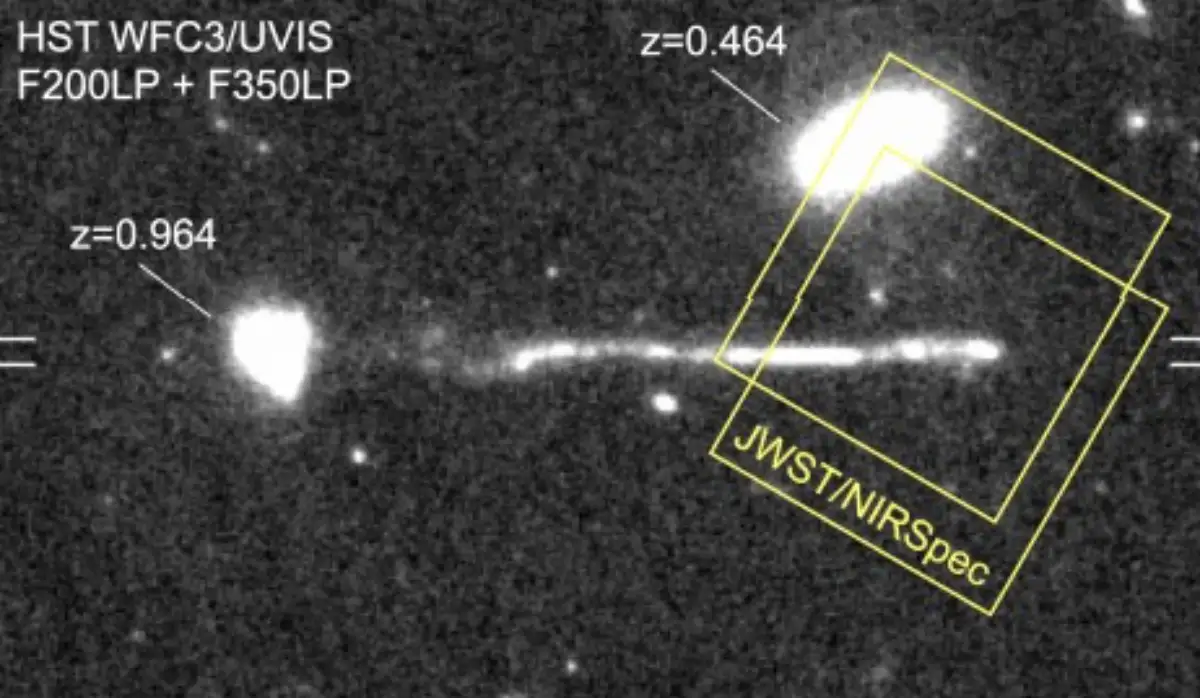
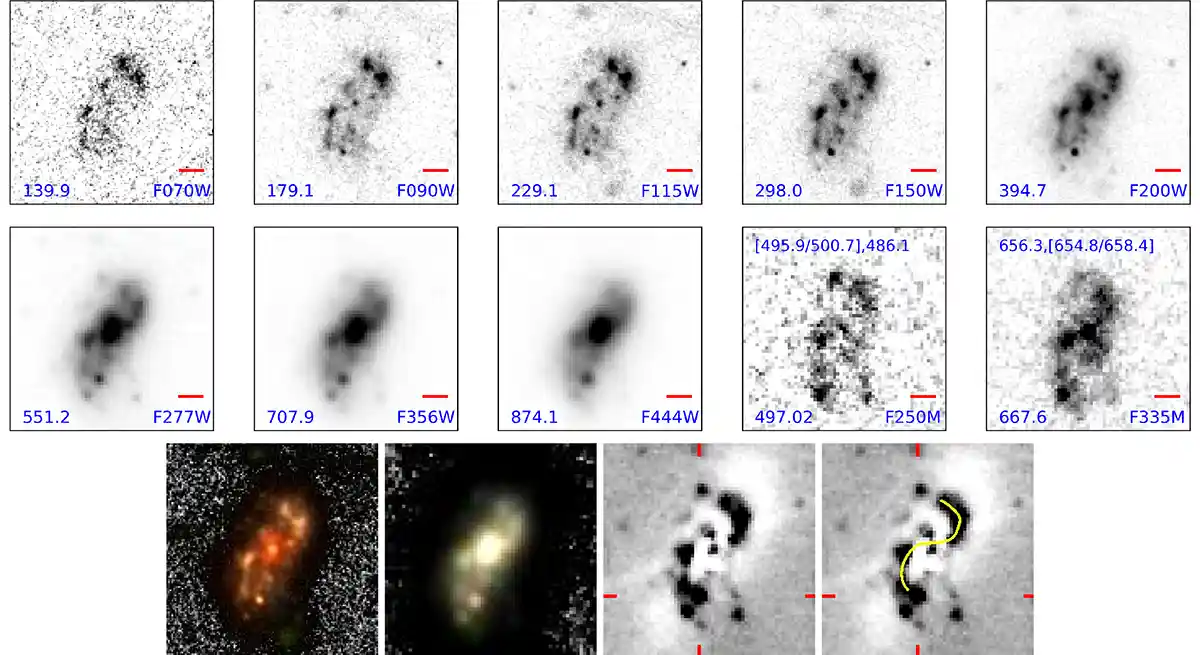
    For the first time ever, astronomers have confirmed that a supermassive black hole has been thrown out of its home galaxy and is racing through space, leaving a glowing trail behind it. The object, known as RBH-1, sits about 7 billion light-years away and was confirmed using the James Webb Space Telescope (JWST). The discovery explains a strange, ruler-straight streak of light seen earlier by Hubble and settles years of debate over what caused it.

    The black hole weighs millions of times more than the Sun and is moving at close to 1,000 kilometers per second. It likely got this violent push during a past galaxy merger, when two black holes joined and released energy unevenly. That imbalance acted like a cosmic kick, strong enough to eject one of them completely.

    Astronomers first noticed the streak in 2023 while studying distant galaxies. The feature stretched for about 62 kiloparsecs and appeared to shoot straight out of one galaxy. Early ideas included a thin galaxy seen edge-on or the remains of a smaller system torn apart. None of those options explained why the light grew brighter at the far end or why stars were missing.

    New data from Webb’s NIRSpec instrument changed everything. The telescope measured gas motions at the tip of the streak and found a sharp split in speeds. Gas on one side moved toward Earth, while gas on the other moved away. The shift happened over a very small distance, a clear sign of a fast-moving object slamming into surrounding gas.

    This pattern matches a bow shock, the same shape water forms ahead of a fast boat. As the black hole plows forward, it heats and squeezes the gas in front of it. That gas cools and glows, creating the bright head of the trail. Behind it, the wake narrows and breaks into clumps as the flow slows down.

    The glow does not come from stars or from the black hole feeding on material. Instead, the motion alone supplies the energy. Over tens of millions of years, the runaway has stirred and recycled huge amounts of gas, enough to form large numbers of stars along the way.

    Astronomers say this finding matters because it confirms long-standing ideas about how black holes behave after mergers. It also offers a new way to spot similar runaways in future surveys. RBH-1 shows that even the biggest objects in the universe can get kicked out, and when they do, they leave tracks that are hard to miss.

    Source: JWST Confirmation of a Runaway Supermassive Black Hole via its Supersonic Bow Shock

  • Ancient Brown Dwarf Found Orbiting One of the Milky Way’s Oldest Stars

    Ancient Brown Dwarf Found Orbiting One of the Milky Way’s Oldest Stars

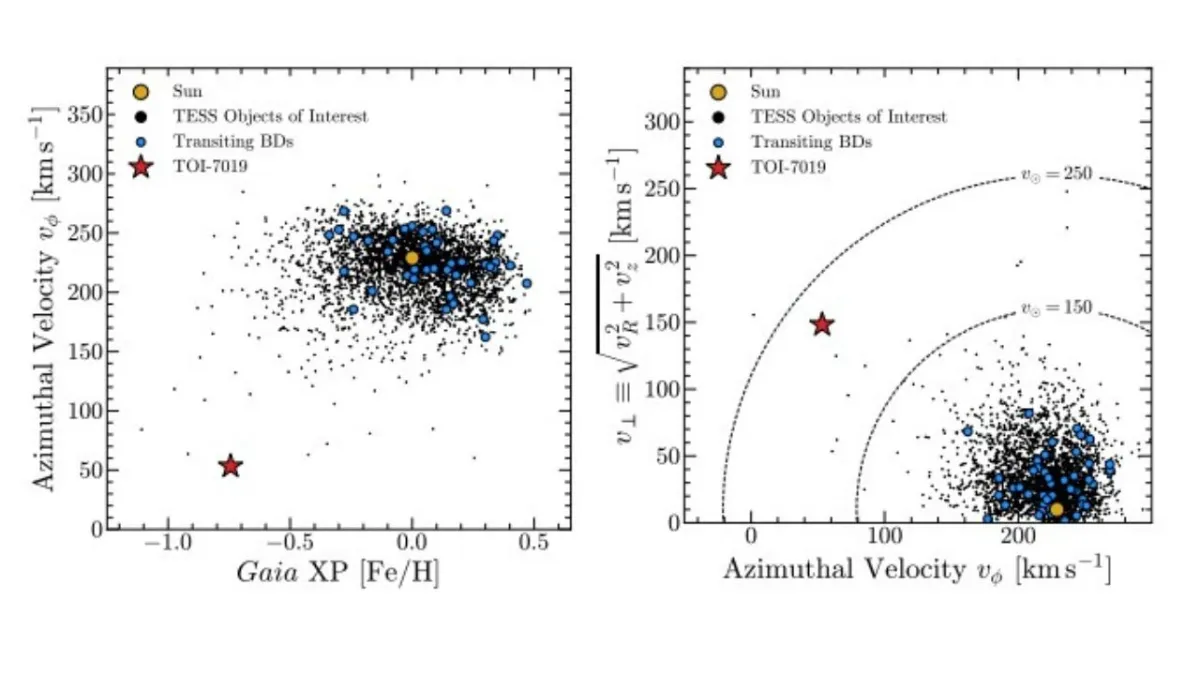
    Astronomers have found the oldest known brown dwarf that passes in front of its star, a rare object that has survived nearly 12 billion years since the early days of the Milky Way. The object, called TOI-7019b, orbits a faint, metal-poor star about 435 light-years from Earth and was detected using NASA’s Transiting Exoplanet Survey Satellite, or TESS. The discovery offers a direct look at how star systems formed when the galaxy was young and heavy elements were scarce.

    TOI-7019b sits in a gray zone between planets and stars. It weighs about 61 times as much as Jupiter but never grew large enough to ignite steady nuclear burning. Instead, it has spent billions of years slowly cooling. Despite its age, it remains slightly larger than expected, which has caught the attention of researchers.

    The host star looks unremarkable at first glance, but its motion tells a different story. Data from the Gaia spacecraft show that it moves through the galaxy on a steep, fast path that marks it as part of the Milky Way’s thick disk. This population of stars formed early, when the universe was only a few billion years old. Chemical tests show the star has far less iron than the Sun, another sign of its great age.

    TESS first spotted the system in 2021 when it noticed a small, regular dip in the star’s brightness every 48 days. That drop, less than one percent, signaled something passing in front of the star. Follow-up checks from ground-based telescopes confirmed the signal and ruled out other stars hiding nearby.

    Measurements of the star’s motion revealed the companion’s mass and showed it follows an oval-shaped path, not a neat circle. That detail matters. Objects born like planets often settle into round orbits, while heavier companions tend to keep stretched paths.

    The brown dwarf’s size raises new questions. Models suggest an object this old and this heavy should have shrunk more by now. Instead, it remains about 82 percent the size of Jupiter. Scientists suspect its unusual chemistry or internal structure may slow its cooling.

    The find stands out because almost all known systems like this orbit younger, metal-rich stars. TOI-7019b proves such companions also formed in the galaxy’s youth. As one researcher joked, it is ancient hardware still running fine.

    Astronomers hope future observations, including infrared studies, will reveal more about its makeup. For now, TOI-7019b offers a rare snapshot of how the Milky Way built its earliest systems and shows that the old neighborhood still has surprises left.

    Source: An Ancient Brown Dwarf Transiting a Metal-Poor Thick Disk Star

  • New Study Explains Why “Gannon’s Storm” Became the Strongest Solar Event in More Than Three Decades

    New Study Explains Why “Gannon’s Storm” Became the Strongest Solar Event in More Than Three Decades

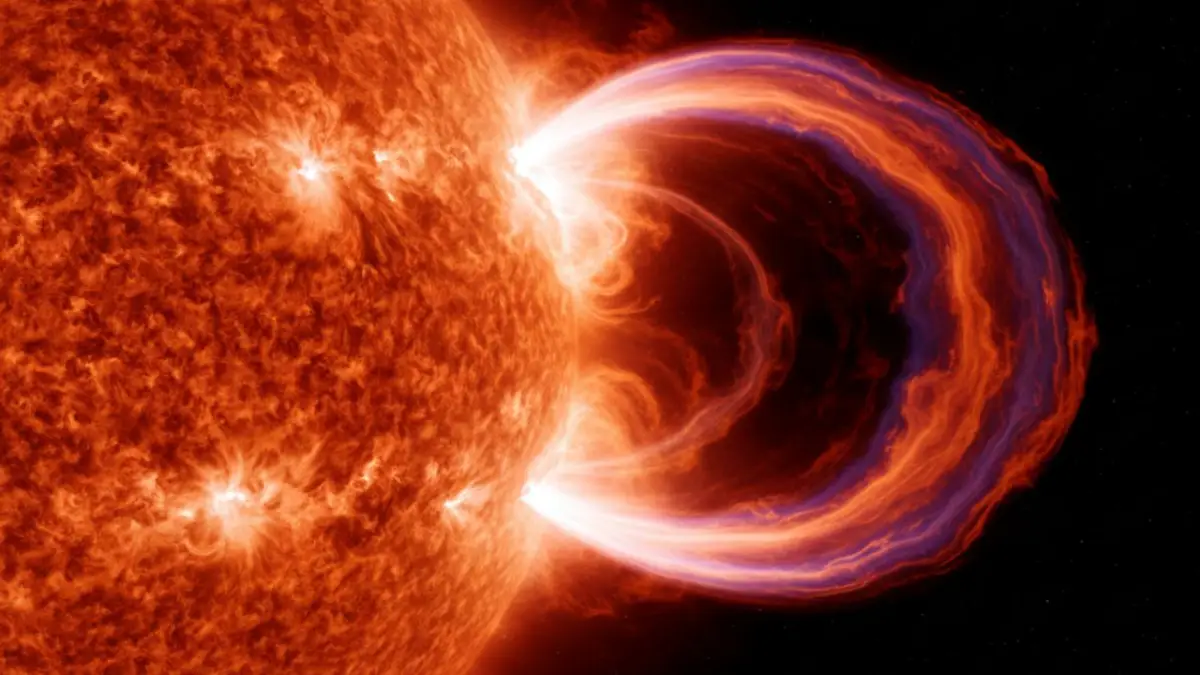
    Indian researchers have figured out why May 2024’s massive solar storm hit Earth harder than any event since 1989, revealing that two solar eruptions merged in space and flipped their magnetic fields in a way that punched through the planet’s defenses and lit up skies from Arizona to Australia.

    The storm struck on May 10 after sunspot region AR3664 fired off a series of powerful flares. Two large clouds of charged gas raced toward Earth at high speed. When they collided in space, their magnetic fields pressed together and reconnected, releasing extra energy that made the combined storm far stronger than either blast alone.

    Data from India’s Aditya-L1 spacecraft, launched in 2023 and parked between Earth and the sun, captured the magnetic flip clearly. The satellite worked with NASA and NOAA missions to track the event across a wide stretch of space. Together they mapped the storm at a scale never seen before.

    The merging process created a zone where magnetic fields broke apart and joined again, a region many times wider than Earth that stayed active for hours. This reconnection tilted the storm’s magnetic field southward for long stretches, making it easier to slip past Earth’s protective shield.

    Sensors recorded the highest alert level when the storm arrived. Earth’s magnetic field compressed sharply. Radio signals went haywire, satellite links failed, and flights faced delays in areas that depend on precise GPS timing. Power operators in Sweden dealt with brief voltage swings.

    The storm also produced bright auroras far beyond the usual polar zones. People in places as far apart as Arizona and Australia saw clear displays. Some watchers compared the event to the famous 1859 Carrington storm, though modern systems prevented the kind of damage that hit telegraph networks back then.

    Scientists say the storm’s unusual strength came from the two eruptions joining forces rather than arriving separately. Early forecasts missed this detail, which is why the actual impact exceeded predictions.

    Aditya-L1 measured sudden jumps in the solar wind and shifts in helium levels, showing details about the layers of the sun that fed the eruption. Detectors on Earth and in orbit recorded increases in fast protons during the peak.

    The findings show why monitoring the space between Earth and the sun matters. When multiple eruptions merge, storms can grow stronger than early warnings suggest. Models need to account for these changes.
    As the sun moves toward another active phase through 2026, teams expect more strong storms. The new data may improve early warnings and give power operators, airlines, and satellite companies more time to brace for impact.

    Source: India’s Aditya-L1 Joins Global Effort in Landmark Solar Storm Study

  • New Study Shows Dark Matter May Change How Neutron Star Mergers Collapse

    New Study Shows Dark Matter May Change How Neutron Star Mergers Collapse

    A new study suggests that fast-spinning neutron star remnants formed after violent mergers may mask or weaken the effects of dark matter hiding inside them. The work, led by Lorenzo Cipriani, looks at why some merged stars delay their collapse and how a small dark core might change their fate during the short but intense stage that follows a collision.

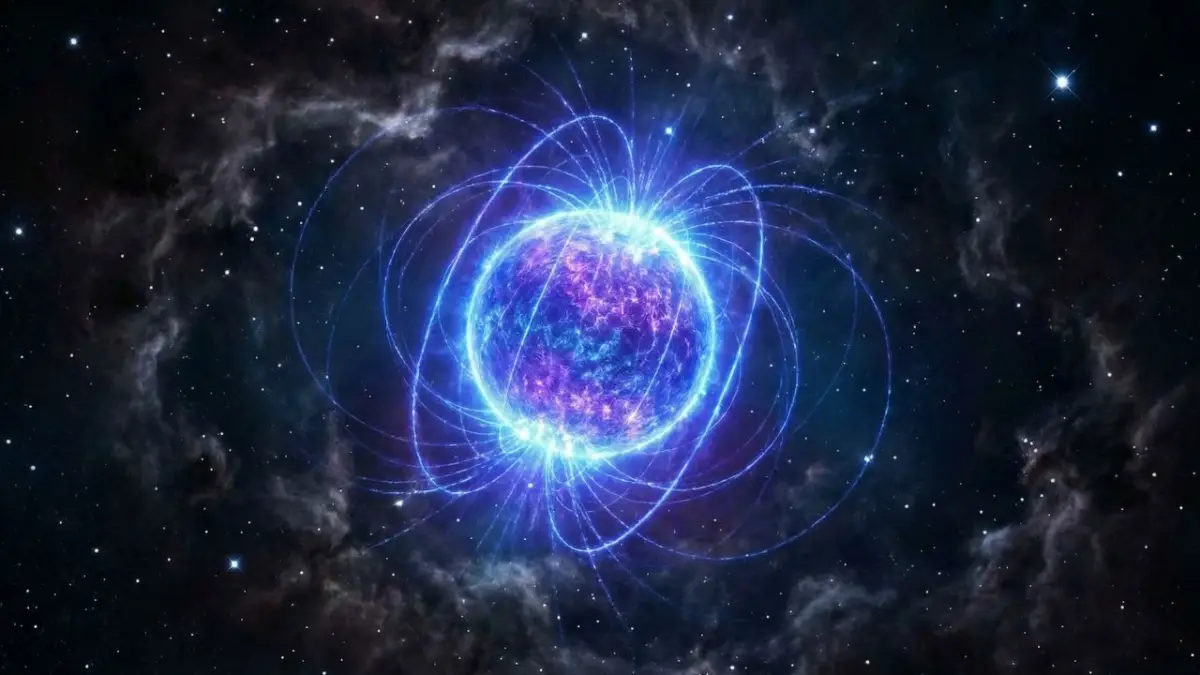
    When two neutron stars crash together, the usual outcome is a black hole. But for a brief moment, the merged object can stay intact as a hypermassive neutron star. This short-lived stage lasts only milliseconds, yet it produces bright flashes across the electromagnetic spectrum and loud bursts of gravitational waves. The remnant survives because its outer layers spin far faster than its center, giving it extra support against gravity.

    Many physics models allow dark matter to gather inside neutron stars over long timescales. If the dark component forms a compact core, it adds extra pull without adding much outward pressure. Earlier studies found that this extra weight makes a non-spinning star easier to collapse. Until now, researchers had not tested how this idea plays out in the rapidly rotating case that actually forms after a merger.

    Cipriani’s team updated the RNS code, a standard tool for modelling spinning stars, so it could track two fluids at once: ordinary matter and a bosonic dark component. They used a realistic equation of state for nuclear matter and rotation patterns that match full merger simulations. The dark core rotated almost uniformly, while the regular matter spun up sharply outside the center and fell off near the edge.

    Their models showed that adding a dark core equal to five percent of the total mass lowers the maximum mass the star can hold by about a third of a solar mass. That matches the softening seen in non-spinning stars. But as the total spin increases, the difference between stars with and without dark matter gets smaller. At extreme rotation rates, the two cases almost meet again, suggesting that rapid spin can partly counter the extra pull from the central core.

    The team found two broad categories of remnants. Some flatten into a toroidal shape and reach higher masses. Others stay closer to round and support less mass. In the rounder models, the spin rate of the regular matter dips slightly a few kilometers from the center before rising again. The dark core reduces the enclosed mass just enough to let this dip form.

    These small changes may matter for future gravitational-wave observatories such as the Einstein Telescope and Cosmic Explorer. These projects will hear the high-frequency ringing of merger remnants in far more detail. Even small adjustments to the frequency or lifetime of the signal could show up when thousands of events are measured.

    Researchers still do not know whether neutron stars actually host dark cores. Most proposed dark matter models face tight limits from astronomy and collider experiments, though a narrow window remains. The new work suggests that rapid and uneven rotation complicates the picture. A dark core that weakens a calm neutron star may leave a smaller trace in the chaotic moments after a merger.

    Future research will test other forms of dark matter and build full three-dimensional merger simulations. For now, the study hints that if we hope to use neutron star mergers to track dark matter, the spin of the remnant cannot be ignored.

    Source: Differentially rotating neutron stars with dark matter cores

  • Euclid Images Show Real Data Can Transform AI Searches for Rare Gravitational Lenses

    Euclid Images Show Real Data Can Transform AI Searches for Rare Gravitational Lenses

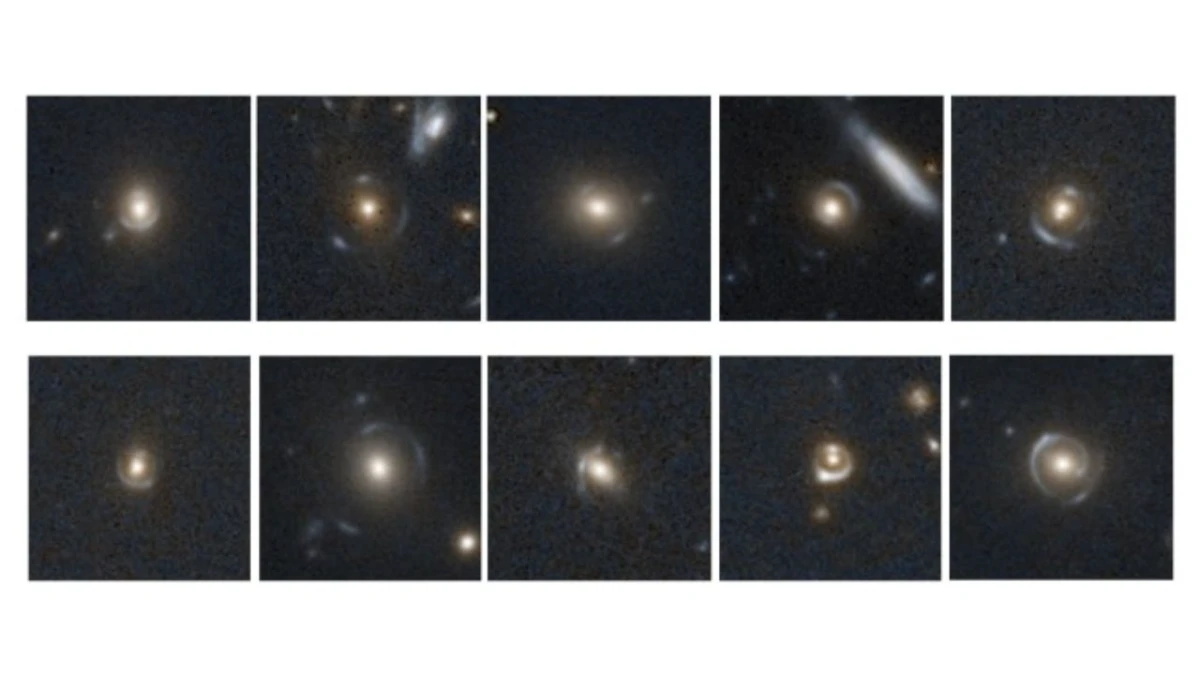
    Euclid’s first public images are giving astronomers a clearer look at why AI systems struggle to find rare gravitational lens events and how a small set of real examples can fix the problem. A team working with the European Space Agency’s new telescope reports that adding only a few hundred real lenses to training sets has sharply improved the performance of machine learning tools that hunt these unusual cosmic scenes.

    Strong lensing happens when a massive galaxy bends the light of a more distant one behind it, forming arcs or repeated images. These cases help track dark matter and measure how fast the universe expands. Euclid is designed to find about 170,000 of them across its full survey, a huge jump from the numbers available today. That scale makes fast and dependable automated searches essential.

    Until now, most AI models learned from simulations because real lenses are so scarce. These simulated images look good to the eye, but they are still idealized. When networks trained on them see actual space data, performance drops. One model that handled simulations with ease fell to half its recovery rate on real Euclid images and produced far more false alarms. It turned out the model had learned shortcuts hidden in synthetic data, not the patterns that matter in the real sky.

    Euclid’s Quick Release 1, which covers just 63 square degrees, provided the first chance to test a better approach. A mix of AI tools, public volunteers, and expert review identified about 500 promising lenses in this small patch. Researchers retrained Zoobot, the top network from the initial search, by mixing these real examples with the usual simulations.

    The change was striking. The model’s F1 score on real data climbed from about 0.37 to 0.65. That level of improvement means far fewer images need human checking to confirm the same number of lenses. Most of the boost came from the real lenses themselves, which taught the system what arcs look like under Euclid’s true noise and imaging quirks. The real non-lenses helped reduce mistakes, especially cases where ordinary galaxy features fooled the model.

    Euclid’s next release will cover a much wider area, bringing thousands more confirmed lenses into the training pool. The Rubin Observatory’s survey, starting soon, faces the same challenge and may benefit from the same method. The early message from Euclid is that simulations help, but real images are the key to making AI searches reliable at the scale modern astronomy demands.

    Source: Euclid Quick Data Release (Q1). From simulations to sky: Advancing machine-learning lens detection with real Euclid data