Category: Astronomy

Look deeper into the science of the stars. This section explores celestial events, cosmic phenomena, and the latest research that helps us understand how the universe came to be and where it’s headed.

  • JWST Spots Perfect Spiral Galaxy That Formed Just 1.5 Billion Years After the Big Bang

    JWST Spots Perfect Spiral Galaxy That Formed Just 1.5 Billion Years After the Big Bang

    Astronomers have found a fully formed spiral galaxy from a time when the universe was only 1.5 billion years old. The galaxy, named Alaknanda, sits behind the massive cluster Abell 2744 and was spotted with help from the James Webb Space Telescope (JWST). Its clear spiral arms, bright center, and wide disk challenge ideas about when large, organized galaxies could first appear.

    Researchers saw the galaxy through the natural magnifying effect of the Abell 2744 cluster. The cluster’s gravity made the distant light brighter and easier to study. Without this help, the spiral structure would have been hard to see. The light from Alaknanda began its journey when the universe was less than 12 percent of its current age. This places the galaxy at a time long before galaxies like the Milky Way were thought to have stable spiral forms.

    Most galaxies from this early period look uneven and broken, with scattered regions of star birth. Many are still forming and lack clear structure. Alaknanda does not match that picture. It shows a smooth disk, a small central bulge, and two clear spiral arms.

    In ultraviolet light, the arms show bright spots where stars are forming. In visible light, those areas blend into clean and continuous arms. These patterns match what astronomers usually see in nearby spiral galaxies today. The disk spans about 10 kiloparsecs, which is about 32,000 light-years across. Around 85 percent of its light comes from this flat disk, not from the center. That means the galaxy is already dominated by an organized structure rather than a growing core.

    Alaknanda contains roughly 16 billion times the mass of the Sun in stars. That is around 15 percent of the current mass of the Milky Way. It is forming stars at a rate of about 63 suns per year, far faster than our galaxy does today.

    Scientists estimate that most of its stars formed in the 200 million years before the light we now see was released. This shows that the galaxy built up its mass very quickly, yet still kept a clear and stable shape. A smaller nearby galaxy sits close to the edge of Alaknanda’s disk. Measurements show it lies at nearly the same distance. Researchers think it may be a satellite galaxy that is starting to interact with the larger one.

    This nearby object could have affected the shape of the spiral arms. Gravitational pull between galaxies can change their structure and trigger star formation. It may have helped give Alaknanda its clean, detailed pattern.

    For years, models suggested that spiral shapes take a long time to develop. They were thought to need calm conditions or special events that the early universe did not often provide. Alaknanda shows that this may not always be true.

    Recent surveys using the JWST have found more disk-shaped galaxies at great distances. These new discoveries suggest that organized galaxies appeared much earlier than expected, not just in rare cases.

    Astronomers now want to measure how the stars and gas within Alaknanda are moving. If the disk is rotating in a smooth way, it would support the idea that it is truly stable and settled. Future studies using Webb and radio telescopes on Earth will map how material moves across the spiral arms. These results will help explain whether the structure is long-lasting or still changing.

    Alaknanda offers a clear view of a young universe that was already capable of forming ordered, mature galaxies. It is now a key target for learning how the first large galaxies grew so fast and took on such clean shapes.

    Source: A grand-design spiral galaxy 1.5 billion years after the Big Bang with JWST

  • JWST may have captured the earliest known star cluster, offering strongest evidence yet for first-generation stars

    JWST may have captured the earliest known star cluster, offering strongest evidence yet for first-generation stars

    Using the James Webb Space Telescope (JWST), astronomers have identified a tiny, distant object that may be the strongest evidence yet for the universe’s first stars. The source, called LAP1-B, lies behind the massive galaxy cluster MACS J0416, which magnifies its light by about a factor of one hundred. JWST captured a detailed spectrum of the object this year, revealing almost no elements heavier than helium. That absence of heavier elements is a key sign of the very first generation of stars, known as Population III.

    These stars formed when the universe contained only hydrogen and helium. With no heavier elements to help gas clouds cool, early stars grew extremely large, sometimes hundreds of times more massive than the sun. They lived for only a few million years before exploding and spreading the first carbon, oxygen, and iron.

    None survive today, and any that did would be far too faint or distant for ground telescopes to detect. Their light also shifts deep into the infrared as it travels across the universe, which makes instruments above Earth’s atmosphere essential.

    LAP1-B sits at redshift 6.6, so we see it as it was about nine hundred million years after the Big Bang. The galaxy cluster in front of it bends and boosts its light, making it bright enough for JWST to study. Without that natural lens, the object would be far too dim to detect. JWST’s observations revealed strong helium emission lines but almost no sign of heavier elements. That pattern matches what scientists expect if LAP1-B is dominated by hot, massive stars formed from untouched primordial gas.

    A team led by Eli Visbal tested the data against the expected conditions for a Population III system. Their model suggests that LAP1-B formed inside a small dark matter halo with the right temperature for early star formation. The stars seem to follow a pattern in which many are very massive, and the entire cluster contains only a few thousand solar masses of material. Earlier candidates were rejected because they showed too many heavy elements or were far larger than theory allows.

    The result is promising but not confirmed. The exact amount of magnification from the lensing cluster can shift, and those changes affect estimates of LAP1-B’s size and mass. Future JWST observations may help measure the metal content more accurately or detect signs of supernovae from massive early stars. JWST cannot isolate individual stars in the cluster; it can only record the combined light.

    These first stars played an important role in shaping the young universe. Their explosions seeded space with the elements needed to form later stars, planets, and eventually life. They also contributed to reionization, the period when the earliest bright objects cleared the fog of neutral hydrogen and allowed light to travel more freely. Understanding when and how they formed helps explain how the first galaxies grew.

    JWST is continuing to scan lensing clusters for faint, distant objects, and many of its targeted fields are ideal for this search. The upcoming Nancy Grace Roman Space Telescope will survey much larger areas and could uncover more candidates. If LAP1-B is confirmed, it could be the first solid glimpse of the universe’s earliest stellar generation and likely not the last.

    Source: LAP1-B is the First Observed System Consistent with Theoretical Predictions for Population III Stars

  • Saturn’s Rings have vanished from view, and the next opportunity won’t come for over a Decade!

    Saturn’s Rings have vanished from view, and the next opportunity won’t come for over a Decade!

    Saturn’s rings briefly disappeared from Earth’s view when the planet reached a rare edge-on alignment with our line of sight. NASA confirmed the event with new Hubble Space Telescope images released a few days earlier, showing the rings reduced to a narrow line. The alignment happens because of how Earth and Saturn move around the Sun. The rings will begin to tilt back into view in early 2026.

    NASA’s image from November 23 shows Saturn as a pale yellow globe with a thin streak across its middle. Even Hubble struggles to detect the rings when they are viewed edge-on, as their thickness is tiny compared to their overall width. Hubble documented a similar alignment in 1995.

    The rings look like they vanish because they are extremely thin. Although they stretch about 282,000 kilometers across, most of the material is packed into a layer only a few dozen meters thick. Saturn is tilted by about 27 degrees relative to Earth’s orbital plane, which causes the rings to swing in and out of view every 13 to 15 years.

    This change in appearance confused early astronomers. Galileo first saw what he described as “handles” on Saturn in 1610. Two years later, he found that the features had disappeared. The actual structure of the rings was not understood until Christian Huygens studied Saturn in the mid-1600s.

    The 2025 alignment happened twice. The first crossing occurred on March 23, but Saturn was too close to the Sun to observe. The second crossing in November offered a clearer view as the planet moved higher in the evening sky. Small telescopes now show Saturn as a round disk with only a faint line marking the ring plane. Saturn’s largest moon, Titan, remains easy to spot.

    The rings will begin opening again in the first months of 2026. They will continue to widen throughout the year and reach their next full tilt toward Earth in 2032. When fully open, the rings show well-known gaps created by the gravitational pull of Saturn’s moons.

    These periodic alignments also help scientists study how the ring system changes over time. Data from NASA’s Cassini mission indicate that particles from the rings slowly fall into Saturn. If that process continues at the same rate, the rings could disappear entirely within 100 to 300 million years.

    People hoping to see Saturn during the alignment can look toward Aquarius after sunset. Binoculars will show a bright point, and small telescopes will reveal the thin appearance of the rings. Those who cannot observe directly can use NASA’s Eyes on the Solar System tool to simulate the event from home.

    The temporary disappearance of the rings is a normal part of Saturn’s orbit, but it remains an uncommon event for observers. The next chance to see the rings edge-on will not arrive again for more than a decade!

  • Astronomers may have finally detected Dark Matter; Milky Way Halo Shows Unusual 20 GeV Gamma-Ray Signal

    Astronomers may have finally detected Dark Matter; Milky Way Halo Shows Unusual 20 GeV Gamma-Ray Signal

    A Japanese astrophysicist has reported a faint but unusually sharp gamma-ray glow around the Milky Way, based on 15 years of data from NASA’s Fermi telescope. The signal peaks near 20 GeV, forms a round halo, and closely matches what researchers expect from dark matter. The result has renewed interest in one of physics’ biggest open questions.

    Tomonori Totani studied a wide region around the galaxy while masking the bright central plane. He modeled all known gamma-ray sources and removed them from the data. What remained was a smooth, spherical excess centered on the Milky Way that did not match any familiar process.

    The shape and energy peak stand out because most gamma-ray sources follow broad trends. This signal rises from a few GeV, peaks sharply at 20 GeV, and fades above 100 GeV. That pattern resembles the expected signature from dark matter particles that collide and produce ordinary particles. A 20 GeV peak would point to particles weighing about 500 to 800 GeV.

    Totani reported a significance above 15 sigma and tested many ways to remove the signal, including changes to cosmic-ray models, the Fermi bubble outlines, and masking choices. The excess stayed in every test.

    Alternative explanations exist but do not fit as well. Millisecond pulsars can explain a known excess near the galactic center, but they would not produce a large spherical halo. Cosmic-ray activity could mimic some energy features but would usually show signs of the disk. The inverse-Compton process comes closest but does not match the symmetry.

    If the excess is from dark matter, the numbers suggest particles around 600 GeV with an interaction rate higher than simple models predict. This pushes against limits from dwarf galaxies but is not ruled out.

    The signal also differs from the lower-energy excess at the galactic center, which many researchers now link to faint pulsars. The two features likely have separate origins.

    More data will be needed to confirm or reject the dark matter idea. Ground-based gamma-ray telescopes and neutrino observatories can check for related signals. Fermi will also continue collecting data that may clarify whether the halo glow marks the long-awaited trace of dark matter.

    Source: 20 GeV halo-like excess of the Galactic diffuse emission and implications for dark matter annihilation

  • JWST spots four dust spirals and a hidden third star in the strange Apep system

    JWST spots four dust spirals and a hidden third star in the strange Apep system

    NASA’s James Webb Space Telescope (JWST) has revealed that the Apep star system, located in our galaxy, is made up of three massive stars forming four repeating dust spirals over a 190-year cycle, a pattern created by violent stellar winds and a sneaky third star that cuts a path through the dust each time it swings past.

    Webb’s Mid-Infrared Instrument captured the clearest image ever taken of Apep. For the first time, scientists could see four thin, evenly spaced spiral shells wrapped around the center of the system. Each shell marks a period when two large, aging stars moved close enough for their winds to crash into each other and create thick clouds of carbon dust.

    Those two stars are known as Wolf-Rayet stars. They are hot, heavy, and in the final stage of their lives. They orbit each other once every 190 years. During about 25 of those years, their winds collide hard enough to produce large amounts of dust. That dust expands and forms a new spiral. Webb’s image shows shells formed from events going back around 700 years.

    In the center of the image is a bright point that earlier telescopes could not clearly explain. Webb confirmed that this point is actually three stars, not two. The third one is a large supergiant that circles the pair from far away. When it passes by, its wind cuts a clear V-shaped gap through the dust being released by the other two stars.

    That same gap appears in every shell. This shows the third star has been taking the same path for centuries. This detail helped scientists confirm that the supergiant is truly part of the system and not just passing through space by chance.

    Apep’s dust is made mostly of carbon. These tiny grains stay warm and glow in mid-infrared light. That is why Webb, which is built to see this type of light, could detect the faint outer shells that ground-based telescopes missed.

    Apep stands out because of its long cycle. Most similar systems create dust every few years or few decades. Apep’s 190-year period is the longest of its kind known in our galaxy, which gives scientists a rare chance to study how powerful winds behave over long periods of time.

    Over the next few hundred thousand years, both Wolf-Rayet stars are expected to explode as supernovae. Because of how fast they spin and how they lose material, one of those explosions could send out a narrow, powerful burst of energy through space.

    Source: The Serpent Eating Its Own Tail: Dust Destruction in the Apep Colliding Wind Nebula

  • Machine learning flags rare quasar lenses, doubling top candidates in a new DESI study

    Machine learning flags rare quasar lenses, doubling top candidates in a new DESI study

    A research team using data from the Dark Energy Spectroscopic Instrument in Arizona has identified seven new quasar systems that appear to act as gravitational lenses. They reported the results this year after training a neural network to scan more than eight hundred thousand quasar spectra.

    The work matters because these rare alignments let astronomers measure the masses of quasar host galaxies, which are normally hidden behind the quasar’s strong light. The group built its model by mixing real quasar data with simulated background galaxies, and the method found far more strong candidates than earlier surveys.

    Quasars shine when supermassive black holes consume nearby gas and dust. Their light usually hides the galaxies that surround them. In rare cases, a quasar sits in the near-perfect position to bend the light of a more distant galaxy behind it. The closer galaxy’s gravity pulls the background light into our line of sight. This forms what astronomers call a lens, but the bright quasar often hides the pattern in normal images.

    These systems are rare because the alignment must be very close to perfect. Large surveys such as the Sloan Digital Sky Survey contain hundreds of thousands of quasars, yet only a small number show clear signs of lensing. Before this study, researchers had confirmed only three systems where the quasar host served as the lens. Several more were possible but needed stronger evidence.

    The DESI project collects millions of spectra with a wide-field telescope at Kitt Peak in Arizona. Its early data release included spectra from more than eight hundred thousand quasars. Instead of relying on imaging, the team focused on the spectra. To train the network, they created mock lenses by adding distant galaxy signals to real quasar spectra. This approach gave the model enough examples to learn what a lensed system should look like.

    The network searched for extra emission lines at higher redshifts than the quasar’s own features. These lines come from the background galaxy. Ground-based telescopes blend light from close objects into one spectrum, so the background signal can ride along with the quasar’s light. The model looked for these faint features that would normally be lost in the noise.

    The system returned seven strong candidates on the first pass. All showed an oxygen line from a more distant galaxy. Four candidates included extra lines from hydrogen and additional oxygen signals. The process also found the one known system in DESI’s footprint, confirming that the method works. This result more than doubled the number of high-quality candidates in the survey area.

    These quasars sit at redshifts up to about 1.8, meaning their light began its journey billions of years ago. Some of the background galaxies lie even farther away. In a few cases, the farther sources may sit at redshift 3 or beyond, which places their light in the early universe.

    The interest in these lenses goes beyond the alignment. When a quasar host galaxy bends the light of a background galaxy, astronomers can measure the Einstein radius, which relates directly to mass. It gives a clear reading of the host galaxy’s mass, including dark matter, even when the quasar normally blocks the view.

    Measuring these masses helps test how galaxies and their central black holes grew together. In the nearby universe, the size of a galaxy and the mass of its black hole follow a close trend. At higher redshifts, quasars are so bright that standard methods cannot separate their host galaxies. Lensing offers a way around that problem.

    The new candidates also help scientists study feeding habits of black holes in the early universe. When a quasar lenses an even more distant galaxy, it gives a view of objects that formed when the universe was only a few billion years old. These systems show how matter moved between galaxies at that time.

    DESI will expand its survey in future releases. With more spectra and improved training sets, researchers expect many more detections. Space telescopes such as Hubble and the James Webb Space Telescope (JWST) can then take sharp images of the best systems. Those images can confirm the lensing pattern and map the mass in the quasar host galaxy.

    The latest study shows how machine learning can raise the discovery rate from rare finds to a steady flow. Seven new strong candidates from one search mark a clear shift in how quickly these systems can be found. As the dataset grows, the list of quasar lenses is expected to grow with it.

    Source: Quasars acting as Strong Lenses Found in DESI DR1

  • New study finds the Pleiades star cluster is part of a vast family spread across space

    New study finds the Pleiades star cluster is part of a vast family spread across space

    Astronomers

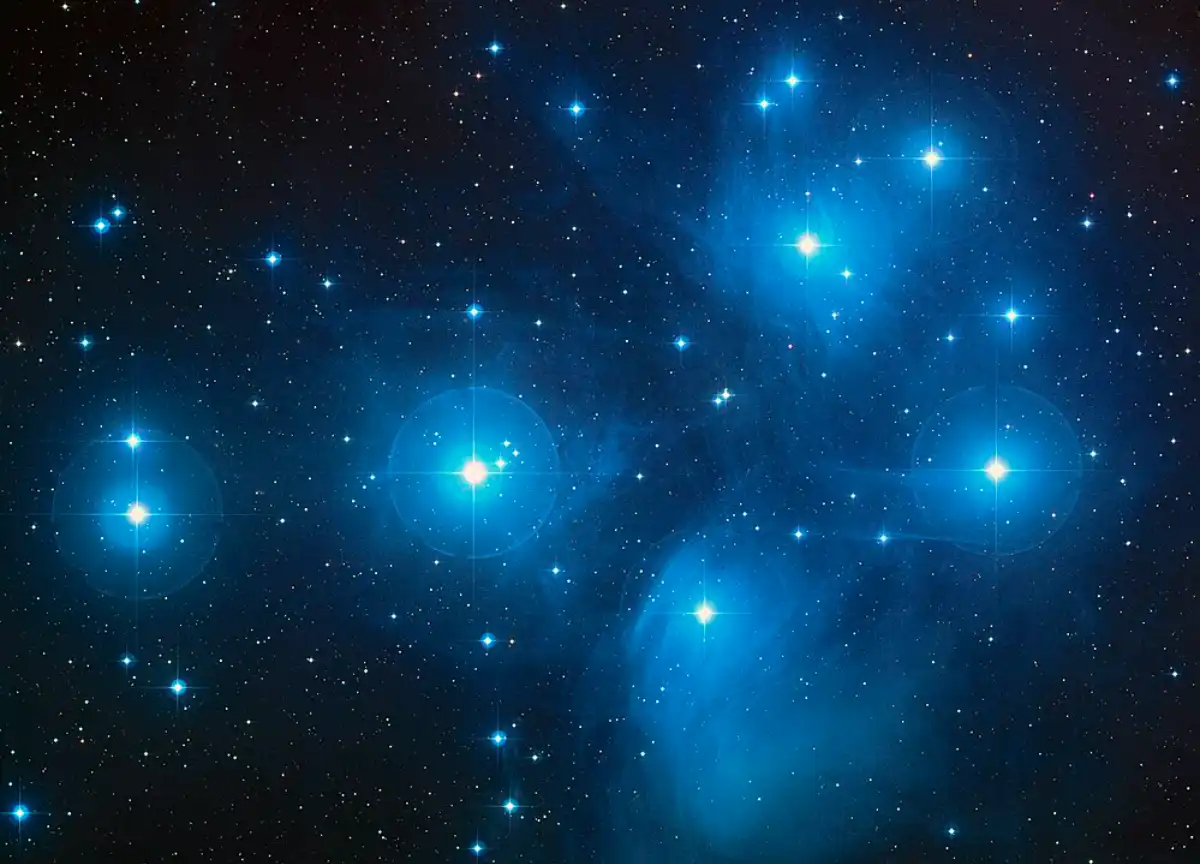
    have reported that the Pleiades, the bright star cluster seen in the constellation Taurus, is only the compact core of a far larger family of stars that formed together about 125 million years ago. By using data from NASA’s TESS satellite and the European Space Agency’s Gaia spacecraft, researchers identified more than 3,000 related stars spread across nearly 2,000 light-years of space.

    The Pleiades, often called the Seven Sisters, has been known for thousands of years. On a clear night, most people can see six or seven bright stars close together in the sky. Astronomers had already studied this central cluster in detail, which lies about 440 light-years from Earth. Until now, the focus remained on only this compact region.

    The full extent of the Greater Pleiades Complex.
    This image shows how the Greater Pleiades Complex would appear if all of its member stars were visible to the naked eye. The seven brightest Pleiades stars are highlighted in green, the wider star family appears in white, and the outlines of the Big Dipper, Orion, and Taurus are marked in blue. Image credit: Andrew W. Boyle et al 2025 ApJ 994 24.

    The new research shows that this visible group is just the middle of what scientists now call the Greater Pleiades Complex. Many related stars sit far from the bright core and do not form a tight cluster anymore. Some are hundreds of light-years away, while others lie more than a thousand light-years from the center.

    To find these hidden members, scientists tracked how fast stars rotate. Young stars spin faster than older ones, and their spin causes small changes in brightness as dark spots move across their surfaces. TESS measures these tiny shifts in light. Gaia then provides exact positions, distances, and movements through space. By combining these two sets of information, the team found stars that move like the Pleiades and spin at the same youthful rate.

    This method revealed long streams of stars that appear to have drifted from the original cluster over time. One stream, called UPK 303, can be traced back toward the Pleiades’ location at the time of its birth. Other groups, such as UPK 545, likely formed in the same large gas cloud but ended up far apart as the cluster slowly broke up.

    Most stars form in groups, but gravity and the pull of the Milky Way usually tear these clusters apart within a few hundred million years. The Greater Pleiades Complex shows that even after a cluster spreads out, its members can still be identified by their shared motion and age. This changes how astronomers view the nearby region of space and suggests there may be many more hidden star families around us.

    The Pleiades has long been used to study how young stars and planets develop. Adding thousands of stars of the same age gives scientists a much larger sample to compare. This can help improve models of how planets form and how stellar systems change over time.

    The study focused on stars between about 50 and 200 million years old, when rotation is still easy to measure. Researchers now plan to use the same approach on other famous groups, including the Hyades and the Scorpius–Centaurus region. The current list includes about 3,100 strong candidates, but future data releases from Gaia and more observations from TESS may reveal many more.

    The Sun is not part of this family, but it likely formed in a similar cluster long ago. Studies like this may one day help locate stars that were born alongside our own.

    When you look up at the Pleiades on a clear winter night, you are only seeing the bright center. Around it, spread wide across the galaxy, lies a much larger family that began in the same cloud of gas and dust millions of years ago.

    Source: Lost Sisters Found: TESS and Gaia Reveal a Dissolving Pleiades Complex

  • NASA releases new images of interstellar comet 3I/ATLAS

    NASA releases new images of interstellar comet 3I/ATLAS

    NASA has released a new set of images showing the interstellar comet 3I/ATLAS as it crossed the inner solar system in October 2025. Spacecraft orbiting the Sun, traveling through deep space, and working around Mars all turned their cameras toward the object after its close pass. The goal was to capture its shape, motion, and makeup before it fades from view and leaves the solar system for good.

    The images were published on November 19, weeks after the comet passed near Mars in early October. NASA confirmed that missions including MAVEN, Psyche, Lucy, and SOHO collected data from different positions in space. Together, they created a rare, multi-angle record of an object that formed around another star.

    In most of the images, the comet appears as a faint, blurred ball surrounded by a cloud of gas and dust. A short tail can also be seen in some views. Despite coming from another star system, it behaves much like comets that formed in our own.

    Interstellar comet 3I/ATLAS captured by MAVEN spacecraft
    Interstellar comet 3I/ATLAS captured by MAVEN spacecraft. Image credit: NASA

    MAVEN, which orbits Mars, used its ultraviolet camera to detect a wide cloud of hydrogen around the comet. This cloud formed as sunlight broke down gases released from the surface. The solar wind then pushed this material away, stretching it through space.

    Interstellar comet 3I/ATLAS captured by the Psyche spacecraft.
    Interstellar comet 3I/ATLAS captured by Psyche spacecraft. Image credit: NASA

    The Psyche spacecraft observed the comet for nearly eight hours as it passed about 33 million miles away. These long observations helped scientists calculate its exact path and speed with better accuracy.

    Interstellar comet 3I/ATLAS captured by LUCY spacecraft
    Interstellar comet 3I/ATLAS captured by LUCY spacecraft. Image credit: NASA

    Farther out, the Lucy spacecraft captured faint images from roughly 240 million miles away. Scientists combined several of these pictures to reveal the dusty cloud and a short tail against the background of stars.

    Interstellar comet 3I/ATLAS captured by the Perseverance rover.
    Interstellar comet 3I/ATLAS captured by the Perseverance rover. Image credit: NASA

    Even on the Martian surface, the Perseverance rover managed to spot a weak trace of the comet in the sky. From Earth’s orbit, the Hubble Space Telescope collected clearer data on the gases surrounding the object. Ground-based telescopes added more detail about its size and activity.

    Chemical readings show large amounts of carbon monoxide and cyanide in the gas cloud around 3I/ATLAS. These substances are also common in comets within our own solar system. This suggests similar conditions may exist in many star systems when comets form.

    The comet is only the third confirmed visitor from outside our solar system, following ‘Oumuamua in 2017 and Borisov in 2019. It is moving at nearly 150,000 miles per hour on a path that will send it back into deep space, never to return.

    The ATLAS survey first discovered the object on July 1, 2025. It made its closest pass to the Sun on October 30 at a distance of about 1.4 times the gap between Earth and the Sun, close to the orbit of Mars. Scientists estimate the solid center of the comet may be between one and five kilometers wide. It appears to be covered in reddish dust, similar to objects found on the edge of our own solar system.

    Large telescopes will continue tracking 3I/ATLAS into early 2026 as it fades. The James Webb Space Telescope has already observed it, and more data is being processed. Each set of images adds to a small but growing record of objects that travel between stars. For now, 3I/ATLAS is offering one of the clearest chances yet to study material formed around another sun.

  • ISRO captures Interstellar Comet 3I/ATLAS from Mount Abu as it exits the Solar System

    ISRO captures Interstellar Comet 3I/ATLAS from Mount Abu as it exits the Solar System

    Indian astronomers have recorded one of the rarest visitors ever seen in the sky. Scientists at the Physical Research Laboratory used the 1.2‑meter telescope at Mount Abu in Rajasthan to image and study the interstellar comet 3I/ATLAS for four nights starting on November 12, 2025.

    The object, which came from outside our solar system, had already passed its closest point to the Sun in late October and is now travelling outward on a one-way path into deep space.

    This makes 3I/ATLAS only the third confirmed interstellar object ever observed in our solar system. The first was ‘Oumuamua in 2017, followed by Comet Borisov in 2019. Unlike most comets, which come from the outer regions of our own system, this object formed around a different star before drifting into our neighborhood.

    The Mount Abu team captured images showing a faint but visible glow around the comet’s core. This glow forms when ice on the surface turns into gas and dust as it is warmed by sunlight. Even though the comet was already moving away from the Sun, it remained active enough to produce a clear cloud around its center.

    Researchers also split the comet’s light into its basic components to study what it is made of. Their data shows a higher level of carbon dioxide compared to water, which is unusual when compared to many comets from our own system. At the same time, it also contains familiar gases such as cyanide and other carbon-based compounds commonly detected in local comets.

    The comet was first discovered on July 1, 2025, by the ATLAS survey in Chile. Further tracking confirmed that it was moving far too fast to be held by the Sun’s gravity. Its stretched, open path shows that it did not originate here and will not return once it leaves.

    At the time of its closest pass, the comet was about 1.5 times farther from the Sun than Earth. While that distance kept it out of public view, it was still close enough for large telescopes to study its behavior and composition. This is why observations from high-altitude sites like Mount Abu were so important.

    Other observatories around the world, as well as instruments near Mars, also tracked 3I/ATLAS. By combining this data, scientists can compare an interstellar object to comets and asteroids formed around our own Sun. This helps them test how common certain materials may be in other star systems.

    Over the coming months, the comet will grow dimmer as it moves farther away from the Sun. By early 2026, it is expected to fade beyond the reach of most telescopes. After that, it will continue its long journey through interstellar space.

    For researchers, even a brief visit like this is important. Each interstellar object carries material from another part of the galaxy. Studying it, even for a short time, adds one more piece to the wider story of how planets and small bodies form around stars across the universe.

  • Moon reaches its farthest distance in 18 years! Rare Apogee aligns with November New Moon

    Moon reaches its farthest distance in 18 years! Rare Apogee aligns with November New Moon

    The Moon will reach its greatest distance from Earth in 18 years on November 20, hours before the new moon. Astronomers say the timing of this apogee, which places the Moon about 406,690 kilometers from Earth, creates an unusual mix of weak tides, a smaller lunar appearance, and sky positions that match an 18.6-year cycle of extreme rises and sets.

    The event happens early on November 20 around 02:46 UTC, when the Moon moves to the farthest point in its orbit. At this range, radio signals take noticeably longer to travel to the Moon and back compared with regular days. The distance is the highest since 2007 and will not occur again until late 2043.

    The Moon travels around Earth in an oval path, so its distance changes from month to month. It comes closest at perigee and farthest at apogee. These distances shift slightly each orbit because the Sun’s gravity pulls on the Moon and slowly changes the shape and direction of its path. When this gradual wobble lines up with Earth’s own position around the Sun, the most distant apogees appear.

    This month’s alignment pushes the Moon to one of its most distant points in nearly two decades. Astronomers have been expecting this peak for months because the orbit cycle is well measured and repeats on a predictable schedule.

    The apogee arrives during the new moon phase, when the moon sits between Earth and the sun. The side facing us is unlit, so the moon is not visible. New moons usually bring strong tides, but the distance this month weakens them. In many coastal regions, high tides drop by about 10 to 15 centimeters. Low tides can reveal patches of mud and rock that usually stay underwater.

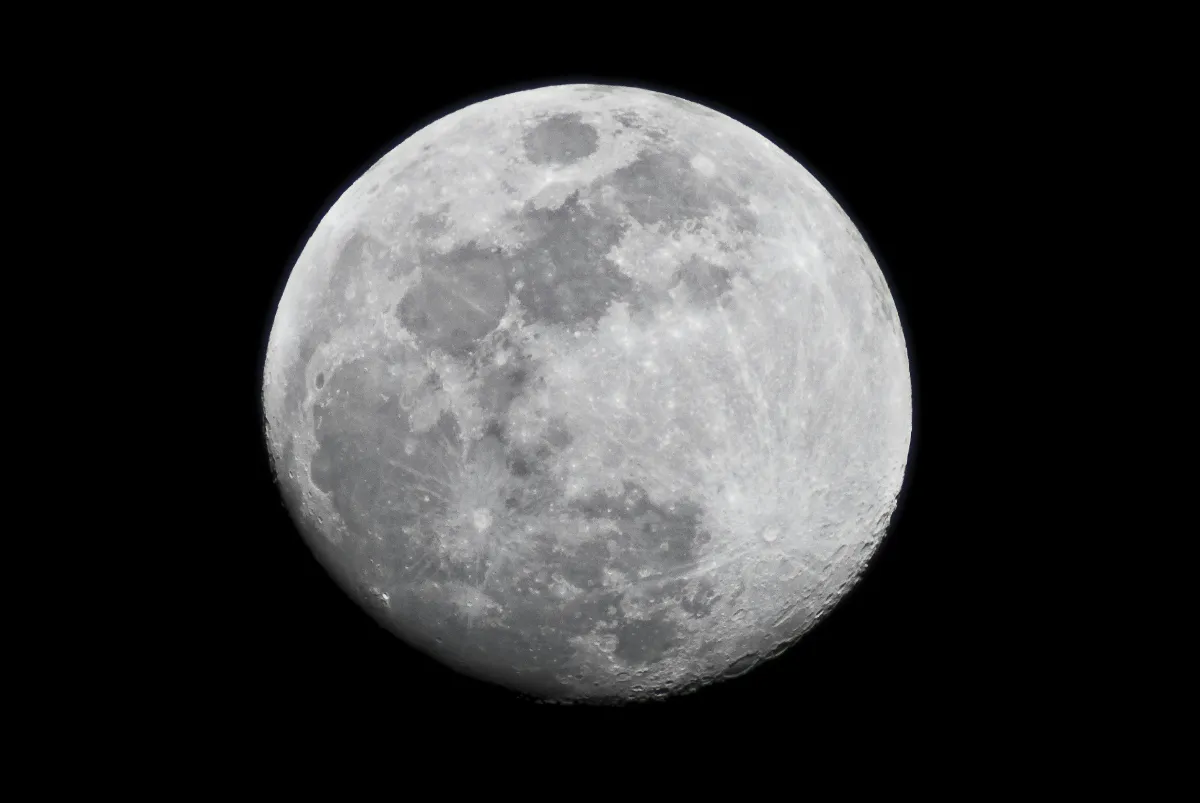
    Although no one can see the Moon that day, its size change is noticeable over the month. At this distance, the Moon looks about 14 percent smaller than it does at a close perigee. The area it covers in the sky drops by almost a quarter. Anyone who compares recent photographs of the moon from earlier this month with those taken in December will see the difference.

    This distant apogee also connects to the lunar standstill, a cycle that peaks every 18.6 years. During these periods, the Moon rises and sets at its most extreme points in the sky. For many locations in the Northern Hemisphere, moonrises and moonsets drift far to the south right now. Historic sites such as Stonehenge and Callanish were designed to track these extremes, and observers still study them during standstill years.

    Most people will not notice anything unusual on November 20 itself because the Moon remains lost in daylight. The best viewing comes in the days after the new moon, when a thin crescent rises very high or low at dawn or dusk. Through binoculars, the Moon appears smaller and sharper than usual, marking this rare point in its long orbital cycle.