Category: Astronomy

Look deeper into the science of the stars. This section explores celestial events, cosmic phenomena, and the latest research that helps us understand how the universe came to be and where it’s headed.

  • Astronomers Spot a Skyscraper-sized Asteroid 2025 SC79 Racing Around the Sun

    Astronomers Spot a Skyscraper-sized Asteroid 2025 SC79 Racing Around the Sun

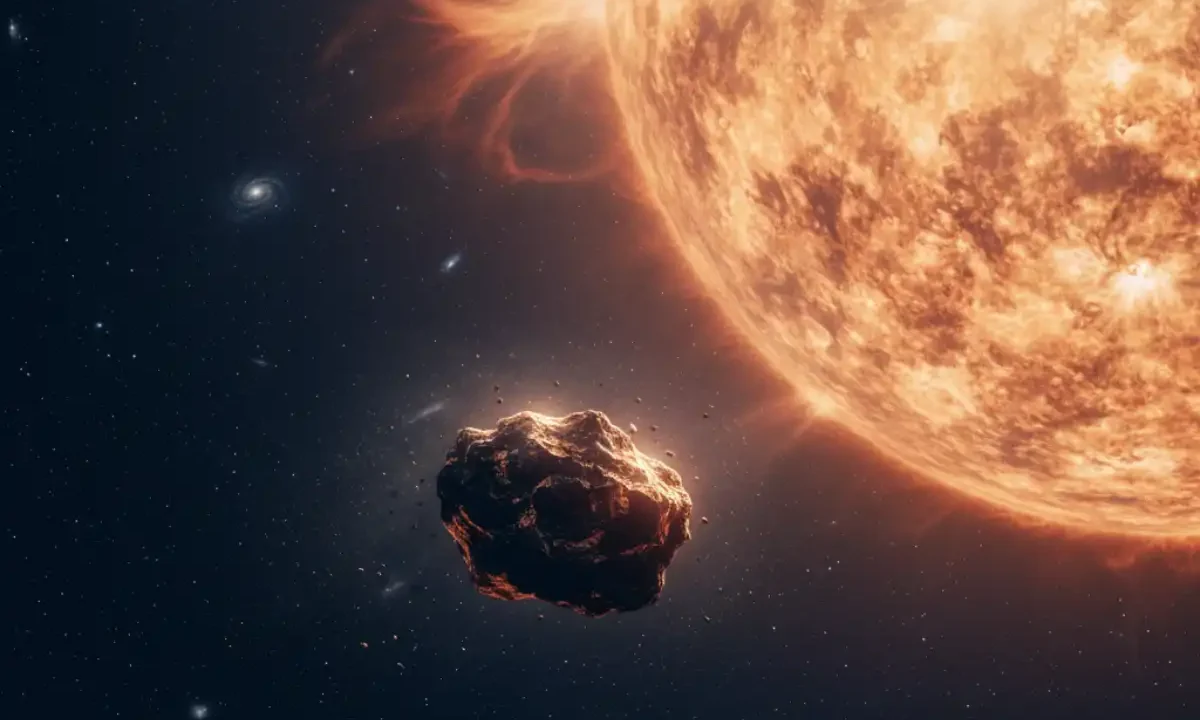
    Astronomers have discovered a rare, fast-moving asteroid orbiting deep within the inner solar system. The object, named 2025 SC79, was detected in October 2025 by the ATLAS sky survey, with observations led by Scott S. Sheppard of Carnegie Science. The asteroid, roughly 700 meters wide, completes one trip around the sun every 128 days, making it the second-fastest asteroid ever recorded, behind only 2021 PH27.

    The find is remarkable because asteroids this close to the sun are hard to detect. For years, 2025 SC79 remained hidden in the glare of sunlight, its faint reflection drowned out by the star it orbits. Researchers were able to spot it only thanks to ATLAS’s sensitive telescopes in Chile, which scan the sky for objects that could pose a threat to Earth.

    Most asteroid-hunting telescopes avoid pointing near the sun because of its brightness. However, ATLAS and similar systems are built to peer into what scientists call the “twilight zone,” a region of space where few objects are visible from Earth.

    2025 SC79 belongs to a rare group called Atira asteroids, objects that never travel beyond Earth’s orbit. Their entire paths lie closer to the sun, under 1 astronomical unit. Because of their proximity, these asteroids are among the hardest to find and study.

    While Venus takes 225 days to complete a solar orbit, 2025 SC79 finishes in nearly half that time. Its path lies mostly within Venus’s orbit, looping tightly around the sun. At its closest point, it moves at about 60 kilometers per second. That speed, driven by the sun’s strong gravity, makes it one of the fastest natural objects in our solar system.

    The only known asteroid with a shorter orbit is 2021 PH27, which circles the sun in just 113 days. Both are part of an extremely small group of inner asteroids that help scientists understand how rocky material behaves so close to the sun.

    Asteroids like 2025 SC79 may have formed closer to the sun than most, or they might have been knocked inward after collisions in the asteroid belt. Studying their orbits helps scientists trace how gravity and planetary interactions shape the solar system over billions of years.

    Despite their tight orbits, these asteroids pose no threat to Earth. Their paths remain well inside our planet’s orbit, where they stay locked in the sun’s gravitational grip. However, tracking them improves models that predict the movement of other near-Earth objects.

    The discovery also highlights progress in detecting asteroids near the sun. Upcoming missions such as NASA’s NEO Surveyor, set to launch later this decade, will scan deeper into this region using infrared sensors that can detect heat instead of reflected light.

    Scientists expect to uncover dozens more Atira asteroids in the next few years. Each new find fills in part of the picture of how planets and smaller bodies formed in the solar system’s earliest days.
  • New Study Suggests Alien Signals May Vanish Within Centuries Due to Rapid Tech Shifts

    New Study Suggests Alien Signals May Vanish Within Centuries Due to Rapid Tech Shifts

    A new analysis from astronomer Michael Garrett at the University of Manchester suggests intelligent civilizations across the galaxy may only emit detectable signals for a short period between 100 and 1,000 years before becoming effectively invisible.

    The finding could help explain why decades of SETI (Search for Extraterrestrial Intelligence) surveys have yet to detect alien broadcasts, despite the vast number of potentially habitable planets in the Milky Way.

    Garrett’s research focuses on how fast technology evolves once a species gains the ability to communicate wirelessly. His models show that once a civilization masters radio or laser communication, it quickly moves toward more efficient, secure, and low-energy systems. That means their detectable “loud” phase when they leak or beam out radio signals may be brief compared to the billions of years that stars and planets exist.

    “We may be missing them by timing alone,” Garrett said in a University of Manchester release. “Civilizations likely go silent quickly, not because they vanish, but because they stop using technologies we can detect.”

    The idea offers a fresh take on the Fermi Paradox, the question first posed by physicist Enrico Fermi in 1950: if life is common, why haven’t we found it? Garrett’s calculations imply that many civilizations could exist, but only a tiny fraction would overlap with our brief listening window.

    On Earth, radio broadcasts began just over a century ago, with satellite and digital networks reducing our own signal leakage since the 1990s. In another few centuries, Garrett predicts, our outward radio footprint could disappear completely as fiber optics and quantum networks replace open transmissions. From another planet’s point of view, humanity might already be fading from the galactic map.

    The study also considers the problem of energy growth. Rapid advances in computing and communication efficiency mirror trends similar to Moore’s Law. As societies expand technologically, they risk overheating their worlds if energy use grows unchecked.

    A 2024 paper from the University of Rochester estimated that continued exponential energy use could raise planetary temperatures to uninhabitable levels within a thousand years. To survive, civilizations must shift toward compact, low-emission technologies, which would also make them harder to detect.

    Garrett argues that SETI strategies should adapt to this reality. Instead of focusing mainly on radio signals, he suggests searching for indirect evidence: infrared emissions from large-scale solar collectors, starlight dimming from partial Dyson spheres, or even unusual neutrino bursts from advanced communications. Such signs would point to mature societies that still exist but no longer radiate traditional signals.

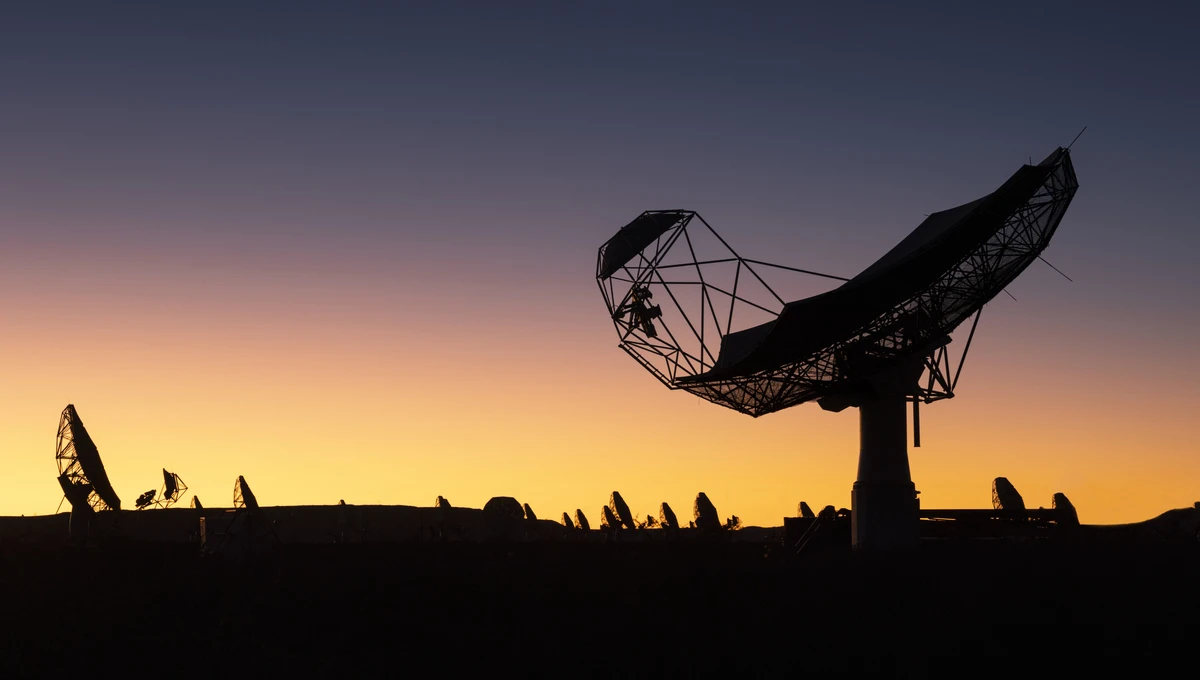
    Astronomers are already expanding the search in this direction. NASA’s Technosignature Program and projects like Breakthrough Listen are using machine learning to scan vast datasets for subtle anomalies. Instruments such as the Australian Square Kilometre Array Pathfinder (ASKAP) in Western Australia and the upcoming SKA Observatory are expected to play key roles in identifying potential technosignatures that might otherwise go unnoticed.

    Garrett’s model also encourages researchers to examine Earth’s own future as a guide. Studies at NASA’s Goddard Space Flight Center simulate how our planet might appear to distant observers 1,000 years from now, showing declining radio output but a growing technosphere of satellites, solar arrays, and artificial light. Understanding how our signal fades could help scientists recognize similar transitions elsewhere.

    While the findings narrow the odds of intercepting a message, they also reshape expectations. The universe may not be silent; it could be full of civilizations operating in communication modes we have yet to understand. For scientists, the next step is widening the search beyond traditional radio frequencies to the full spectrum of possible technologies.

    “If intelligence survives long enough, it becomes quieter,” Garrett said. “The challenge for us is to learn how to listen differently.”

    Source: Projecting what Earth will Look Like 1000 years from now Could Assist in the Search for Advanced Civilizations

  • Comet Lemmon Brightens Ahead of October 21 Close Approach, Now Visible in Northern Skies

    Comet Lemmon Brightens Ahead of October 21 Close Approach, Now Visible in Northern Skies

    A newly discovered comet is putting on an unexpected show in the October sky. Comet C/2025 A6 Lemmon, first spotted in January by the Mount Lemmon Observatory in Arizona, is brightening faster than astronomers expected and will pass within 90 million kilometers of Earth on October 21. Northern Hemisphere observers now have a chance to see it in binoculars either before sunrise or just after sunset.

    When first observed, Lemmon was faint at magnitude 21.5, barely distinguishable from an asteroid. But as it drew closer to the sun, it became active. By late September, the comet reached magnitude 6.6 and displayed a three-degree-long ion tail. As of October 9, it had brightened further to magnitude 5.8, making it a visible target in binoculars under dark skies.

    The brightening is due to sunlight heating the nucleus, causing ices to vaporize and release gas and dust. The coma now shows a cyan tint from cyanogen, a common comet molecule. Lemmon follows a long retrograde orbit of about 1,350 years, though a gravitational nudge from Jupiter will shorten this to 1,150 years after it leaves the inner solar system.

    For skywatchers, the first half of October offers morning views. The comet sits in Ursa Major, about 15 degrees below the Big Dipper’s cup. Around October 10, it will be high enough to remain visible all night for locations north of 48 degrees latitude, including Scotland and Alaska.

    From mid-October, it will appear in the west after sunset, low on the horizon, moving through Leo Minor, Ursa Major, and Canes Venatici at about four degrees per day.

    Key observing dates include October 9, when it passes near the star Omega Ursae Majoris, and October 15, when it comes within two degrees of Messier 94, a spiral galaxy. On October 16, it will pass close to Cor Caroli, a bright star in Canes Venatici. The closest approach to Earth comes on October 21, at 0.60 astronomical units. Its perihelion, the closest point to the sun, follows on November 8 at 0.53 astronomical units.

    By late November, Lemmon will appear near Mars, offering another viewing opportunity. Its tilted path, inclined 144 degrees to the plane of the planets, explains why it favors northern observers during this apparition.

    Lemmon is not the only comet active this month. C/2025 R2 SWAN will pass 0.26 astronomical units from Earth on October 20 and is currently at magnitude 6. Together, the two comets could provide favorable binocular views around Halloween. Interstellar comet 3I/ATLAS is also moving through the inner solar system, though much fainter at magnitude 11.

    Observers hoping to see Lemmon should use binoculars or a small telescope. The coma spans about one arcminute, with a faint tail pointing away from the sun. Under very dark skies, it may eventually become visible to the naked eye if it brightens to magnitude 3 later this month.

    Skywatching apps such as Stellarium can help locate the comet. For photography, short exposures of 10 to 30 seconds can capture the coma and part of the tail, while stacking multiple images reveals more detail. Recent photos have shown changes in the tail linked to interactions with the solar wind.

    Astronomers note that Lemmon is brighter than predicted, about 600 times more than its initial estimate. That makes it one of the more surprising comets in recent years, drawing comparisons with NEOWISE in 2020 and Tsuchinshan-ATLAS in 2024. As it fades after perihelion, attention will shift to C/2025 R3 PanSTARRS, due in early 2026. For now, Lemmon offers a rare autumn viewing opportunity for comet enthusiasts.

  • Sunset Bay Astronomy Festival with star parties, workshops, and night hikes

    Sunset Bay Astronomy Festival with star parties, workshops, and night hikes

    The Sunset Bay Astronomy Festival will return to Oregon’s coast from September 25 to 27, offering three nights of star parties, hikes, and family-friendly activities at Sunset Bay and Shore Acres state parks near Coos Bay. Organizers say the annual event gives visitors a rare chance to see the night sky free from city light pollution while learning more about the universe.

    The festival opens Thursday evening with a photography workshop led by park staff, where participants can learn how to capture the Milky Way and other celestial scenes using long-exposure techniques.

    Throughout the weekend, guided hikes and interpretive talks will introduce visitors to natural features and constellations visible in the September sky. Children can take part in junior ranger programs designed to explain basic astronomy in simple terms.

    Each night at 8 p.m., Shore Acres will host a star party with telescopes set up by operators who guide the public through views of Saturn, star clusters, galaxies, and the arc of the Milky Way. Park manager Lee Ricci says the setting allows people to see up to 2,500 stars on a clear night, compared to a few hundred in most cities.

    Astronomers point out that the timing offers good viewing conditions. Late September skies feature the autumn constellations, including Pegasus rising in the east. Saturn may still be visible low in the west, while the Andromeda Galaxy can sometimes be spotted with the naked eye. The moon will be in its crescent phase during the festival’s first nights, leaving skies darker for stargazing.

    Visitors are advised to dress warmly, bring a red-filter flashlight to protect night vision, and download a stargazing app to help identify what they see. Parking at Shore Acres requires a $10 day-use permit. Because events depend on weather, attendees are encouraged to check forecasts before traveling.

    To join the photography workshop, advance registration is required by emailing Kenneth.Page@oprd.oregon.gov.

    For more information on schedules and activities, contact Rose Shimberg at rshimberg@salem.gannett.com, who is covering the event for local media.

  • A Total Lunar Eclipse Will Turn the Moon Red on September 7–8, 2025

    A Total Lunar Eclipse Will Turn the Moon Red on September 7–8, 2025

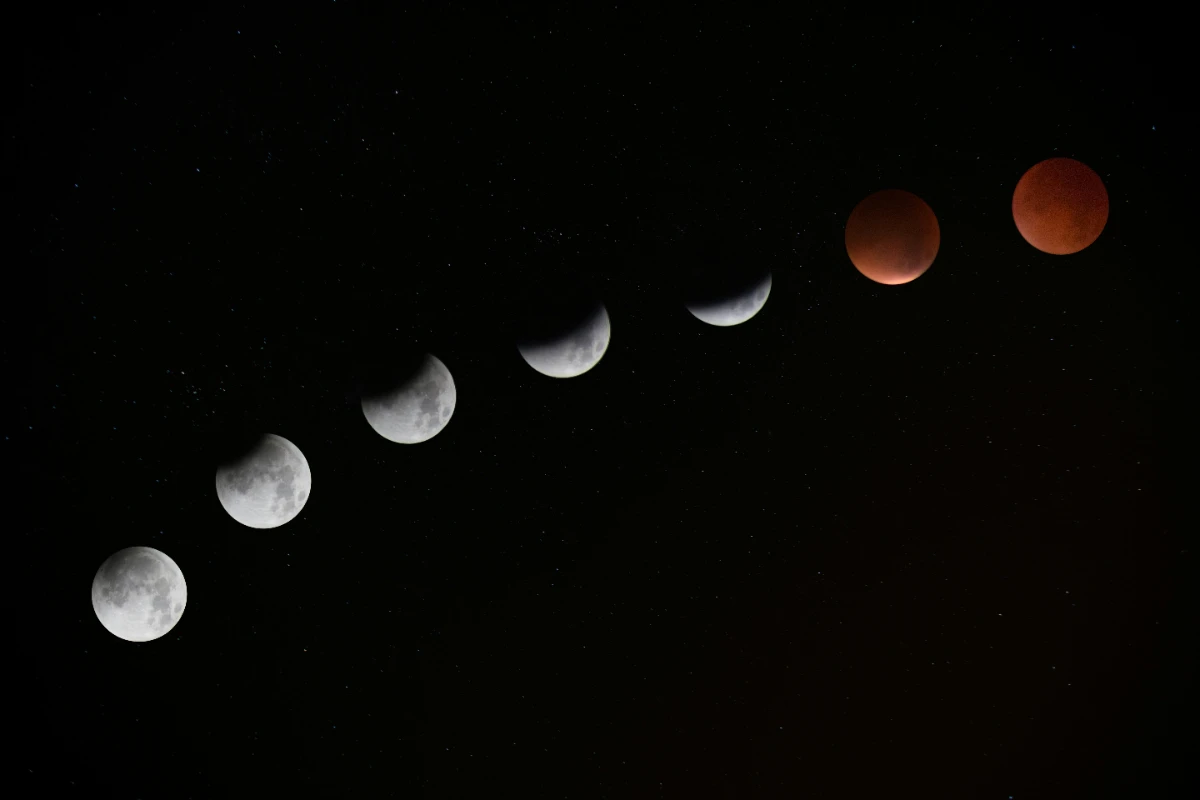
    A total lunar eclipse will paint the Moon red on September 7–8, 2025, visible across Europe, Africa, Asia, and Australia. Known as a “Blood Moon,” the event happens when Earth blocks direct sunlight from reaching the Moon, causing it to glow in shades of red. The eclipse will last for about five hours, with totality peaking at 6:11 p.m. UTC on September 7.

    During this eclipse, observers in North America may see the start or end, depending on time zones. The rest of the world can watch the full sequence unfold, from the faint penumbral stage to the deep red of totality.

    What is a Blood Moon?

    The term “Blood Moon” refers to the reddish color the Moon takes on during a total lunar eclipse. The color isn’t mystical; it comes from basic physics. When the Sun, Earth, and Moon line up, Earth blocks sunlight. But Earth’s atmosphere bends some of that light around its edges. Shorter blue wavelengths scatter, leaving behind longer red wavelengths that illuminate the Moon.

    The exact shade depends on the atmosphere at the time. Dust, smoke, or volcanic ash can make the Moon appear darker or more orange. On clearer nights, the red can look brighter.

    How does a Lunar Eclipse occur?

    A lunar eclipse occurs when the Moon moves into Earth’s shadow. The process has three stages. First, the penumbral phase makes the Moon appear slightly dimmer. Next, the partial phase begins as Earth’s central shadow takes a bite out of the Moon. Finally, the total phase, or umbra, covers the Moon completely.

    Unlike solar eclipses, lunar eclipses are safe to watch with the naked eye. No special glasses are needed, though binoculars or a telescope can reveal surface details during the dim red glow.

    History

    Ancient cultures often saw lunar eclipses as omens. The Incas, for example, believed a jaguar was attacking the moon during an eclipse. Today, astronomers understand it as a natural alignment of Earth and its satellite.

    In some cases, lunar eclipses line up with perigee (the point when the Moon is closest to Earth), creating what’s called a “supermoon eclipse.” That makes the Moon appear slightly larger in the sky. The September 2025 eclipse won’t coincide with perigee, but the view will still be striking.

    Why observe an Eclipse?

    Eclipses connect sky watchers to the rhythms of the solar system. They happen a few times a year, but total lunar eclipses are less frequent and widely anticipated. This one offers a long viewing window and a clear display of Earth’s shadow at work.

    Astronomers recommend finding a dark location away from city lights for the best view. Apps such as SkySafari and NASA’s Eclipse Explorer will provide local timings. With clear skies, millions of people worldwide will have the chance to see the Moon turn red in real time.

  • Purnima Dates 2025 with Tithi Timings

    Purnima Dates 2025 with Tithi Timings

    Purnima marks the full moon day in the Hindu lunar calendar. People observe it with fasts and prayers, often honoring Lord Vishnu. Astronomically, it’s when the moon sits opposite the sun from Earth’s view, fully lit.
    This day falls on the 15th tithi of the bright half, or Shukla Paksha. The tithi measures the moon’s position relative to the sun.

    Purnima Dates and Tithi Timings for 2025

    Here’s the complete list for 2025, based on standard Indian panchang calculations for New Delhi (times in IST). The date listed is the full moon day, when the tithi ends.

    January (Pausha)

    • Date: January 13 (Monday)
    • Tithi Start: 5:03 AM, January 13
    • Tithi End: 3:56 AM, January 14
    • Cultural Significance: Shakambhari Purnima is good for river baths.

    February (Magha)

    • Date: February 12 (Wednesday)
    • Tithi Start: 6:56 PM, February 11
    • Tithi End: 7:23 PM, February 12
    • Cultural Significance: Maghi Purnima, a time for charity and holy dips.

    March (Phalguna)

    • Date: March 14 (Friday)
    • Tithi Start: 10:36 AM, March 13
    • Tithi End: 12:24 PM, March 14
    • Cultural Significance: Holi falls around this, with bonfires the night before.

    April (Chaitra)

    • Date: April 12 (Saturday)
    • Tithi Start: 3:22 AM, April 12
    • Tithi End: 5:52 AM, April 13
    • Cultural Significance: Hanuman Jayanti often coincides.

    May (Vaishakha)

    • Date: May 12 (Monday)
    • Tithi Start: 8:02 PM, May 11
    • Tithi End: 10:25 PM, May 12
    • Cultural Significance: Buddha Purnima, marking Buddha’s birth.

    June (Jyeshtha)

    • Date: June 11 (Wednesday)
    • Tithi Start: 11:36 AM, June 10
    • Tithi End: 1:13 PM, June 11
    • Cultural Significance: Vat Savitri Vrat for married women.

    July (Ashadha)

    • Date: July 10 (Thursday)
    • Tithi Start: 1:37 AM, July 10
    • Tithi End: 2:06 AM, July 11
    • Cultural Significance: Guru Purnima, honoring teachers.

    August (Shravana)

    • Date: August 9 (Saturday)
    • Tithi Start: 2:12 PM, August 8
    • Tithi End: 1:25 PM, August 9
    • Cultural Significance: Raksha Bandhan day.

    September (Bhadrapada)

    • Date: September 7 (Sunday)
    • Tithi Start: 1:41 AM, September 7
    • Tithi End: 11:38 PM, September 7
    • Cultural Significance: Start of Pitru Paksha.

    October (Ashvina)

    • Date: October 7 (Tuesday)
    • Tithi Start: 12:24 PM, October 6
    • Tithi End: 9:17 AM, October 7
    • Cultural Significance: Sharad Purnima, with moonlight rituals.

    November (Kartika)

    • Date: November 5 (Wednesday)
    • Tithi Start: 10:36 PM, November 4
    • Tithi End: 6:49 PM, November 5
    • Cultural Significance: Kartik Purnima, lantern festivals.

    December (Margashirsha)

    • Date: December 4 (Thursday)
    • Tithi Start: 8:38 AM, December 4
    • Tithi End: 4:44 AM, December 5
    • Cultural Significance: Dattatreya Jayanti.

    These timings can vary slightly by location due to local sunrise rules in the panchang. To know accurate tithi timings for your location, visit Drik Panchang.

    Why Do Tithi Timings Matter?

    Tithi timings help decide when to start fasts or pujas. If the tithi spans two days, the vrat day is usually when it covers midday.

    Astronomers calculate these using the moon’s position. The 12-degree shift for each tithi comes from the moon’s faster orbit compared to the sun’s apparent motion.

    The Astronomy of Full Moons

    The moon orbits Earth every 27.3 days, but full moons happen roughly every 29.5 days due to Earth’s movement around the sun. During a full moon, sunlight hits the moon straight on, making it appear round and bright.

    The exact moment comes when the sun, Earth, and moon align, with Earth in the middle. This alignment shifts slightly each month because of the moon’s tilted orbit.

    Full moons influence tides through gravity, pulling harder on Earth’s water. They don’t cause major behavior changes in people, though some studies note minor sleep effects from the extra light.

    Cultural and Scientific Importance

    Many link full moons to calm minds, though science sees them as brighter nights affecting sleep. Rituals like offering water to the moon aim to reduce stress.

    In 2025, watch for eclipses; none directly on these Purnimas, but nearby dates might bring partial ones. Purnima reminds us of the moon’s steady cycle amid our busy lives. Track one this year and see the sky light up.

    Check the Moon Phase on your Birthday.

  • No, the ‘Eclipse of the Century’ isn’t happening in 2025. Claims circulating on Social Media are false!

    No, the ‘Eclipse of the Century’ isn’t happening in 2025. Claims circulating on Social Media are false!

    Viral social media posts claim that the world will go dark on August 2, 2025. That’s false. There will be no eclipse or global blackout on that date. But there is something worth getting excited about: a total solar eclipse on August 2, 2027. According to Time & Date, it will be the longest total solar eclipse of this century and hence it’s named as the ‘Eclipse of the Century.’

    Solar eclipses happen when the Moon passes between Earth and the Sun, casting a shadow that briefly blocks sunlight. On August 2, 2027, the Moon will completely cover the Sun for up to 6 minutes and 22 seconds. That’s nearly two full minutes longer than the April 8, 2024, eclipse that passed over North America.

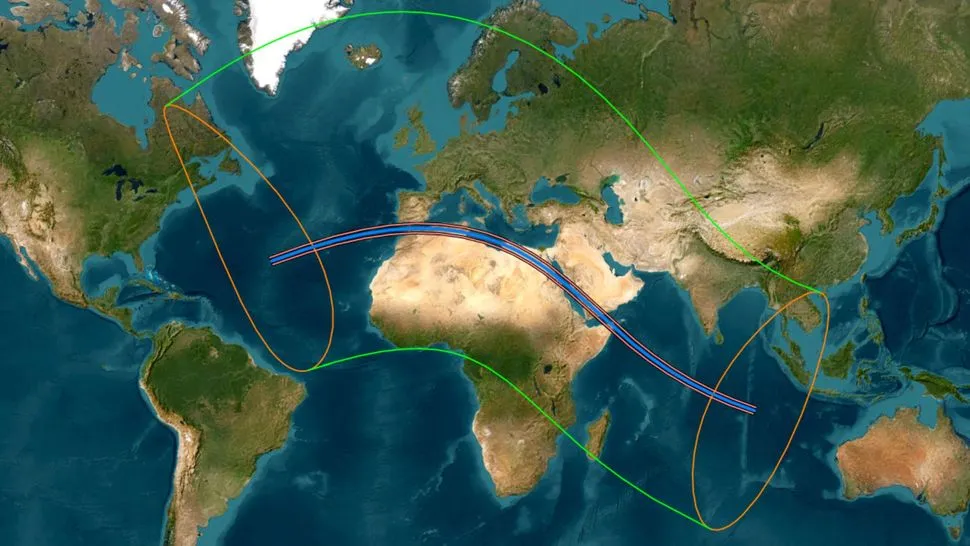
    Path of Totality of the 2027 Total Solar Eclipse
    A 2D map showing the path of totality of the 2027 total solar eclipse. Image credit: Created using MapHub.net. Source: Esri, Maxar, GeoEye, Earthstar Geographics, CNES/Airbus DS, USDA, USGS, AeroGRID, IGN, and the GIS User Community; path from Xavier M. Jubier.

    The path of totality will stretch over 9,462 miles and pass through 11 countries: Spain, Gibraltar, Morocco, Algeria, Tunisia, Libya, Egypt, Sudan, Saudi Arabia, Yemen, and Somalia. The Moon will appear slightly larger in the sky because it will be closer to Earth, making the shadow wider, but it will still only cover a small portion of the planet.

    In India, the eclipse will be partial. Cities like Mumbai and Bengaluru will see 32% to 39% of the sun covered in the late afternoon, between 3:34 PM and 5:53 PM IST. Cloud cover may block the view in many places, so clear skies will be key.

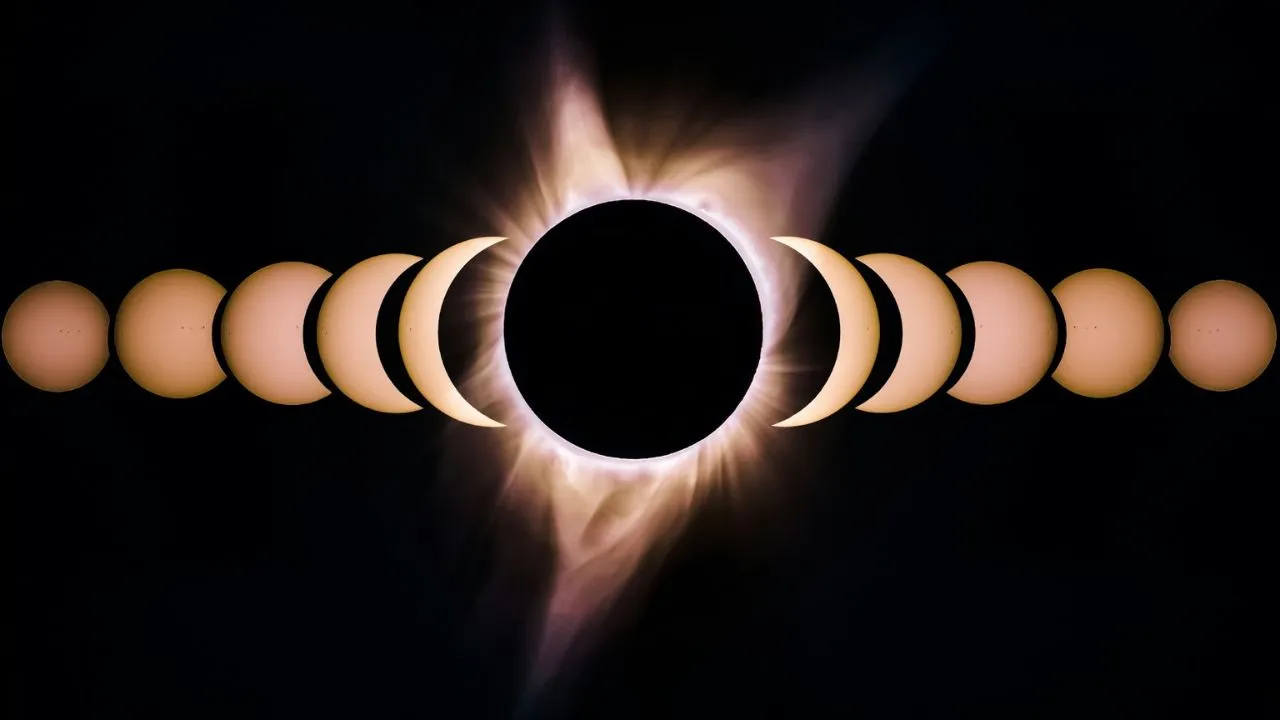
    A Composite of Total Solar Eclipse
    A time-lapse composition of the August 2017 eclipse from start to totality, captured at Crooked River Ranch, Oregon. Each frame was taken about 10 minutes apart, with totality shown at the center. Image credit: Bryan Goff/Unsplash

    The 2025 rumor likely comes from confusion around a real, but unrelated, partial eclipse happening on September 21, 2025. That one will only be visible in parts of the Pacific and Antarctica

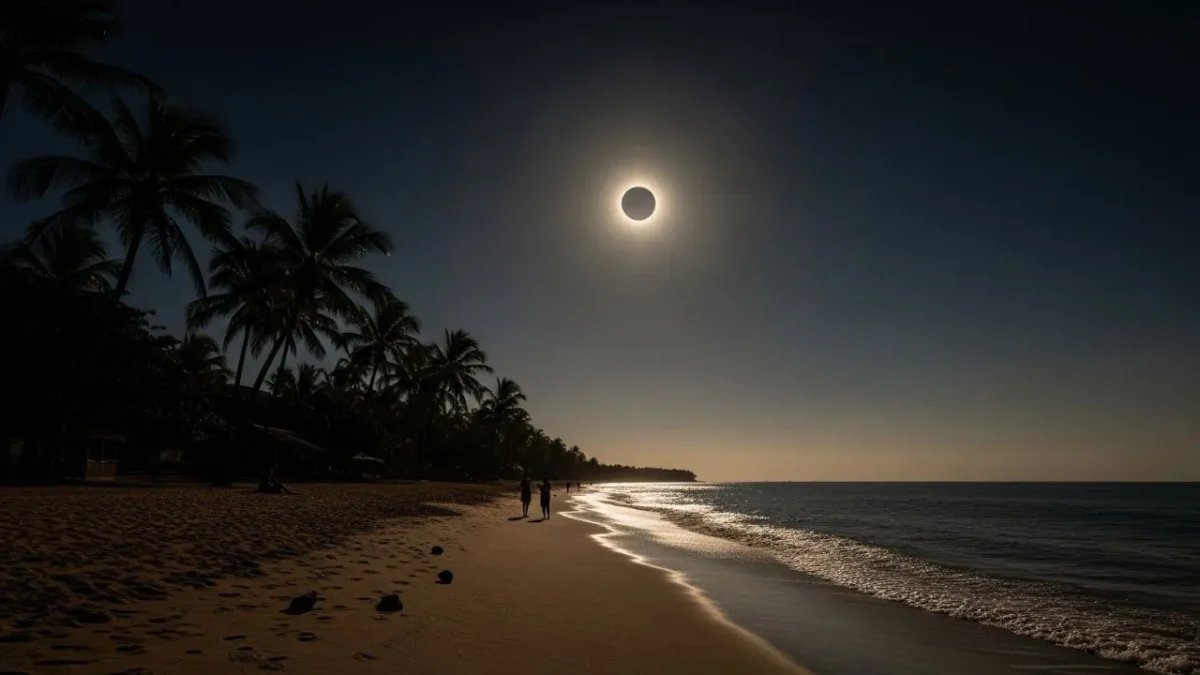
    During a total solar eclipse, daylight fades, temperatures drop, and the Sun’s glowing outer atmosphere, called the corona, becomes visible. It’s an eerie and unforgettable experience.

    For 2027, some of the best places to see it include Tarifa, Spain; Tunisia’s Mediterranean coast; and Luxor, Egypt. If you’re outside the path of totality, you’ll still be able to see a partial eclipse from much of Africa, Europe, and southern Asia. But again, the view depends on the weather.

    Other upcoming eclipses include a partial one on September 21, 2025, and a total eclipse on August 12, 2026. For Indian skywatchers, the 2027 event is the most notable one in the coming years.

    This total eclipse will be the longest visible on land until July 2114, offering a rare chance that most people alive today will see only once. Keep visiting our website and follow us on Instagram for future updates!

  • “I’m thrilled!” Astrophotographer Captures the Rare ISS-Saturn Transit

    “I’m thrilled!” Astrophotographer Captures the Rare ISS-Saturn Transit

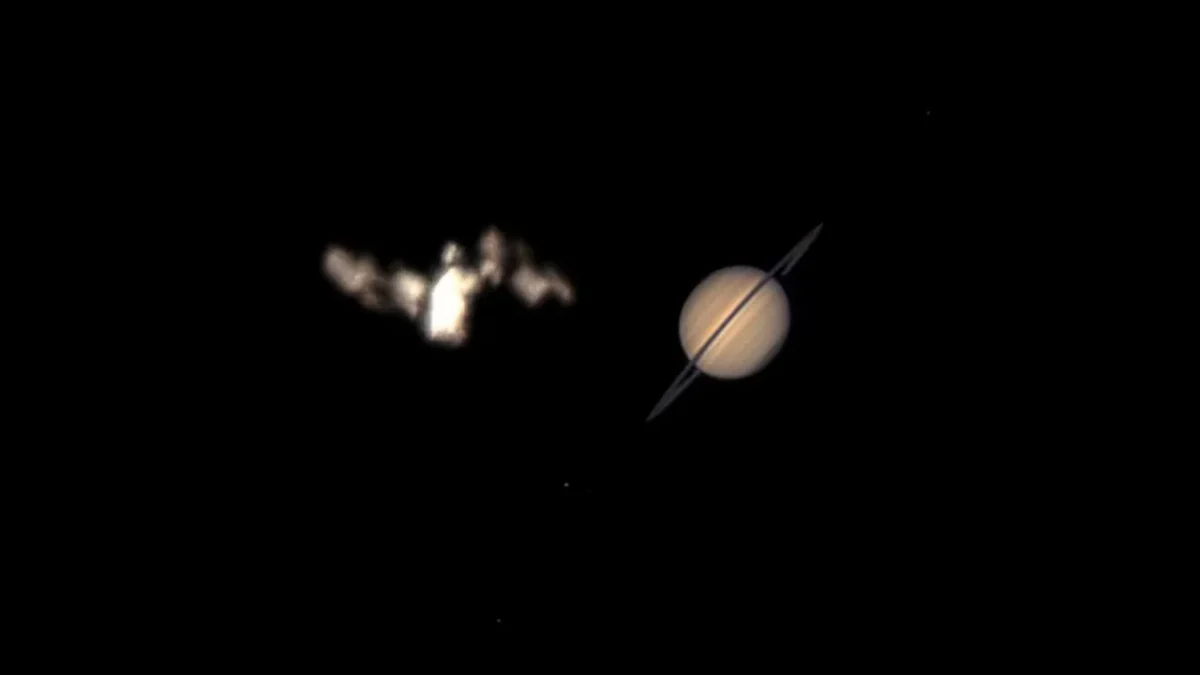
    Adam Smadi, a 20-year-old astrophotographer from Shoreline, Washington, captured a rare image of the International Space Station (ISS) passing in front of Saturn on the morning of July 6 (Eastern time), achieving a stunning visual alignment of two celestial objects 1.39 billion kilometers apart.

    After two days of meticulous planning and a 50-mile journey to a precise location, Smadi used the Stellarium app and coordinate calculations to pinpoint the exact spot where the ISS and Saturn would briefly appear to overlap from Earth’s perspective. This fleeting event, known as a transit, marks a feat accomplished by only a handful of people worldwide.

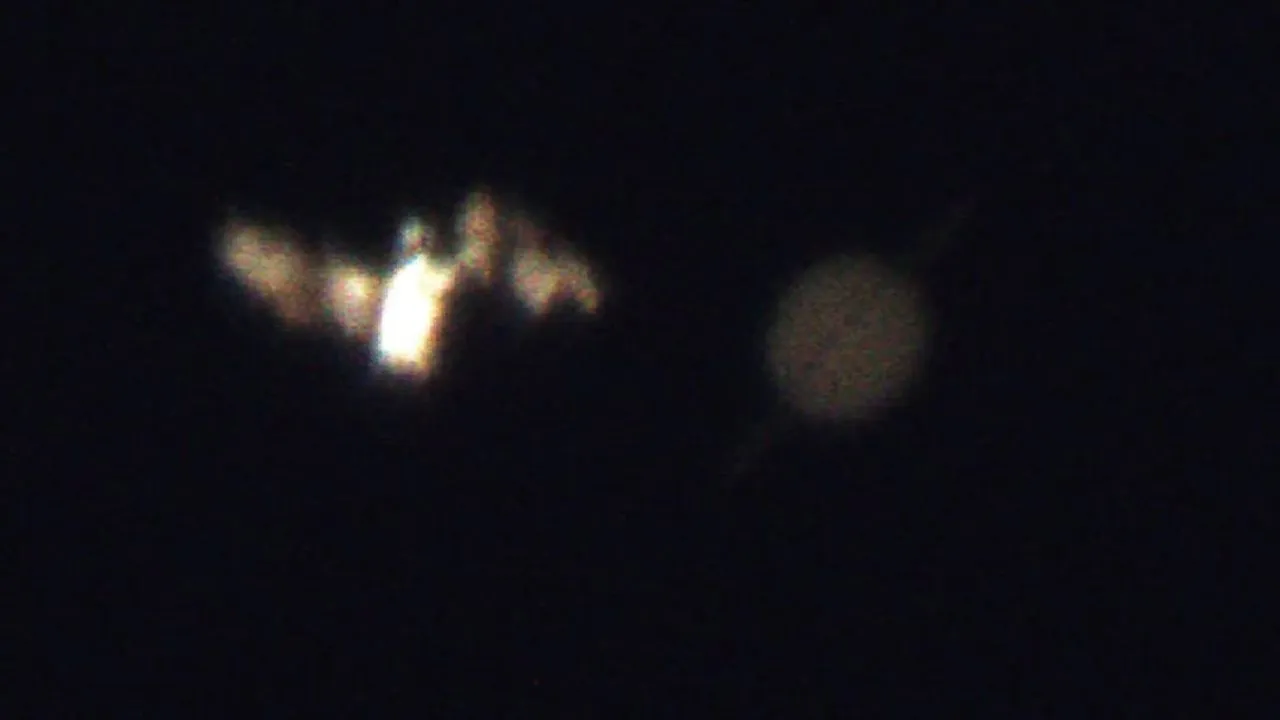
    Single, raw Frame of ISS transiting Saturn.
    Single, raw frame of the ISS-Saturn transit captured on July 6, 2025. Image Credit: Adam Smadi

    Using a Celestron NexStar Evolution 9.25” telescope and a ZWO ASI662MC camera with an IR685 and visible light blend, Smadi documented Saturn’s iconic rings in vivid detail, though the ISS appears less sharp due to its significant distance from Earth at the time.

    Smadi, who previously photographed a rare solar eclipse on Saturn, noted that Saturn’s dimmer appearance compared to the ISS results from the inverse square law of light, which causes surface brightness to drop rapidly with distance from the inner solar system. “The conditions were great, but the station was quite far, so it’s not the sharpest. Still, Saturn looks amazing, and I’m stoked with the result,” Smadi shared on Instagram.

    This remarkable image underscores the precision and dedication required in astrophotography, blending advanced technology, careful planning, and a deep understanding of celestial mechanics to capture a moment that bridges the vast distances of our solar system.

  • Must see Astronomical events in July 2025

    Must see Astronomical events in July 2025

    Attention, stargazers! July 2025 offers some exciting stargazing opportunities for both casual observers and professional astronomers around the globe. Starting with the conjunction of Antares and the Moon, the month will end with the peak of the Delta Aquarids meteor shower.

    This article serves as a clear and reliable guide to help you navigate the celestial events of July, offering detailed insights into each event so you can make the most of your stargazing experience.

    Key astronomical events in July 2025

    • July 1-7: Mercury appears bright and easy to see low in the western sky 30 to 45 minutes after sunset. A clear horizon is required for visibility before it sets.
    • July 3: Mercury lies near the Beehive Cluster in the western sky after sunset, visible until around 8:20 p.m. At the same time, Spica appears close to the Moon and remains in view until midnight.
    • July 4: Earth reaches its farthest distance from the Sun (Aphelion): 152 million kilometers. Mercury reaches its greatest eastern elongation, offering its widest separation from the Sun in the evening sky.
    • July 21-22: A crescent moon appears close to Venus and Jupiter in the eastern sky just before sunrise. Several bright stars remain visible in the same region.
    • July 28: A crescent moon appears near Mars in the western sky after sunset.
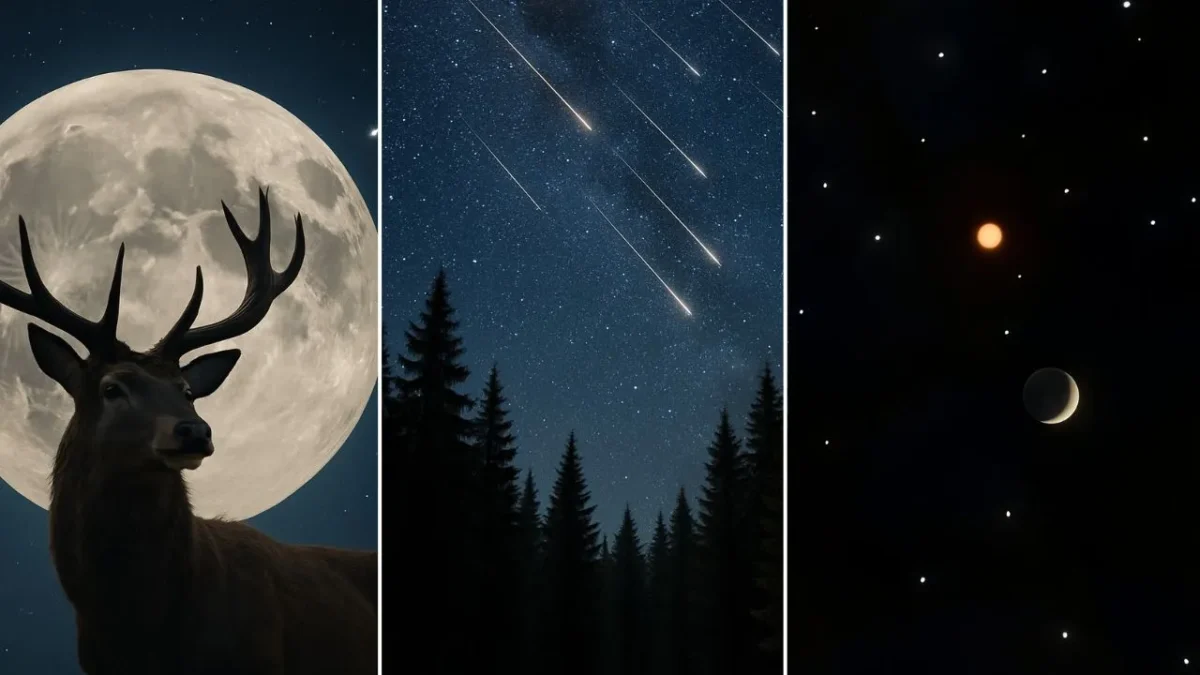
    • July 30-31: The Delta Aquariids meteor shower peaks, with as many as 25 meteors per hour visible from 9:30 p.m. until dawn. (Check Radiant Point.)

    The Buck Moon

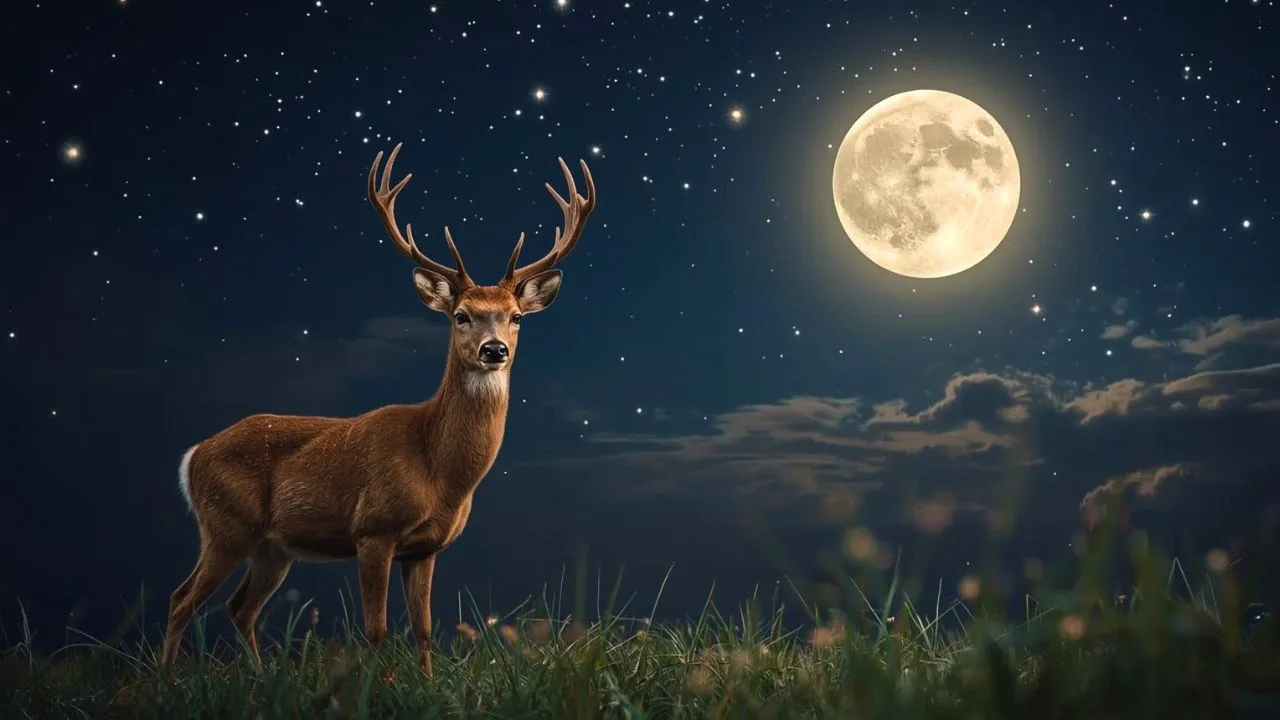
    The Buck Moon/the July full moon.
    (Artists’s Concept)

    According to Forbes, the Buck Moon (Full Moon of July) will reach its full phase at 4:38 p.m. EDT on Thursday, July 10. While it will appear full the night before and after its peak, the most breathtaking view will be during moonrise at dusk on July 10. That is when the full moon will hang low on the horizon, appearing larger, brighter, and more dramatic.

    According to Farmer’s Almanac, the name comes from Native American traditions, referring to the time of year when male deer, or bucks, begin to grow new antlers covered in soft velvet. The term has since become widely recognized in modern lunar calendars.

    This year’s Buck Moon does not coincide with the Delta Aquariids peak, allowing clearer views of the meteor shower later in the month.

    Planets and constellations visible in July 2025

    • Venus shines brightly in the eastern sky during the two hours before sunrise, appearing near the Pleiades star cluster, Aldebaran, and Capella throughout the month.
    • Mars appears low in the west after sunset and remains visible for a couple of hours. Its brightness gradually fades as the month continues.
    • Jupiter begins rising in the east around an hour before sunrise from mid-July onward, climbing higher each morning.
    • Saturn rises around midnight and stays high in the southern sky through the early morning hours.
    • The Aquila constellation is visible in the eastern sky during the first half of the night. Its brightest star, Altair, forms one corner of the Summer Triangle and remains easy to locate, even from areas with light pollution.

    Space History

    The month of July 2025 marks 60 years since NASA’s Mariner 4 performed the first successful flyby of Mars in July 1965. It was the first mission to send back close-up images of another planet and revealed that Mars has a very thin, cold atmosphere.

    Moon phases for July 2025

    • First quarter: July 2
    • Full Moon: July 10
    • Third quarter: July 17
    • New Moon: July 24

    Darker skies around the new moon offer ideal conditions for viewing faint stars, planets, and meteor showers. Topped with multiple conjunctions, July remains a rewarding month for skywatching.

  • ‘Won’t happen again until 2038’: Astrophotographer captures a rare solar eclipse on Saturn

    ‘Won’t happen again until 2038’: Astrophotographer captures a rare solar eclipse on Saturn

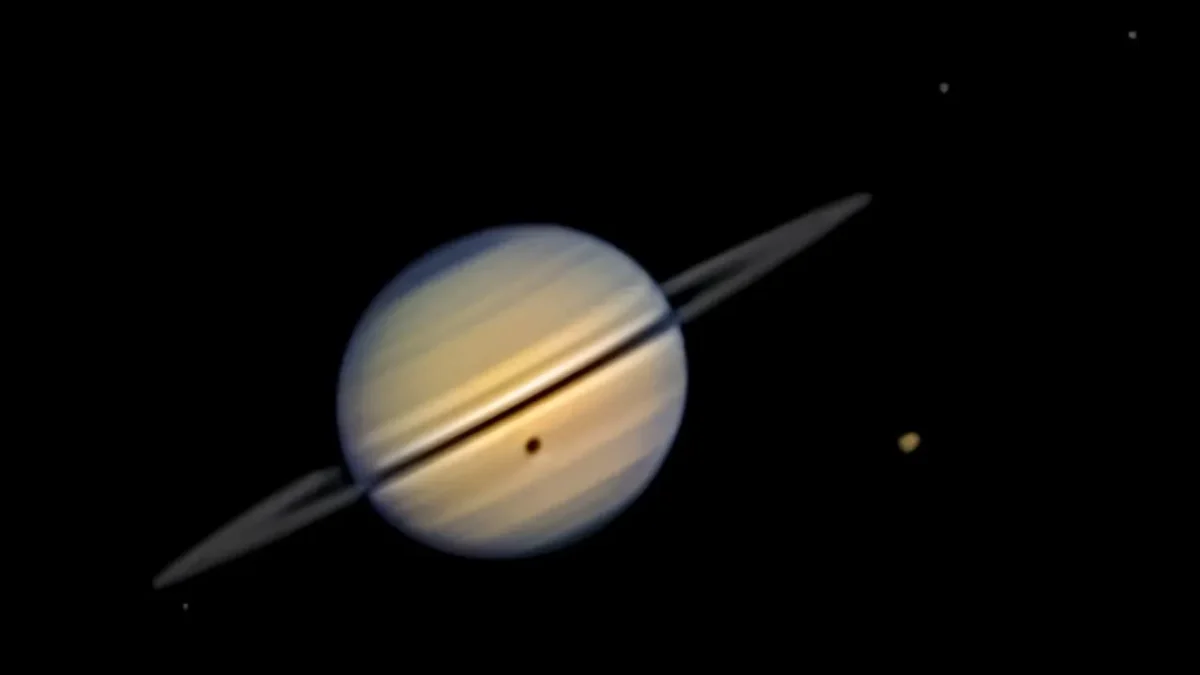
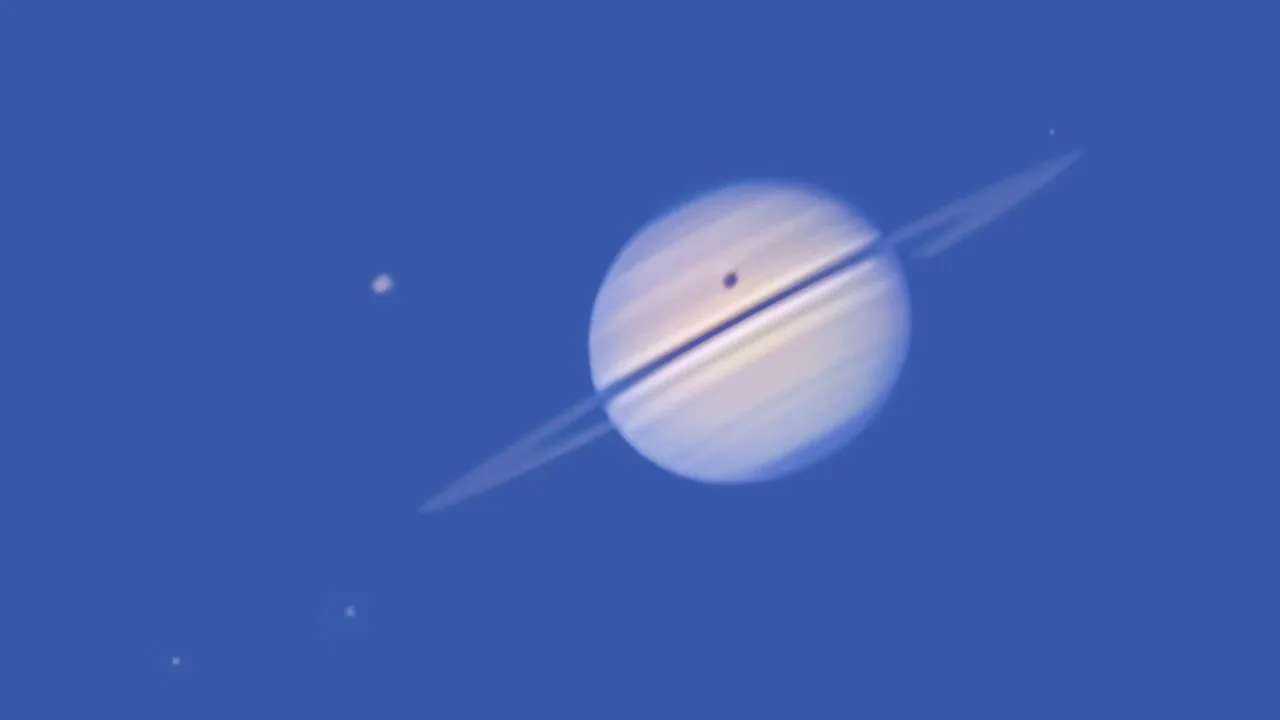
    A 20-year-old astrophotographer from Shoreline, Washington, has captured a rare solar eclipse on Saturn. The event, known as a shadow transit, showed Saturn’s largest moon, Titan, casting a small dark shadow on the planet’s surface. This type of eclipse will not be visible again until 2038.

    Adam Smadi has been practicing astrophotography for about two years. He said that he planned the shot days in advance using the Stellarium software, which helped him find the exact time and location from which the eclipse would be visible.

    “I saw that it was going to be visible during the perfect time from Shoreline,” Smadi told Wonders in Space. “I knew I had to try.”

    A rare solar eclipse on Saturn, caused by its largest moon, Titan, with other moons—Dione, Tethys, and Enceladus—visible in the frame.
    Titan casts its shadow on Saturn, creating a rare solar eclipse, while three of Saturn’s moons, Dione (bottom left), Tethys (far bottom left), and Enceladus (a faint dot just above the tip of Saturn’s ring on the right), join the scene. Credit: Adam Smadi

    He began setting up his 9.25 inch telescope around 1 a.m. to let the equipment cool down and match the outdoor temperature and reduce air currents inside the telescope, helping create sharper images. By 3:30 a.m., Saturn was high enough in the sky to begin imaging. Smadi used a ZWO ASI662MC camera and an infrared filter (685 nm) that helped reveal more detail in Saturn’s atmosphere.

    “I stacked thousands of images using video captures,” he told Wonders in Space. “And there’s the result.”

    Shadow transits like this are rare. They only happen when Saturn’s rings are edge-on from Earth’s point of view, allowing moon shadows to cross the planet’s face. These viewing windows last only a few months and return about every 15 years.

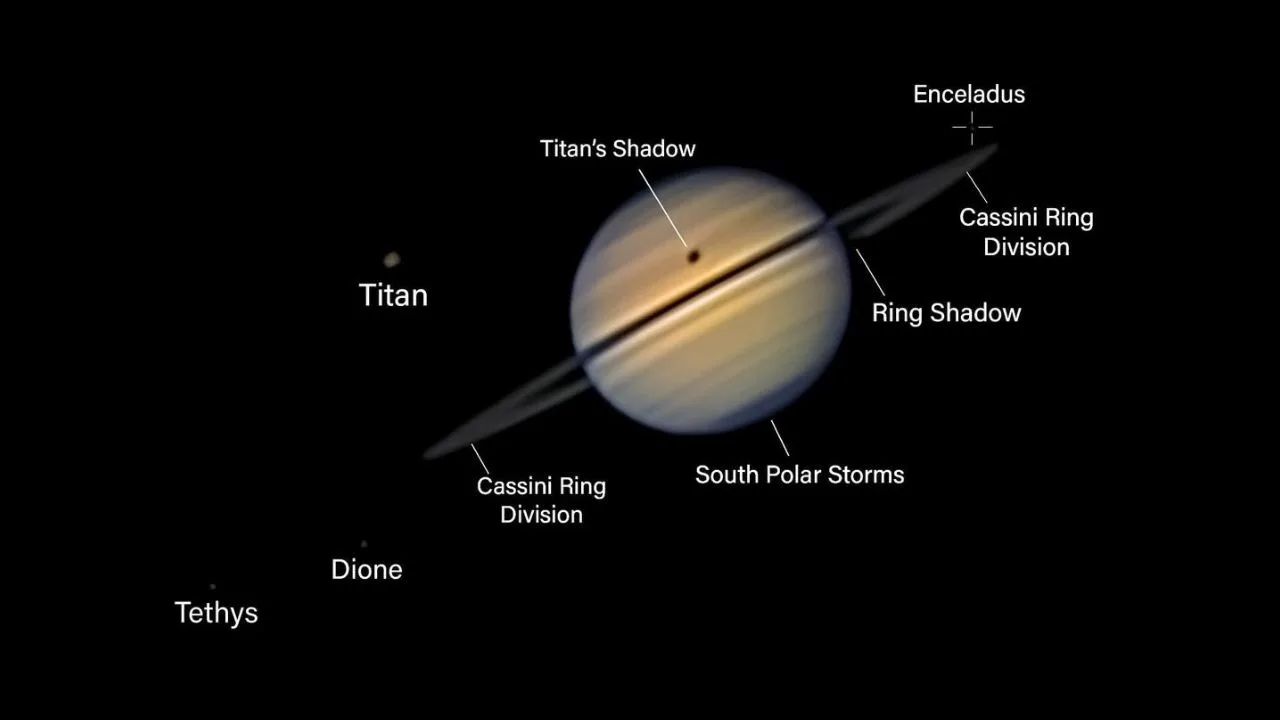
    Labeled image of a rare solar eclipse on Saturn.
    (Labeled image) Titan casts its shadow on Saturn, creating a rare solar eclipse, with moons Dione, Tethys, and Enceladus also in view. Features like the Cassini Division, ring shadow, and south polar storms are also visible in this stunning view. Credit: Adam Smadi

    Smadi’s stunning photos have been widely shared across astronomy forums and social media platforms, drawing praise from viewers around the world. On Instagram, his followers and viewers flooded the comments with admiration and excitement. “Award winning,” one user wrote. “Fantastic, glad you were able to catch it!” said another.

    While it may look like a small dot on a giant planet, it reflects hours of preparation and a precise understanding of planetary motion.

    Follow Adam Smadi on Instagram to see more of his stunning work.