Category: Space

Explore the vastness beyond our planet. This section covers missions, discoveries, and events that expand our reach into the cosmos. From new rocket launches to deep-space observations, “Space” keeps you updated on humanity’s steps into the unknown.

  • NASA’s Perseverance Rover Finds Mars Rock “Cheyava Falls” That May Hold Clues to Ancient Microbial Life

    NASA’s Perseverance Rover Finds Mars Rock “Cheyava Falls” That May Hold Clues to Ancient Microbial Life

    NASA’s Perseverance rover has discovered a rock on Mars that may hold fossil evidence of ancient microbial life. The arrowhead-shaped, vein-filled rock, nicknamed “Cheyava Falls,” was found in the northern part of Neretva Vallis, an ancient river valley on Mars, on July 21, 2024. Scientists believe this rock could contain some of the earliest signs of microbial life that existed billions of years ago when the area possibly had flowing water.

    Instruments aboard Perseverance analyzed the rock’s chemical makeup and structure, finding qualities that match those expected from ancient microbial fossils. The rock contains large veins of calcium sulfate and reddish-brown bands, indicating the presence of hematite (a mineral linked to Mars’ rusty surface).

    Closer inspection revealed dozens of irregularly shaped, off-white spots surrounded by black rings, resembling patterns sometimes seen in fossilized microbial life on Earth. Perseverance’s PIXL (Planetary Instrument for X-ray Lithochemistry) found that the black halos contain iron and phosphate, elements often connected to microbial fossils.

    Ken Farley, Perseverance project scientist at Caltech, described Cheyava Falls as “the most puzzling, complex, and potentially important rock yet investigated by Perseverance.” David Flannery, an astrobiologist on the mission team, noted that these features are commonly linked to ancient microbial life found beneath Earth’s surface.

    This discovery could represent a major step toward finding evidence of life beyond Earth. However, confirming this will require more detailed study of samples returned to Earth in future missions. Until then, Cheyava Falls remains one of the most promising clues in the search for past life on Mars.

  • India’s GROWTH-India Telescope Tracks 380-Foot Asteroid 2011 MW1 in Close Flyby at 10× Lunar Distance

    India’s GROWTH-India Telescope Tracks 380-Foot Asteroid 2011 MW1 in Close Flyby at 10× Lunar Distance

    The GROWTH-India Telescope at the Indian Astronomical Observatory in Hanle, Ladakh, captured a 116-meter (380-foot) asteroid, 2011 MW1, as it flew past Earth on July 25, 2024, just ten times the distance to the Moon, highlighting India’s growing role in tracking near-Earth objects with cutting-edge robotic observatories.

    GROWTH-India telescope and the asteroid pass

    Growth India telescope
    The GROWTH-India telescope. Image credit: GROWTH India

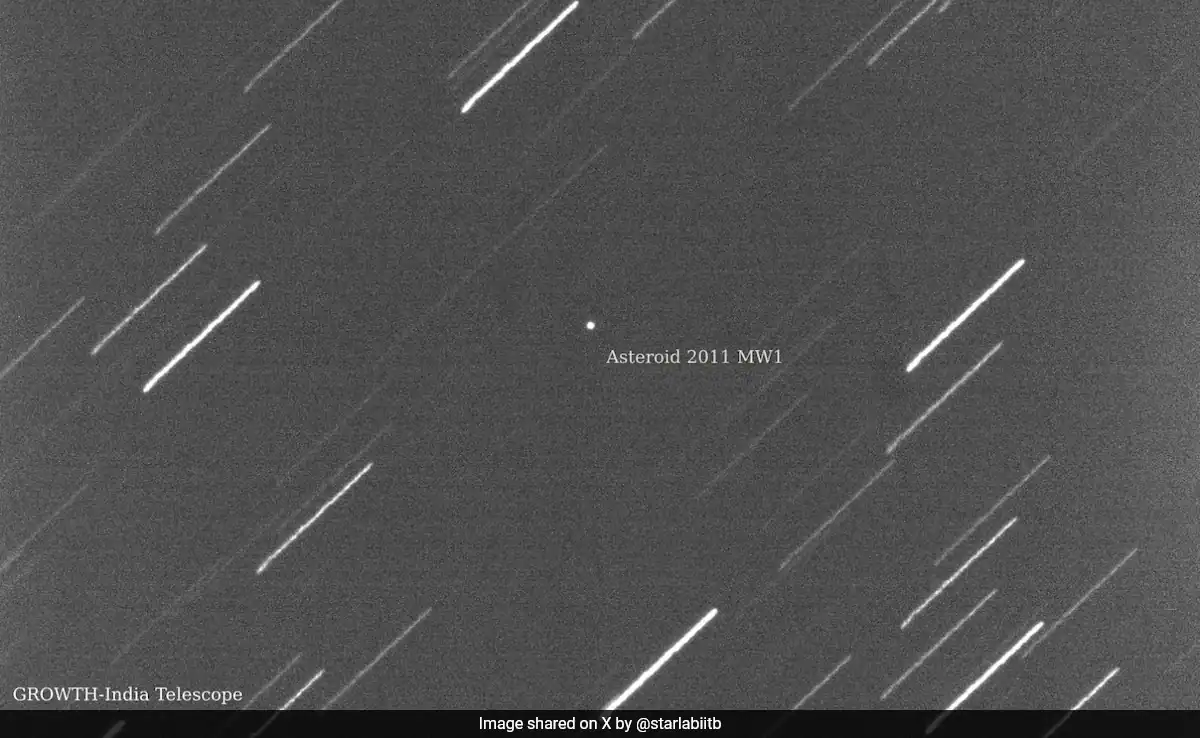
    The asteroid 2011 MW1, roughly the size of a small building at about 116 meters across, passed Earth on July 25 at a high speed of 28,946 km/h and a distance of around 2.4 million miles (10× lunar distance). The GROWTH-India telescope tracked its rapid motion so precisely that stars in the background appeared as streaks in the images.

    Varun Bhalerao, an astrophysicist at IIT Bombay’s STAR lab, shared the image on X (formerly Twitter): “We tracked the rapid motion of the asteroid as it zipped across the sky at just 10× lunar distance. The rapid motion makes background stars look like streaks.”

    The GROWTH-India Telescope, India’s first fully robotic optical research telescope, stands at roughly 0.7-meter aperture and is housed at 4,500 meters altitude in Hanle, Ladakh—making it one of the world’s highest observatories. It was developed by the Indian Institute of Astrophysics (IIA) and IIT Bombay, with funding and support from the Department of Science and Technology, Indo-US Science & Technology Forum, and IIT Bombay’s alumni.

    This telescope is part of the international Global Relay of Observatories Watching Transients Happen (GROWTH) network, designed to monitor fleeting cosmic events without interruption by daylight. Its main mission includes observing near-Earth asteroids, supernovae, gamma-ray bursts, and other fast-changing phenomena.

    The successful tracking of 2011 MW1 underscores the GROWTH-India Telescope’s ability to observe fast-moving space objects, which is vital for mapping their paths, assessing any threat, and enriching global efforts to understand near-Earth asteroids.

  • Global temperatures hit record high on July 23, 2024

    Global temperatures hit record high on July 23, 2024

    The Copernicus Climate Change Service, which has tracked global temperatures since 1940, officially identified Monday, July 23, 2024, as the hottest day ever recorded on Earth. This new record surpassed the previous high set just a day earlier, on July 22, 2024. The temperature on July 23 reached 62.87°F (17.15°C), edging out Sunday’s 62.76°F (17.09°C). These findings highlight a disturbing upward trend in global temperatures over the past year.

    Data from the Copernicus Climate Change Service confirms that the 12 months leading up to July 2024 experienced the highest average global temperatures in recorded history. Scientists and climate experts warn that this rapid warming is largely driven by human activities, including the burning of fossil fuels and deforestation. These activities release greenhouse gases that trap heat in the atmosphere, causing global temperatures to rise.

    The consequences of this trend are severe. Rising temperatures contribute to more frequent and intense heatwaves, droughts, wildfires, and storms worldwide. Ecosystems are under stress, and many plant and animal species face increased risks of extinction. Human health is also at risk, with heat-related illnesses becoming more common, especially in vulnerable populations.

    In addition to direct temperature effects, climate change is causing shifts in Earth’s physical processes. Scientists recently found that melting polar ice is affecting the Earth’s rotation, leading to slightly longer days. This unexpected change shows how interconnected climate impacts can be.

    Experts emphasize that urgent action is needed to limit further warming. Reducing emissions, transitioning to renewable energy, protecting forests, and adopting sustainable practices are critical steps to avoid more catastrophic consequences. Without immediate global cooperation, the worsening climate crisis could threaten the survival of many species, including humans.

    For more on how polar ice affects Earth’s rotation, see this article.

  • ISRO successfully tests air breathing propulsion technology using RH-560 sounding rocket

    ISRO successfully tests air breathing propulsion technology using RH-560 sounding rocket

    The Indian Space Research Organization (ISRO) successfully conducted its second experimental flight test of Air Breathing Propulsion Technology on July 22, 2024, at 7 a.m. Indian Standard Time (IST).

    The test took place at the Satish Dhawan Space Centre in Sriharikota, where the propulsion system was mounted on the RH-560 Sounding Rocket and launched to evaluate its performance. This test is a significant step in advancing India’s capabilities in developing efficient propulsion systems for future space missions.

    ISRO’s RH-560 Sounding Rocket

    RH-560 sounding rocket on the launch pad.
    The RH-560 sounding rocket on the launch pad, July 22, 2024. Image credit: ISRO

    The RH-560 is a two-stage solid motor suborbital rocket designed to test new aerospace technologies. It is the heaviest-sounding rocket developed by ISRO so far and serves as a testbed for critical propulsion systems. During this flight, the rocket successfully carried and ignited the air-breathing propulsion systems, demonstrating key advances in this technology.

    ISRO monitored around 110 parameters throughout the flight, including the rocket’s overall performance and the ignition of the air-breathing propulsion system. The data collected will be crucial for refining and developing this propulsion technology further, which could improve the efficiency and cost-effectiveness of future space vehicles.

    Before this flight, extensive ground tests took place at various ISRO facilities, including the Liquid Propulsion Systems Centre (LPSC), Vikram Sarabhai Space Centre (VSSC), ISRO Propulsion Complex (IPRC), and CSIR-National Aerospace Laboratories. These tests ensured the reliability and safety of the propulsion systems before they were integrated into the RH-560 rocket.

    Air-breathing propulsion technology aims to use oxygen from the atmosphere during initial flight phases instead of carrying all the oxidizer onboard. This can potentially reduce the weight of rockets and increase their payload capacity, making launches more efficient. ISRO’s progress with these tests highlights India’s growing expertise in next-generation aerospace propulsion.

  • NASA reveals detailed image of merging galaxies the Penguin, the Egg, captured by JWST

    NASA reveals detailed image of merging galaxies the Penguin, the Egg, captured by JWST

    NASA has released a striking new image from the James Webb Space Telescope (JWST), marking the observatory’s second anniversary. Taken on July 12, 2024, the photograph shows two galaxies in the process of merging, officially known as ARP 142 and nicknamed “the Penguin” and “the Egg” for their shapes.

    Captured in unprecedented detail, the image reveals how gravity is slowly pulling the galaxies together, setting the stage for them to combine into a single, larger galaxy.

    The Penguin, cataloged as NGC 2936, is a warped former spiral galaxy now stretched into an arc-like form. The Egg, NGC 2937, is a rounder, compact galaxy seen to the left of the frame. JWST’s infrared observations show the pair locked in a slow gravitational interaction about 100,000 light-years apart. Over time, their mutual pull is drawing them closer, compressing clouds of dust and gas, and igniting bursts of new star formation.

    The image was shared by NASA on X as part of celebrations marking two years since JWST began delivering scientific data. The telescope, launched in December 2021, is the largest and most powerful space observatory in operation. While the Hubble Space Telescope observes mainly in visible and ultraviolet light, JWST specializes in the infrared spectrum. This allows it to see through thick clouds of cosmic dust, revealing objects that are too faint or obscured for other instruments.

    According to NASA, this capability is key to studying galaxy mergers like ARP 142. Infrared imaging can expose the dense, dust-covered regions where stars are forming, helping astronomers understand how such interactions shape galaxies over billions of years. The Penguin and Egg are currently in an early stage of their merger, but simulations suggest they will eventually combine into one elliptical galaxy.

    JWST’s anniversary image not only highlights its scientific power but also underscores its mission: to deliver sharper, deeper, and more revealing views of the universe than ever before. More images from its second year of operation are expected to be released in the coming months, offering further insight into the origins and evolution of galaxies.

  • NASA tracks 380-foot asteroid on close approach to Earth at nearly 29,000 km/h

    NASA tracks 380-foot asteroid on close approach to Earth at nearly 29,000 km/h

    NASA has issued an alert for a possible asteroid flyby. The near-earth asteroid ‘asteroid 2011 MW1’ is approaching Earth at a speed of 28,946 km/h. It will pass within 2.4 million miles from Earth, which is a minimal distance in astronomical units. Despite its size and trajectory, NASA has said it poses no threat but is being closely monitored.

    Asteroid 2011 MW1 is a massive 380-foot asteroid heading towards Earth at a speed of 28,946 km/h. The data from NASA’s Center for Near-Earth Object Studies (CNEOS) suggests that the asteroid will make its closest approach to Earth on July 25, coming within approximately 2.4 million miles.

    Asteroid 2011-MW1 is an Apollo-class asteroid. Being 380 feet large, it is the size of a skyscraper. Its impact could lead to human extinction, but for now, we are safe, as NASA has classified it as a near-earth asteroid (NEA) and not ‘a potentially hazardous asteroid (PHA)’ based on its orbital distance from the Earth.

    To date, NASA has tracked over 35,000 Near-Earth Objects and will continue to do so, as monitoring and classifying space rocks is essential to avoiding any possible catastrophic impact.

    Keeping a watch on space rocks

    NASA’s Center for Near Earth Object Studies (CNEOS) is responsible for tracking the Near Earth Objects (NEOs) and classifying them based on their distance from the Earth. Space rocks that orbit within 120 miles of the Sun are classified as NEOs, as they pose a threat to Earth.

    NASA has various observatories like Pan-Starrs, the Catalina Sky Survey, NASA’s NEOWISE mission, and the new NEO Surveyor that track the asteroids and collect important data about them. Other than this, planetary initiatives such as the Goldstone Solar System Radar Group work on tracking the space rocks.

  • NASA advances Artemis program with upcoming lunar missions, tests, and crew training

    NASA advances Artemis program with upcoming lunar missions, tests, and crew training

    NASA is moving closer to the launch of Artemis II, with several key milestones reached in recent days. On August 10, the Orion spacecraft was fueled and transferred to its next processing site at Kennedy Space Center.

    The four-member crew has also begun training aboard Orion, marking a significant step toward their planned lunar flyby. At Marshall Space Flight Center, NASA showcased the final piece of flight hardware for the Artemis II Space Launch System (SLS) rocket before delivery.

    Meanwhile, preparations extend beyond the rocket and spacecraft, with the program’s next-generation spacesuits now featuring Oakley-style gold-plated visor technology to reduce glare and protect astronauts from radiation during moonwalks.

    International partners are also contributing to the mission. South Korea has sent a radiation-measuring CubeSat, named K-RadCube, to be flown on Artemis II as part of its scientific payload.

    Looking further ahead, NASA is planning for long-term lunar infrastructure, including a nuclear reactor expected to be built on the Moon by 2030. This power source would ensure reliable energy for habitats, rovers, and experiments, particularly during the long lunar night or in permanently shadowed craters where solar power is not an option.

    Everything about NASA’s Artemis Program

    NASA’s Artemis program is a series of missions designed to return humans to the Moon for the first time since 1972. Conducted with international and commercial partners, the program will use advanced spacecraft, rockets, and a planned lunar space station to explore the Moon, test new technologies, and prepare for future missions to Mars.

    Artemis I launched in 2022, Artemis II will carry a crew around the Moon in 2025, and Artemis III aims to land astronauts on the lunar surface, marking a major step toward long-term lunar exploration.

    NASA's SLS rocket test flight liftoff with ignited boosters and a smoke cloud around them.
    NASA’s SLS Rocket Carrying Orion Spacecraft Test Flight Launch on November 16, 2022. Image credit: NASA/Bill Ingalls

    Artemis I

    Launched on November 16, 2022, Artemis I was an uncrewed test of NASA’s Space Launch System (SLS) rocket and the Orion spacecraft. The mission sent Orion into lunar orbit and back to Earth, testing its systems over several weeks to ensure readiness for crewed flights. It confirmed the safety and performance of the hardware before moving to human missions.

    Artemis II

    Artemis program Crew in a simulator room.
    Crew from left to right: Jeremy Hansen (CSA), Victor Glover (NASA), Reid Wiseman (NASA), and Christina Koch (NASA). Image credit: NASA

    Artemis II will be the first crewed flight of the SLS and Orion. Four astronauts will test systems in Earth orbit before Orion travels around the Moon on a free-return path to Earth. Originally set for late 2024, launch is now targeted for September 2025.

    Artemis III

    Planned for no earlier than April 2025, Artemis III will attempt the first crewed lunar landing of the program. The mission depends on a Starship Human Landing System (HLS) being placed in lunar orbit ahead of time. Once in orbit, Orion will dock with HLS, and two astronauts will land on the Moon for about 6.5 days, conducting surface activities before returning to Orion for the trip back to Earth.

    Spacecraft, Rockets, and Landers

    The Lunar Gateway

    A major difference from Apollo is the Lunar Gateway, a small space station that will orbit the Moon. It will serve as a communications hub, science lab, and temporary living space for crews.

    The Gateway is an international collaboration involving NASA, the European Space Agency (ESA), the Japan Aerospace Exploration Agency (JAXA), the Canadian Space Agency (CSA), and the Mohammed Bin Rashid Space Centre. It will be the first crewed outpost beyond Earth’s orbit and a model for future Mars-bound infrastructure.

    Space Launch System (SLS)

    The SLS is NASA’s most powerful rocket, designed to carry astronauts and cargo far beyond Earth. Standing 98 meters tall, it produces about 8.8 million pounds of thrust at liftoff—more than the Saturn V.

    It uses four RS-25 engines (upgraded versions from the Space Shuttle) and two solid rocket boosters to send Orion on its way to the Moon. Future SLS upgrades will carry heavier payloads and support Mars missions.

    Falcon Heavy

    Falcon Heavy rocket on the launch pad with purple blue sky in the background.
    Falcon Heavy Rocket. Image credit: SpaceX

    Built by SpaceX, Falcon Heavy is a partially reusable rocket capable of lifting heavy cargo to orbit and beyond. While it is not launching a crew for Artemis, it will deliver components of the Lunar Gateway and other hardware. Its three booster cores can generate over 5 million pounds of thrust, and two of them can land back on Earth for reuse

    Orion Spacecraft

    Selfie taken by the Orion Spacecraft.
    Selfie Taken by Orion Spacecraft. Image credit: NASA

    Orion is NASA’s crew spacecraft for Artemis missions, designed by Lockheed Martin with a European Service Module built by Airbus. It can carry four astronauts beyond low Earth orbit for up to 21 days undocked, or six months when docked.

    Orion’s crew module provides 316 cubic feet of habitable space, roughly equivalent to a large walk-in closet. The spacecraft’s life support systems can recycle air and water, generate oxygen through electrolysis, and scrub carbon dioxide from the atmosphere. Backup systems provide redundancy for every critical function, ensuring crew survival even if primary systems fail.

    Solar panels on the European Service Module generate up to 11.1 kilowatts of electrical power, enough to supply an average American home. The service module also provides propulsion, using 33 thrusters fueled by toxic but reliable hydrazine and nitrogen tetroxide.

    Starship HLS

    Graphics of the Starship HLS on the Moon with the Earth visible in background.
    The image illustrates the Starship HLS on the Moon. Image credit: NASA

    SpaceX’s Starship HLS will carry astronauts from lunar orbit to the surface and back. Unlike Orion, it will not return to Earth. Instead, it will remain in space for reuse on later missions.

    The lander will feature spacious interiors, airlocks for lunar surface access, and storage for science equipment. It is being designed to operate in low-gravity environments and support extended surface stays.

    International and Commercial Partners

    Artemis is not just a NASA program; it’s a multinational partnership. ESA is building Gateway modules and the Orion service module. JAXA will provide habitation components and logistics. CSA will contribute a robotic arm for the Gateway. Private companies like SpaceX, Boeing, and Northrop Grumman are supplying rockets, spacecraft, and critical systems.

  • ESA, ISRO Proba-3 formation-flying Solar mission

    ESA, ISRO Proba-3 formation-flying Solar mission

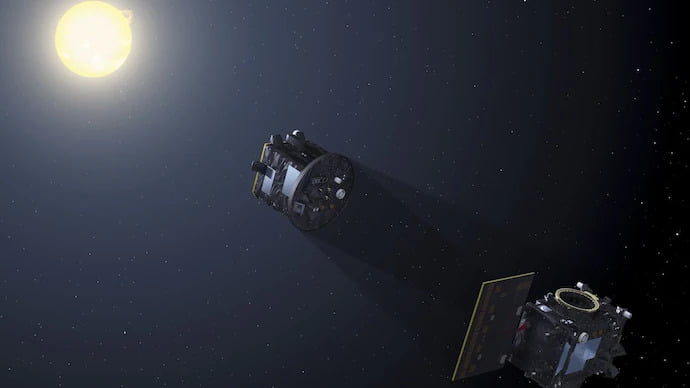
    The European Space Agency (ESA) and the Indian Space Research Organization (ISRO) launched the Proba-3 mission on December 5, 2024, from India aboard the PSLV-XL rocket. The mission is the first in history to create artificial solar eclipses in space using two spacecraft flying in precise formation.

    Designed to study the Sun’s corona in detail, the mission could also advance space-based astronomy and improve predictions of space weather that affect satellites, power systems, and communications.

    Proba-3 uses two spacecraft positioned 144 meters apart. One carries a telescope aimed at the Sun, while the other holds an occulting disc to block its bright surface, revealing the much fainter corona. This formation flying approach could lead to future missions capable of building virtual telescopes hundreds of meters wide for sharper, more detailed views of distant space objects.

    The mission’s goal is the Sun’s outer atmosphere, or corona, which reaches temperatures above one million degrees Celsius despite being farther from the surface than the cooler layers below.

    The corona is the source of space weather events that can damage satellites and disrupt power and communication networks. Because the corona is so faint as compared to the actual surface of the Sun, it can normally be studied only during short natural eclipses. Proba-3 will allow uninterrupted observations for up to six hours, offering data that could improve space weather forecasting.

    Technical details

    The Proba-3 project began in 2005 as a collaboration between ESA and ISRO. Its two spacecraft fly in a fixed line, separated by 144 meters, with the occulting disc on one craft aligned to block the Sun’s bright inner region from the telescope on the other. This arrangement makes the corona visible in much greater detail than from Earth-based observations.

    Mission challenges

    Formation flying at this scale requires extreme precision. The spacecraft must maintain positions accurate to within millimeters and point within thousandths of a degree, all while travelling at speeds between 1 and 10 kilometers per second. Each craft carries its own guidance systems and processors, enabling them to operate and align without constant ground control.

    The mission’s orbit allows the artificial eclipse to last up to six hours. During this time, the spacecraft coordinate in real time to collect and transmit data. The extended viewing period will give scientists a detailed and continuous record of the corona, helping to answer questions about its structure, heat, and role in driving solar activity.

  • Will Asteroid 99942 Apophis ‘God of Chaos’ hit Earth in 2029? NASA, ESA rule out the 2029 Apophis impact

    Will Asteroid 99942 Apophis ‘God of Chaos’ hit Earth in 2029? NASA, ESA rule out the 2029 Apophis impact

    Asteroid Apophis, a 375-meter-wide space rock once thought to threaten Earth, will pass closer than some satellites on April 13, 2029. The approach, at about 32,000 kilometers, will be visible to the naked eye from parts of Europe, Africa, and western Asia. NASA and other agencies confirm it poses no risk, but the close flyby offers a rare chance for scientists to study its surface, structure, and orbit in detail.

    Apophis will be the largest asteroid to pass this close in history. Its path will take it just below geostationary satellite orbits, creating a bright, fast-moving point of light in the night sky. Observers in the Eastern Hemisphere will have the best view without telescopes or binoculars. Researchers aim to measure its spin, composition, and surface features during the event.

    Earlier calculations suggested possible impacts in 2029, 2036, and 2068, raising fears that Apophis could be a “planet killer.” Updated data from NASA’s tracking programs have ruled out any chance of collision for at least the next century. A study by astronomer Paul Wiegert notes a very small chance that a collision with another asteroid could alter its course, but the probability of a 2068 impact remains about one in 150,000.

    Is Apophis a planet killer?

    With all impact risks removed for over a century, Apophis is not considered a planet killer. While its unusual orbit once caused concern, scientists now agree the asteroid will pass safely by Earth in 2029 and 2036.

    What would happen if Apophis hit Earth?

    If Apophis struck Earth, the damage would be regional but severe. The Planetary Society estimates the energy released would equal about 1,200 megatons of TNT. Such an event could cause strong earthquakes, widespread fires from heat and debris, and, if it hit the ocean, massive tsunamis.

    Discovery of asteroid Apophis

    Apophis was discovered in 2004 at Arizona’s Kitt Peak Observatory by Roy Tucker, David Tholen, and Fabrizio Bernardi. Initial tracking placed it among the most dangerous known asteroids, but improved observations over the years proved those early predictions wrong. By 2021, new measurements confirmed it will not impact Earth in the foreseeable future.

    Structure and formation

    The asteroid is made of silicates mixed with iron and nickel, with a peanut-like shape consisting of two lobes. It originated in the main asteroid belt between Mars and Jupiter before being moved into its current orbit by gravitational interactions.

    Dimensions and details

    Apophis spins once every 30 hours and completes an orbit around the Sun in 324 days. Its 2029 path will take it near satellite altitudes, but the likelihood of hitting one is extremely small. The best viewing will be from Europe, Africa, and western Asia.

    Where does the name Apophis come from?

    The name comes from Apophis, the Greek form of Apep, an ancient Egyptian deity representing chaos and an enemy of the sun god Ra. The name reflects the asteroid’s once-feared potential.

    Future missions to study Apophis

    NASA has adapted its OSIRIS-REx spacecraft into OSIRIS-APEX, which will rendezvous with Apophis after the 2029 flyby. The probe will orbit for 18 months, map the asteroid, and use bursts of gas to expose subsurface material.

    The European Space Agency is also developing Ramses, a mission planned for a 2028 launch if approved in 2025. Ramses would accompany the asteroid during its close approach, deploying CubeSats for additional data.