Category: Space

Explore the vastness beyond our planet. This section covers missions, discoveries, and events that expand our reach into the cosmos. From new rocket launches to deep-space observations, “Space” keeps you updated on humanity’s steps into the unknown.

  • Astronomers Use Sulfur Gas to Reveal Hidden Shockwaves Powering Violent Galaxy Cores

    Astronomers Use Sulfur Gas to Reveal Hidden Shockwaves Powering Violent Galaxy Cores

    A team of astronomers led by Martín Sato at the Chalmers University of Technology has used sulfur-based molecules to track violent gas shocks inside three nearby galaxies, uncovering how mergers and black hole activity shape their hidden cores.

    Using the Atacama Large Millimeter/submillimeter Array (ALMA), the group detected hydrogen sulfide (H₂S) gas in galaxies NGC 1377, NGC 4418, and NGC 1266, finding signs of powerful outflows that can either fuel or suppress star formation.

    The galaxies studied are known as luminous infrared galaxies, or LIRGs. They emit large amounts of infrared light because their cores are packed with dust that hides intense bursts of star formation and feeding black holes. These systems form when galaxies collide, compressing gas clouds and triggering activity that is invisible to regular telescopes.

    The researchers turned to hydrogen sulfide as a new tool to study this process. On Earth, H₂S is known for its unpleasant smell, but in space it sticks to dust grains and only becomes detectable when shocks from gas collisions heat and release it. Because of that, H₂S is an excellent marker of energetic and turbulent regions.

    Using ALMA’s Band 5 and Band 6 receivers, Sato’s team observed the galaxies at frequencies of 168 and 217 gigahertz, achieving resolutions as fine as 0.2 arcseconds. That level of detail revealed gas motion and structure within just 150 parsecs of each galaxy’s center, a scale small enough to study how material moves near the supermassive black holes and dense star clusters.

    The results showed compact H₂S regions overlapping the dusty cores of all three galaxies. In each case, the spectra displayed wide velocity wings, which indicate gas moving at hundreds of kilometers per second. These are signatures of outflow streams of gas pushed out by radiation, stellar winds, or jets from black holes.

    In NGC 1377, located about 21 million light-years away, the H₂S signal appeared in a narrow region roughly 150 parsecs across. It stretched east to west, matching the direction of a previously detected molecular jet.

    The broad velocity wings suggest this gas is being accelerated, possibly by the same jet that pushes cooler carbon monoxide gas at rates of 8 to 35 solar masses per year. The hydrogen sulfide also traced warmer conditions, between 40 and 200 Kelvin, compared to the colder CO gas nearby.

    NGC 4418, about 30 million light-years away, showed an even more complex motion pattern. The H₂S gas in this galaxy appeared to rotate opposite to the stars, likely due to a recent merger that introduced new material. One side of the emission extended into redshifted velocities, hinting at either inflowing gas or a tilted outflow cone. Its dusty core is so dense that it may contain a young, still-forming active nucleus.

    In NGC 1266, the hydrogen sulfide behaved differently. Instead of emitting light, it absorbed it, a sign that cooler gas is expanding outward in front of the bright central dust. The blue-shifted absorption and faint red emission together point to a shell of material being driven away from the center, consistent with other observations showing a powerful outflow fueled by either a starburst or a black hole.

    To understand the physical conditions inside these regions, the team ran simulations using a program called RADEX. They found that H₂S emission requires gas densities above 10 million molecules per cubic centimeter, ten times higher than estimates based on carbon monoxide in the same areas. This indicates that the sulfur gas traces much denser, more compact zones of shocked material.

    The researchers argue that these dense knots form in shock fronts created by fast-moving gas. The shocks compress material without destroying the molecules, a process called C-type shock, where magnetic fields cushion the impact. These conditions resemble those seen in regions of star formation within our own galaxy, such as the Orion Kleinmann-Low nebula, where hydrogen sulfide is also abundant.

    The findings are important because LIRGs represent a nearby window into the kinds of galaxy mergers that were common in the early universe.

    They help scientists understand how galaxies regulate their growth through feedback, the process where outflows from black holes and stars heat or expel gas, slowing down further star formation. Without these outflows, galaxies could collapse under their own gravity or feed their black holes too rapidly.

    Earlier single-dish observations by Sato’s team in 2022 had hinted that hydrogen sulfide emission was connected to the mass of the outflowing gas. The new high-resolution data confirm that connection and show that shocks, not just warm gas, are responsible for producing the H₂S signal.

    The team plans to expand this research to a larger sample of galaxies. Future instruments such as the next-generation Very Large Array (ngVLA) will be able to detect even fainter H₂S lines, allowing astronomers to study galaxies farther away and link their observations to the inflows and outflows that the James Webb Space Telescope is finding at high redshift.

    Source: High-resolution ALMA observations of H₂S in LIRGs

  • NASA’s AVATAR Project Uses Astronaut Cells to Study Space Radiation in Deep Space

    NASA’s AVATAR Project Uses Astronaut Cells to Study Space Radiation in Deep Space

    NASA is preparing to send pieces of human biology into deep space to find out how radiation and weightlessness harm the body. The AVATAR project, short for A Virtual Astronaut Tissue Analog Response, will fly on the Artemis II mission in 2026. The experiment uses small organ chips containing real astronaut cells to study how bone marrow reacts to cosmic conditions.

    The findings will help protect future crews traveling to the Moon, Mars, and beyond while advancing cancer treatment research on Earth.

    Each AVATAR chip is about the size of a thumb drive. Inside, it holds living human cells that behave like miniature organs. These chips mimic bone marrow, made from stem cells taken from the Artemis II astronauts. They reproduce how blood-forming cells grow and react inside the body, allowing scientists to study deep-space effects without endangering crew members.

    To build each chip, researchers extract stem cells from the astronauts’ blood. They place them inside narrow channels lined with blood vessel cells. Fluid circulates through these channels to simulate the movement of blood.

    Sensors record how the tissue responds to space conditions such as microgravity and cosmic radiation. This approach comes from microfluidic technology developed in the 2010s and replaces some forms of animal testing with realistic human cell models.

    NASA chose bone marrow for AVATAR because it produces red, white, and platelet cells essential for oxygen transport, immunity, and clotting. Radiation and weightlessness disrupt all three. In deep space, radiation exposure can be hundreds of times stronger than on Earth, especially during solar quiet periods. Understanding how bone marrow responds is vital for maintaining astronaut health on long missions.

    Artemis II will be NASA’s first crewed flight of the Orion spacecraft and the Space Launch System rocket. The 10-day mission will loop around the Moon and return to Earth. The AVATAR hardware, designed by Space Tango, will run automatically inside the spacecraft while astronauts focus on flight tasks.

    The chip technology itself is supplied by Emulate, a company specializing in organ-on-a-chip systems that can function for months without direct maintenance.

    Outside Earth’s magnetic field, the chips will experience real radiation that cannot be fully simulated in labs on Earth. Scientists expect to see DNA damage, altered gene expression, and weakened cell growth. Early lab tests already show that marrow cells change how they produce proteins when exposed to radiation.

    After the mission, researchers will analyze the returned samples using RNA sequencing to measure how spaceflight changed each gene’s activity.

    These results will build on earlier studies like NASA’s Twins Study, which compared astronaut Scott Kelly’s year in orbit with his twin brother on Earth. AVATAR goes a step further by testing astronaut-derived tissue directly in deep space. The project may explain why some people handle radiation better, leading to more personalized space medicine.

    For Mars missions lasting up to three years, this data could help NASA create individual medical kits and drug plans. Each astronaut’s cells could reveal unique sensitivities, allowing doctors to design custom countermeasures before launch. The same knowledge could improve care for cancer patients on Earth, where radiation therapy often damages bone marrow and causes fatigue, infections, or anemia.

    AVATAR’s benefits extend to drug testing, too. Organ chips already allow pharmaceutical companies to predict side effects and test treatments without animal trials. By using astronaut tissue, NASA adds an extreme testing ground that could improve how therapies are designed for both space and Earth.

    NASA plans to expand the project after Artemis II to include organ chips representing the liver, kidneys, and heart. In the future, astronauts could even carry chips that monitor their health in real time, warning of radiation damage before symptoms appear.

    The AVATAR project bridges the gap between spaceflight and medicine. By sending human cells where no lab can go, NASA hopes to better protect astronauts on future deep-space missions and bring home discoveries that improve lives on Earth.

  • ESA Study Tracks Over 1,000 Dust Devils on Mars, Revealing Surprising Wind Speeds and Patterns

    ESA Study Tracks Over 1,000 Dust Devils on Mars, Revealing Surprising Wind Speeds and Patterns

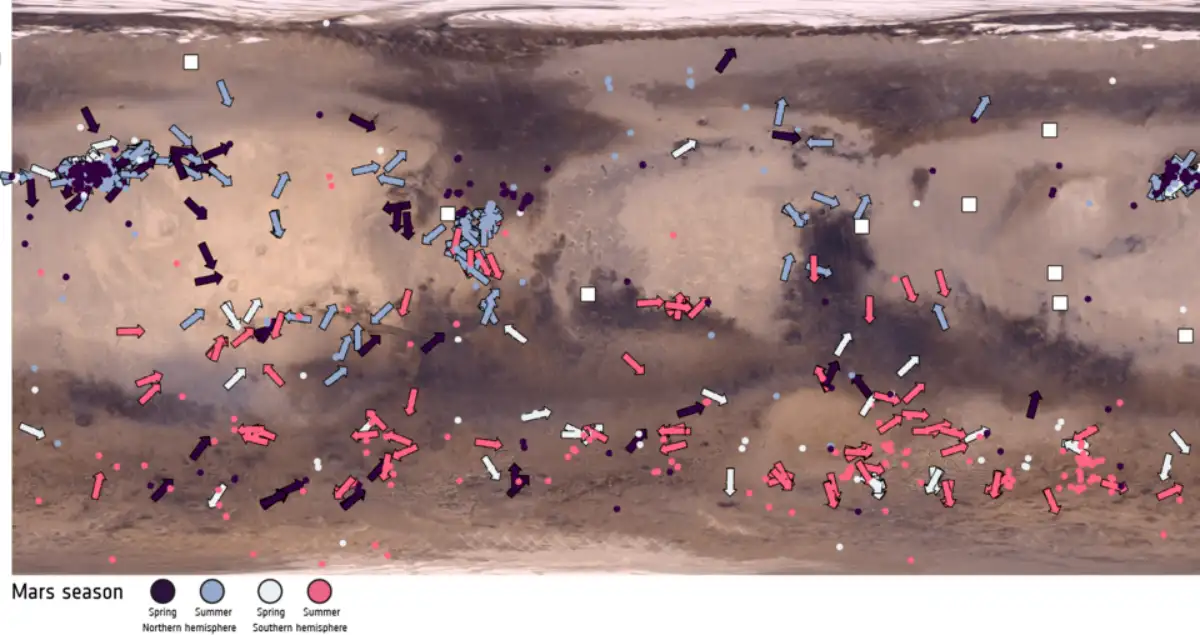
    Scientists using ESA’s Mars Express and ExoMars Trace Gas Orbiter have tracked more than a thousand dust devils across the Martian surface, revealing winds far stronger than expected. The study, published in Science Advances, shows that these spinning columns of dust can reach speeds up to 158 kilometers per hour. The findings help researchers understand how Martian weather works and how it could affect future missions.

    Dust devils form when warm air rises through cooler air, creating rotating vortices that lift dust from the ground. On Mars, they leave visible streaks behind as they clear fine material from the surface. Unlike on Earth, they thrive in an atmosphere just one percent as dense, yet they are strong enough to move dust high into the sky.

    The new survey catalogued 1,039 dust devils, the first time scientists have been able to map them on a global scale. Many were found in dusty plains such as Amazonis Planitia. The study shows that some whirlwinds wobble as they move, changing direction unexpectedly. Seasonal patterns also emerged, with activity peaking in the Martian spring and summer, between late morning and early afternoon.

    To measure wind speed, researchers used a neural network to identify dust devils in two decades of images from the orbiters. The spacecraft’s cameras, designed to photograph the surface, occasionally recorded the same scene several seconds apart.

    Dust devils shifted between these exposures, and scientists used that displacement to calculate speed and direction. Mars Express provided delays of up to 19 seconds, while ExoMars’ CaSSIS camera offered longer delays of up to 46 seconds, making movement easier to track.

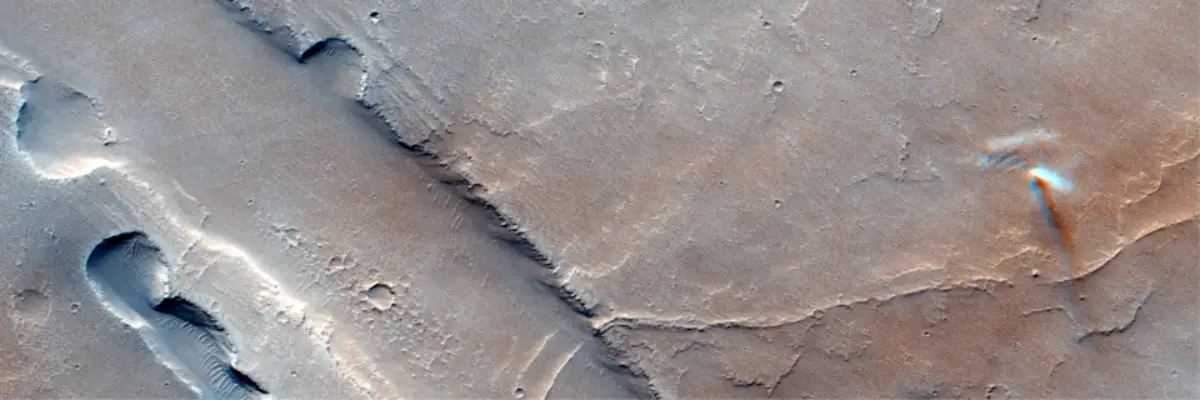
    A Dust Devil on Mars.
    A dust devil on Mars captured by ESA’s ExoMars TGO. Image credit: ESA

    Some dust devils were clocked at 44 meters per second, faster than anything previously measured by rovers on the surface. These high speeds mean that dust storms on Mars may carry more material than current models predict, affecting the climate and shaping how the thin atmosphere evolves over time.

    Dust plays an important role in Mars’ environment. It cools the surface during the day, warms the air at night, and can seed clouds. On a larger scale, storms can lift water vapor into the upper atmosphere, where it may escape into space. The dust also impacts robotic missions. Accumulation on solar panels reduces power, as seen with NASA’s InSight lander, which shut down in 2022 after losing too much energy.

    Understanding when and where dust devils occur could help engineers select safer landing sites and design more resilient equipment. The new catalog shows where activity is most common and provides data for improving climate models.

    The researchers also highlighted how these dust devils are not evenly spread across the planet. While Amazonis Planitia produced many of them, areas such as Hellas Basin recorded fewer, likely because of less loose material. Some whirlwinds were also observed on the slopes of giant Martian volcanoes, showing that elevation does not prevent them from forming.

    Future work will focus on combining observations from both orbiters taken at the same time, which could confirm speed calculations. As the catalog grows, scientists expect to refine models of Martian weather, helping prepare for both robotic and eventual human missions.

    Mars Express and ExoMars continue to send back images, adding new examples of dust devils to the record every week. Researchers say these findings are a step toward understanding how winds shape the planet’s surface and atmosphere.

    Sources: Dancing dust devils trace raging winds on Mars; Dust devil migration patterns reveal strong near-surface winds across Mars

  • ESA Mars Orbiters Capture Rare Images of Interstellar Comet 3I/ATLAS Passing Near the Red Planet

    ESA Mars Orbiters Capture Rare Images of Interstellar Comet 3I/ATLAS Passing Near the Red Planet

    Two European spacecraft orbiting Mars have captured rare images of an interstellar comet passing nearby. On October 3, ESA’s ExoMars Trace Gas Orbiter and Mars Express turned their cameras toward comet 3I/ATLAS as it came within about 30 million kilometers of the red planet. The close approach gave scientists an unusual chance to study material from beyond our solar system.

    Comet 3I/ATLAS was first spotted in July 2025 by the ATLAS telescope in Chile. It is only the third interstellar comet ever confirmed, following ‘Oumuamua in 2017 and Borisov in 2019. These comets travel on hyperbolic paths, meaning they are not bound to the sun and will not return once they pass through.

    Astronomers believe 3I/ATLAS may be far older than our solar system. Models suggest it formed about 7.6 billion years ago, roughly three billion years before the sun and planets. Its orbit shows that it likely escaped from a distant star system long ago and has been drifting through space ever since, carrying frozen material from another corner of the galaxy.

    The ExoMars orbiter used its CaSSIS camera to take a series of long exposures, capturing the comet as a faint white spot moving across the sky. That blur represents the nucleus and its coma, the cloud of dust and gas released as sunlight warms the surface.

    The nucleus itself is estimated to be only about a kilometer wide, too small to be resolved directly from such a distance. By comparison, scientists described it as like trying to see a phone from the surface of the moon.

    The coma already measures thousands of kilometers across, though its edges are hard to see against the background. No tail has yet been detected, but astronomers expect one to form as the comet moves closer to the sun in the coming weeks.

    Mars Express also attempted to record the event, but its shorter exposures made the comet more difficult to pick out. Teams are combining and processing multiple images to improve visibility. Both orbiters also tried to collect spectral data to identify gases escaping from the comet.

    Capturing these images was a technical challenge. The orbiters are built to photograph the Martian surface, which is only hundreds of kilometers away. The comet, by contrast, was tens of millions of kilometers distant and tens of thousands of times dimmer. According to CaSSIS team leader Nick Thomas, the task pushed the limits of the spacecraft’s instruments.

    Studying interstellar comets is important because they are made of material that formed around other stars. Small differences in their chemistry, such as isotope ratios or unusual ice content, help researchers compare how planetary systems form across the galaxy.

    When astronomers studied 2I/Borisov, for example, they found unusually high levels of carbon monoxide, suggesting it came from a colder environment than our solar system.

    Analysis of the Mars images will continue for several weeks, as scientists measure the coma’s size and look for chemical signatures. The comet will also be observed by ESA’s Juice spacecraft, which is currently on its way to Jupiter. Juice is expected to capture new data after 3I/ATLAS makes its closest approach to the sun. Because of the spacecraft’s distance, that information will not reach Earth until February 2026.

    Looking ahead, ESA plans to launch the Comet Interceptor mission in 2029. The spacecraft will wait in space for a target, which could be an untouched comet from the Oort Cloud or even another interstellar visitor. Unlike current observations from afar, a direct encounter would allow scientists to study the surface and structure of such an object up close.

    Source: ESA’s ExoMars and Mars Express observe comet 3I/ATLAS

  • Russian amateur astronomer discovers distant supernova using remote telescope in Australia

    Russian amateur astronomer discovers distant supernova using remote telescope in Australia

    A Russian amateur astronomer has discovered a supernova more than 2 billion light-years away, using a rented telescope on the opposite side of the planet. On August 17, Filipp Romanov spotted the faint glow of SN 2025umq in the constellation Pisces. The find was later confirmed as a Type Ia supernova by professional astronomers, making it his first solo discovery of this kind.

    Romanov identified the event while scanning images taken through the iTelescope T59 in Australia, a 0.51-meter telescope he controls online from his home in Primorsky Krai, Russia. The object appeared at magnitude 20, barely visible in the data but clearly absent from earlier photographs.

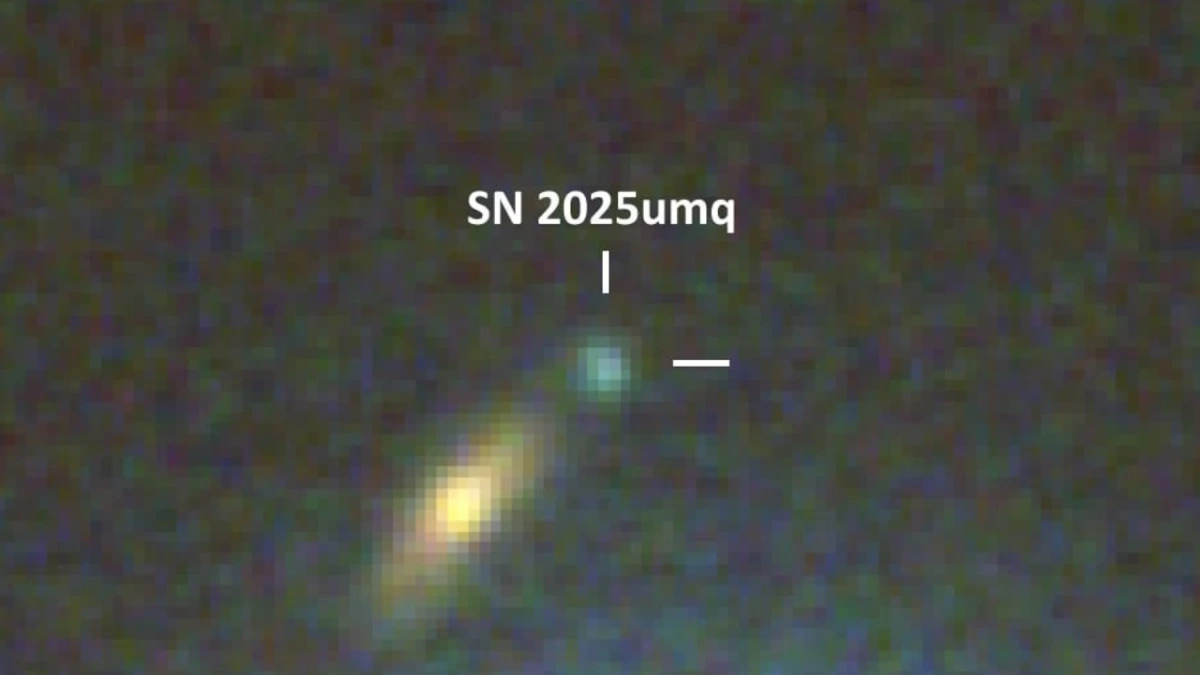
    Supernova SN 2025umq
    Supernova SN 2025umq captured by Filipp Romanov on August 24, 2025.

    The candidate was reported to the International Astronomical Union’s Transient Name Server, which registered it as AT 2025umq. Follow-up observations from the Liverpool Telescope in La Palma, Spain, confirmed its spectrum as a Type Ia supernova, with a redshift of 0.159.

    That places the explosion about 2 billion light-years away. Pre-discovery images from the Zwicky Transient Facility showed the supernova was already active by late July, but Romanov’s report secured his credit.

    Type Ia supernovae occur when a white dwarf accumulates too much material from a companion star, triggering a runaway explosion that destroys it completely.

    They briefly shine brighter than a billion suns, often outshining their host galaxies. Because these supernovae always reach a consistent peak brightness, astronomers use them as “standard candles” to measure cosmic distances. This method helped reveal the accelerating expansion of the universe and the existence of dark energy.

    SN 2025umq adds to the global catalog of thousands of supernovae discovered each year, each one refining distance calculations and models of how galaxies evolve. For astronomers, these explosions also represent factories of heavy elements such as iron and nickel, which enrich galaxies with the material needed for planets and, eventually, life.

    Romanov’s discovery also highlights the role of amateur observers in modern astronomy. Remote telescope networks like iTelescope allow people anywhere in the world to collect professional-grade data without owning large instruments. By booking time on telescopes in Australia, Spain, and the U.S., Romanov can bypass local weather and light pollution, giving him constant access to clear skies.

    Romanov, self-taught and based in Russia’s far east, has already discovered 82 variable stars, nine asteroids four of which are named for family members and several novae in the Andromeda Galaxy.

    He has co-authored other supernova discoveries through survey data but this is his first confirmed find on his own. He has also captured unusual celestial events, including a comet discovery in 2025 and a rare occultation of Uranus by the eclipsed Moon in 2022.

    He admitted luck played a role this time, noting that the supernova was located near the edge of the image frame and could have been missed if cropped. Still, the discovery adds his name to the long-running list of amateur astronomers making contributions alongside large automated surveys.

    The host galaxy, SDSS J004819.14+075856.8, lies in Pisces, a constellation that rises high in the northern sky during autumn and winter. For now, astronomers will continue to monitor SN 2025umq as it fades, while Romanov prepares for his next search.

  • NASA and Blue Origin prepare Mars mission with twin probes to study atmosphere loss

    NASA and Blue Origin prepare Mars mission with twin probes to study atmosphere loss

    NASA and Blue Origin are preparing to launch two small spacecraft to Mars later this year to study how the planet lost most of its atmosphere. The ESCAPADE mission, carried by Blue Origin’s New Glenn rocket from Cape Canaveral, will send twin probes into orbit around Mars to track how solar particles strip away its air.

    The spacecraft are part of NASA’s low-cost planetary program and are scheduled to launch in late October or early November. The mission is led by the University of California, Berkeley’s Space Sciences Laboratory, with spacecraft built by Rocket Lab. NASA says the data could help explain how Mars changed from a wetter, potentially habitable world into the desert planet seen today.

    Each probe, named Blue and Gold, is about the size of a carry-on suitcase and powered by solar panels. They carry instruments such as magnetometers and plasma analyzers to measure the interaction between charged particles from the sun and Mars’ thin atmosphere. By flying in different orbits, the two will give scientists simultaneous readings from multiple points around the planet.

    The mission focuses on the effect of the solar wind, the constant flow of charged particles from the sun. On Earth, a strong global magnetic field deflects most of these particles, but Mars has only weak, patchy magnetic fields. As a result, the solar wind directly hits the atmosphere, knocking particles into space.

    NASA has studied this process before with the MAVEN mission, launched in 2014, which first mapped how solar wind affects Mars. ESCAPADE adds another dimension by providing two vantage points at once, allowing researchers to track changes in real time. The goal is to learn how quickly the atmosphere escapes and how that process shapes climate and habitability.

    The New Glenn rocket carrying the probes is a heavy-lift vehicle capable of hauling more than 45 tons into low Earth orbit. It runs on methane fuel and is designed for reuse, with the first stage returning to land after launch. This will be the rocket’s second flight, a major milestone for Blue Origin as it builds up its launch record. A hotfire test is expected in the coming weeks.

    NASA’s Heliophysics Division is funding the mission, which ties into research on how the sun affects planets across the solar system. Understanding these effects is also important for planning human missions to Mars, since space weather can interfere with communications and safety during future crewed flights.

    Reporters wishing to cover the launch must apply for media credentials by October 13. NASA is posting updates on its ESCAPADE mission blog ahead of the launch.

  • Cassini data reveals new organic compounds on Saturn’s moon Enceladus

    Cassini data reveals new organic compounds on Saturn’s moon Enceladus

    Scientists have identified more complex organic molecules on Saturn’s moon Enceladus, deepening evidence that its hidden ocean could support the chemistry needed for life. This discovery comes from a reanalysis of Cassini spacecraft data gathered during a 2008 flyby.

    Enceladus is a small icy moon, just 500 kilometers across, that constantly ejects plumes of water vapor and ice from cracks at its south pole. Between 2005 and 2015, NASA’s Cassini probe flew through these plumes 23 times, sampling material believed to come from a global ocean beneath the surface.

    During its E5 flyby in October 2008, Cassini passed just 21 kilometers above the moon at a speed of 17.7 kilometers per second. At this velocity, fresh ice grains only minutes old were collected and smashed into a rhodium plate inside the Cosmic Dust Analyzer. This allowed scientists to examine their chemical makeup with unusual clarity, free from interference seen at slower flybys.

    Researchers confirmed the presence of compounds already known from earlier studies, such as methane, ammonia, and carbon dioxide. But the reanalysis also revealed aldehydes like acetaldehyde, esters including allyl propionate, and ethers such as diethyl ether.

    Some molecules contained nitrogen or oxygen, including pyridine-related compounds and acetonitrile. Many of these appeared in grains linked to the subsurface ocean rather than surface contamination.

    With phosphorus detected in earlier studies, Enceladus now shows all five of life’s basic elements like carbon, hydrogen, nitrogen, oxygen, and phosphorus alongside a wide mix of organic compounds. These ingredients could combine into amino acids, lipids, or even building blocks of RNA under the right conditions.

    The environment beneath Enceladus’ icy crust may provide those conditions. Tidal forces from Saturn’s gravity flex the moon’s interior, generating heat. This keeps a liquid ocean tens of kilometers below the surface and may drive hydrothermal activity on the seafloor. Evidence of silica in the plumes suggests vent temperatures above 90°C, similar to hydrothermal vents on Earth where microbes thrive without sunlight.

    Scientists say the presence of both energy and organic molecules makes Enceladus one of the most promising places to search for life beyond Earth. While there is no direct evidence of biology, the chemistry strongly points toward processes that could support it.

    Comparisons are often made to Jupiter’s moon Europa, which also has a subsurface ocean and possible plumes. NASA’s Europa Clipper, launching later this decade and arriving in 2030, will carry instruments similar to Cassini’s to test whether Europa holds the same chemistry.

    For Enceladus, future mission ideas include the proposed Enceladus Life Finder, which would fly through plumes again, and the Orbilander, which could both orbit and land to analyze samples more directly.

    Cassini’s mission ended in 2017 with a dive into Saturn, but its archive continues to produce discoveries years later. This latest study shows how re-examining old data can expand the search for habitable environments in the outer solar system.

    Sources: Saturn’s Moon Emits Organic Compounds, Out-of-this-World Ice Geysers

  • Axiom Space selects Portuguese physiologist to lead six-month astronaut training program

    Axiom Space selects Portuguese physiologist to lead six-month astronaut training program

    Axiom Space

    has chosen Portuguese physiologist Emiliano Ventura to head a new astronaut preparation program aimed at readying future crews for commercial spaceflight. The announcement, made at the International Astronautical Congress, places Ventura in charge of a six-month trial called Project Astronaut, which blends elite sports training methods with the physical and medical challenges of space.

    Ventura is no stranger to Axiom’s missions. His Lisbon-based team at the Motor & Sport Institute (MSI) supported astronauts during quarantine for the company’s Ax-3 and Ax-4 flights, including Swedish astronaut Marcus Wandt.

    Now, Ventura will adapt performance science used in soccer and Formula 1 to astronauts who must cope with weightlessness, radiation, and the stress of launch. He has also stated that he hopes to join a future Axiom mission himself.

    At MSI’s Bio Performance Center, Ventura works with professional athletes, measuring heart rate, oxygen use, and recovery times to improve endurance. Those same tools apply in space, where microgravity shifts blood toward the head, weakens bones, and reduces muscle strength. Astronauts can lose up to 20 percent of leg power in weeks, and Ventura aims to design exercise and nutrition plans that reduce this decline.

    The six-month training program includes centrifuge sessions to simulate launch forces, parabolic flights that provide 20–30 seconds of weightlessness at a time, and altitude chamber drills that mimic cabin depressurization. Outdoor survival activities will build teamwork, while spacesuit trials replicate the strain of working in bulky gear weighing more than 100 kilograms.

    Veteran astronauts Peggy Whitson and Michael López-Alegría will contribute their experience to the program, ensuring it reflects real mission demands. By combining academic research with practical testing, Ventura intends to shorten the time it takes crews to adapt to orbit, allowing them to focus more quickly on experiments and station operations.

    Ventura has set his sights on flying himself, possibly on Axiom’s Ax-5 mission or later. With the International Space Station due for retirement around 2030, his opportunity may come aboard Axiom’s own station. The first module will dock with the ISS next year, with plans to expand into a free-flying outpost by the end of the decade.

    Traditionally, NASA astronauts train for two years with extensive survival and systems drills. Axiom’s shorter six-month approach reflects the shift toward private space travel, where scientists, doctors, and even paying passengers may replace career pilots as crew members. The company believes this faster and more specialized track will reduce costs while widening access to space.

    As competition in Low Earth Orbit (LEO) grows, with projects like Starlab also in development, Axiom is positioning itself as a leader in commercial astronaut preparation. Ventura’s mix of sports science and space physiology could shape how future travelers train for what may become routine trips beyond Earth.

  • NASA and ISRO’s NISAR Satellite Sends First Radar Images of Earth

    NASA and ISRO’s NISAR Satellite Sends First Radar Images of Earth

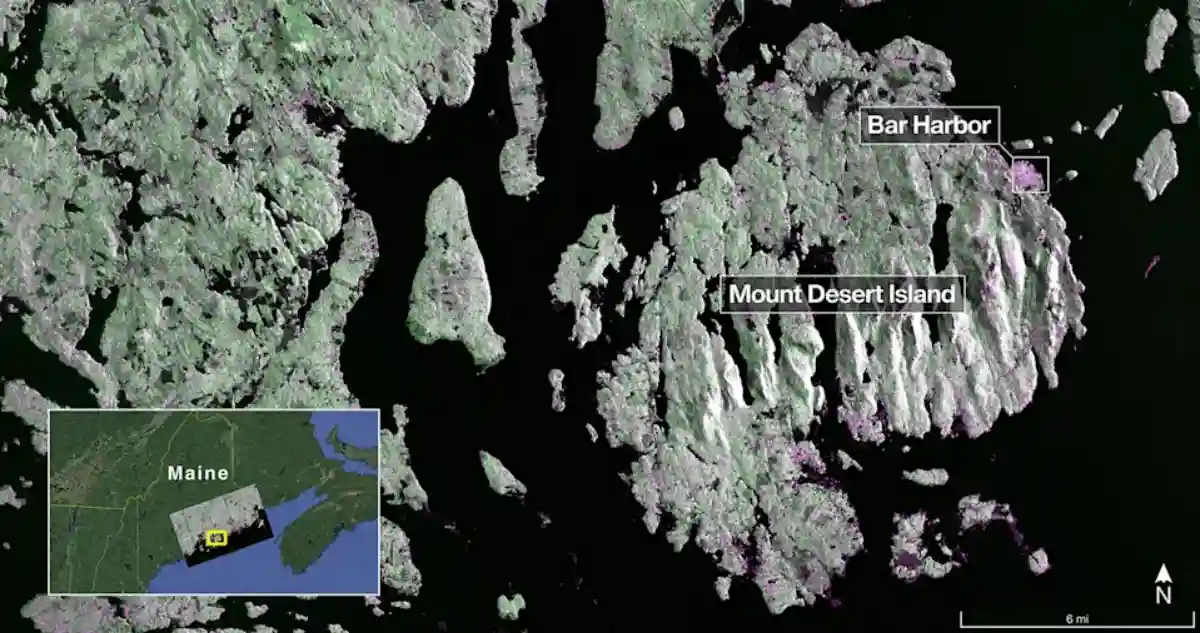
    NASA and India’s ISRO have released the first radar images from their joint NISAR satellite, just weeks after its launch from Sriharikota on July 30, 2025. The mission, short for NASA-ISRO Synthetic Aperture Radar, sent back views of Mount Desert Island in Maine on August 21 and farmland in North Dakota two days later.

    Scientists say the data shows how the satellite can track land, crops, forests, and water with clarity unmatched by other Earth-observing missions.

    NISAR is the first spacecraft to carry two radar systems at once. NASA’s L-band radar can detect deep changes in soil, ice, and forests, while ISRO’s S-band radar is tuned for monitoring crops and smaller vegetation. From its orbit 747 kilometers above Earth, NISAR scans nearly the entire planet every 12 days.

    Its 12-meter antenna, the largest NASA has launched, captures swaths 240 kilometers wide and can spot features as small as five meters. Unlike optical satellites, it works day or night and through cloud cover.


    The first images highlight what the system can do. In Maine, forests appeared in green, water in black, and buildings in magenta. In North Dakota, radar distinguished wetlands, forests, bare soil, and irrigated farmland, even showing circular crop patterns.

    Scientists say this ability to separate surface types will help track floods, droughts, deforestation, and melting ice, as well as measure ground shifts from earthquakes or landslides down to a centimeter.

    The mission represents nearly a decade of work between NASA’s Jet Propulsion Laboratory and ISRO. India provided the S-band radar, spacecraft bus, and launch on its GSLV-F16 rocket, while NASA contributed the L-band radar, antenna, and communications systems. Engineers on both sides say the successful deployment of the satellite’s antenna in orbit was a key milestone.

    NISAR is now in its commissioning phase, with full operations set to begin in November 2025. Once active, it will deliver open-access data for researchers worldwide. Scientists expect it to become one of the most detailed Earth-monitoring tools yet, helping governments and communities respond to disasters, manage resources, and understand climate change.

  • NASA and Australia Sign Framework Agreement to Expand Space and Aeronautics Cooperation

    NASA and Australia Sign Framework Agreement to Expand Space and Aeronautics Cooperation

    NASA

    and the Australian Space Agency signed a framework agreement in Sydney on Tuesday, marking a new stage in more than 50 years of cooperation between the two nations. Acting NASA Administrator Sean Duffy and Australian Space Agency chief Enrico Palermo signed the deal during the International Astronautical Congress, which Australia is hosting for the first time since 1988.

    The agreement sets out how the two countries will develop joint projects in aeronautics and space exploration, with a focus on peaceful uses and long-term collaboration.

    The timing reflects the high-profile nature of the International Astronautical Congress, where officials, researchers, and companies from around the world meet to exchange ideas.

    Duffy described Australia as a reliable partner, noting the role it played in the Apollo program and more recently in the Artemis program. The new agreement raises their partnership to a treaty-level understanding, providing a framework for larger and more complex projects in the future.

    The United States and Australia first formalized their space ties in 1960. Since then, Australian ground stations have played a central role in tracking and relaying data for U.S. missions. Canberra’s station in the Deep Space Network helped track Apollo 11 and carried communications during the Apollo 13 emergency.

    Today, it continues to operate as part of NASA’s system, sending commands to spacecraft such as Mars rovers and the James Webb Space Telescope (JWST) when U.S.-based antennas are not in position.

    The new agreement includes joint work in multiple areas. These range from planetary exploration and Earth monitoring to geodesy, a field that measures Earth’s gravity to track sea levels and climate change.

    Space medicine and aeronautics are also included, such as research into quieter aircraft engines. Australia’s location in the Southern Hemisphere also gives it a vantage point for observing cosmic events, allowing it to contribute to global monitoring of high-energy events like gamma-ray bursts.

    Australia is developing its own contributions to lunar exploration. A semi-autonomous rover is under construction and set to launch before 2030. It will travel aboard a commercial lander as part of NASA’s CLPS program, carrying a U.S. instrument designed to analyze lunar soil for water ice and minerals.

    The rover will use onboard navigation to avoid craters and obstacles, serving as a test case for future human operations on the Moon.

    Australia joined the Artemis Accords in 2020, aligning itself with NASA’s framework for cooperative lunar exploration. This week’s Artemis principals’ meeting, co-hosted by Australia and the United Arab Emirates, focused on international coordination for future lunar bases.

    Duffy noted that the collaboration could extend to Mars, with both countries sharing research on the effects of space travel on human health. Palermo said the partnership will also drive opportunities for Australian industries, including satellite networks that track natural disasters like bushfires.

    Officials said the agreement is a practical step to expand cooperation in science, industry, and spaceflight. By combining technical knowledge and resources, NASA and the Australian Space Agency aim to make space operations more efficient and open new opportunities for exploration and research.