Category: Space

Explore the vastness beyond our planet. This section covers missions, discoveries, and events that expand our reach into the cosmos. From new rocket launches to deep-space observations, “Space” keeps you updated on humanity’s steps into the unknown.

  • Asteroid Ryugu Sample Contaminated by Earth Bacteria Despite Strict Handling Protocols

    Asteroid Ryugu Sample Contaminated by Earth Bacteria Despite Strict Handling Protocols

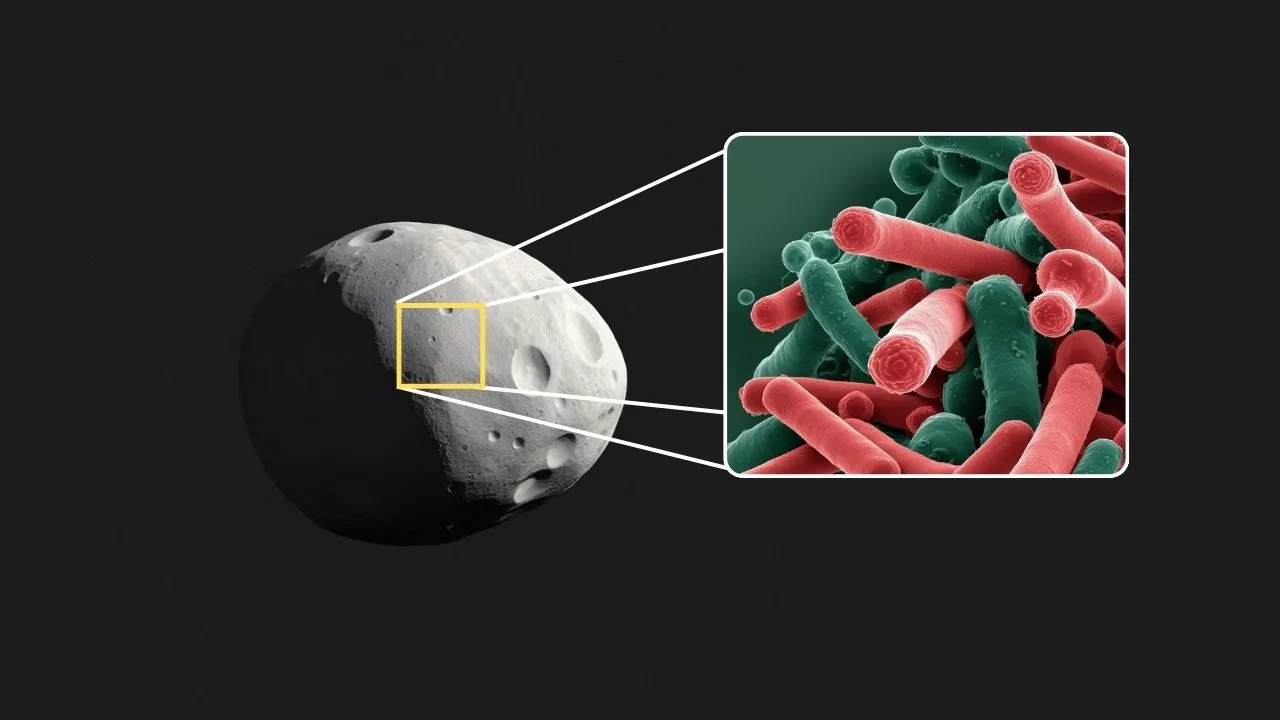
    A rare asteroid sample brought back to Earth by Japan’s Hayabusa 2 mission has been found to contain Earth bacteria, raising questions about contamination risks in the study of extraterrestrial material. Researchers discovered filament-shaped microbes resembling the Bacillus genus inside a fragment of the asteroid Ryugu, despite strict controls meant to prevent such exposure.

    The Hayabusa 2 spacecraft launched in December 2014 and landed on Ryugu in June 2018, collecting material from the asteroid’s surface. The samples were returned to Earth in December 2020 and distributed among international research teams for analysis. The contaminated fragment was examined using high-resolution microscopy, which revealed structures consistent with Earth-based bacteria.

    According to one of the researchers, the bacteria took a filamentous form, suggesting they likely came from Bacillus, a common group of rod-shaped bacteria. The contamination likely occurred during handling or storage on Earth rather than during the mission itself, researchers said.

    The finding was shared publicly after a user on X posted excerpts from the study, noting that the sample was “rapidly colonized by terrestrial microorganisms despite strict contamination control.” The revelation highlights the challenges scientists face in preserving the integrity of rare extraterrestrial material once it reaches Earth.

    Asteroid samples are highly sought after because they offer a window into the early solar system. Unlike Earth, where geological processes erase ancient records, asteroids remain unchanged for billions of years. Examining their composition helps researchers understand how planets formed and whether asteroids carried organic molecules that may have seeded life on Earth.

    Ryugu’s samples are not the only ones under study. NASA’s OSIRIS-REx mission recently returned material from the asteroid Bennu, which was found to contain carbon and water-bearing minerals. These discoveries support the idea that asteroids could have delivered the ingredients for life to Earth through impacts. Future missions, including Europe’s Hera spacecraft, aim to expand knowledge of these small but important bodies.
  • Toxic Odor Detected on ISS from Russian Cargo Ship, Crew Contained Incident Safely

    Toxic Odor Detected on ISS from Russian Cargo Ship, Crew Contained Incident Safely

    Astronauts aboard the International Space Station (ISS) detected a toxic smell shortly after opening the hatch of Russia’s Progress MS-29 cargo spacecraft, which had docked with the station on November 23. The odor, traced to materials inside the newly arrived supply ship, prompted the crew to quickly seal the hatch and activate air filtration systems to ensure their safety.

    Progress MS-29 had delivered more than 5,500 pounds of supplies, including food, propellant, and equipment. The spacecraft docked to the Poisk module two days after launch, and the incident occurred when astronauts began unloading its cargo.

    Along with the odor, the crew also observed small droplets floating inside the vehicle. The crew reported the issue to mission control several hours later.

    Commander Sunita Williams and astronaut Butch Wilmore, who are currently leading the station crew, followed emergency procedures and closed off the Progress spacecraft. Ground controllers then initiated the station’s air-cleaning systems, including the Trace Contaminant Control Subassembly, to remove any lingering toxins. According to NASA, air quality returned to normal by the time the systems were fully engaged.

    Williams and Wilmore have been on the ISS since July, after arriving on Boeing’s Starliner spacecraft. Technical problems forced the Starliner to return to Earth without them, leaving the pair to extend their mission for at least six months. NASA has scheduled their return aboard a SpaceX Crew Dragon capsule in February 2025.

    The extended stay has brought health challenges, including weight loss for Williams due to prolonged exposure to microgravity. NASA continues to monitor the astronauts closely as they manage the demands of their unplanned longer mission, now marked by the added complication of the Progress cargo issue.

  • Proba 3 Spacecraft Stacked on ISRO PSLV Rocket for December 4 Launch to Study Sun’s Corona

    Proba 3 Spacecraft Stacked on ISRO PSLV Rocket for December 4 Launch to Study Sun’s Corona

    Europe’s Proba 3 spacecraft

    has been successfully stacked on ISRO’s PSLV-XL rocket at the Satish Dhawan Space Centre in India and is scheduled to launch on December 4. This mission, a collaboration between the Indian Space Research Organisation (ISRO) and the European Space Agency (ESA), aims to study the Sun’s corona by creating the first artificial solar eclipse in human history.

    Proba 3 consists of two spacecraft: the Occulter Spacecraft (OSC) and the Coronagraph Spacecraft (CSC). The mission will place the probes in a unique orbit that allows extended observation of the solar corona when the spacecraft are farthest from Earth.

    The mission demonstrates advanced precision flying and synchronization techniques. Both spacecraft must maintain alignment to a millimeter scale, with precise pointing measurements in the thousands of degrees, to achieve the required observational accuracy.

    One spacecraft carries observation equipment, while the other has an occulting disc. The disc blocks the direct light of the Sun, allowing the telescope on the other spacecraft to capture detailed images of the outer atmosphere, or corona, effectively creating a controlled, artificial solar eclipse.

    This first-of-its-kind mission is expected to provide unprecedented insight into solar physics and showcase the capabilities of precision spacecraft formation flying for scientific research.

  • SpaceX Launches GSAT-N2 for ISRO, Boosting India’s High-Speed Communication Network

    SpaceX Launches GSAT-N2 for ISRO, Boosting India’s High-Speed Communication Network

    SpaceX successfully launched the GSAT-N2 communication satellite, also known as GSAT-20, from Cape Canaveral Space Force Station in Florida on November 19, 2024, at 12:01 AM IST, reported the Hindustan Times. The launch marks a major collaboration between SpaceX and the Indian Space Research Organisation (ISRO) through its commercial arm, NewSpace India Limited (NSIL). The satellite was placed into orbit 34 minutes after liftoff.

    The GSAT-N2 satellite, weighing around 4,700 kg, was deployed aboard a Falcon 9 rocket into a Geosynchronous Transfer Orbit (GTO). Operational control has been transferred to ISRO’s Master Control Facility (MCF). The satellite aims to enhance India’s communication infrastructure, especially in remote and underserved regions.

    GSAT-N2 is designed to provide high-throughput communication across India, operating in the Ka-band for faster and more reliable data transmission. It features 32 user beams, including eight narrow spot beams for the Northeast and 24 wide beams for the rest of the country.

    With a throughput of around 48 Gbps, it improves broadband access and enables in-flight internet connectivity for commercial airlines. The satellite has an expected operational lifespan of approximately 14 years.

    Technically, GSAT-N2 uses a multi-beam architecture to maximize frequency reuse and overall throughput. It carries three 2.5-meter parabolic deployable reflectors, a bipropellant chemical propulsion system for orbital adjustments, and sensors such as Sun and Earth sensors to maintain precise attitude control.

    The launch represents a significant milestone for India’s space partnerships, signaling a shift from traditional reliance on providers like Arianespace to international commercial firms. Union Minister Jitendra Singh highlighted the potential for this collaboration to improve internet service delivery nationwide.

    In summary, the successful deployment of GSAT-N2 not only strengthens India’s communication capabilities but also sets the stage for future international collaborations in space technology, meeting the growing demand for high-speed connectivity across the country.

  • ISRO Plans Independent Lunar Space Station by 2040 to Advance India’s Role in Space Exploration

    ISRO Plans Independent Lunar Space Station by 2040 to Advance India’s Role in Space Exploration

    The Indian Space Research Organization (ISRO) has announced plans to launch an independent lunar space station, the Bharatiya Chandrama Antariksh Station, by 2040. The project aims to strengthen India’s presence in the global space economy and support long-term lunar exploration.

    Dr. S. Somanath highlighted ISRO’s ambitious roadmap, including the Chandrayaan-4 mission and the Gaganyaan human spaceflight program. The Gaganyaan mission, India’s first crewed spaceflight, is scheduled no earlier than 2025, with uncrewed test flights planned by the end of this year.

    ISRO has allocated Rs 2,104.06 crore for Chandrayaan-4 to advance lunar research. The planned lunar station will orbit the Moon, collect essential data for future missions, and facilitate international collaboration to study the lunar surface, including its structure and potential resources, according to the Indian Defence Research Wing (IDRW).

    India achieved a major milestone on August 23, 2023, when Chandrayaan-3 successfully landed on the Moon’s south pole. This historic mission allowed ISRO to become the first organization to land in this unexplored region, providing critical data on seismic activity, thermo-physical properties, plasma environment, and elemental composition.

    With projects like the Bharatiya Chandrama Antariksh Station and Chandrayaan-4, India continues to expand its capabilities in space exploration, contributing significant scientific knowledge and paving the way for future lunar missions.

  • James Webb and Hubble Capture Detailed Images of Merging Galaxies IC 2163 and NGC 2207

    James Webb and Hubble Capture Detailed Images of Merging Galaxies IC 2163 and NGC 2207

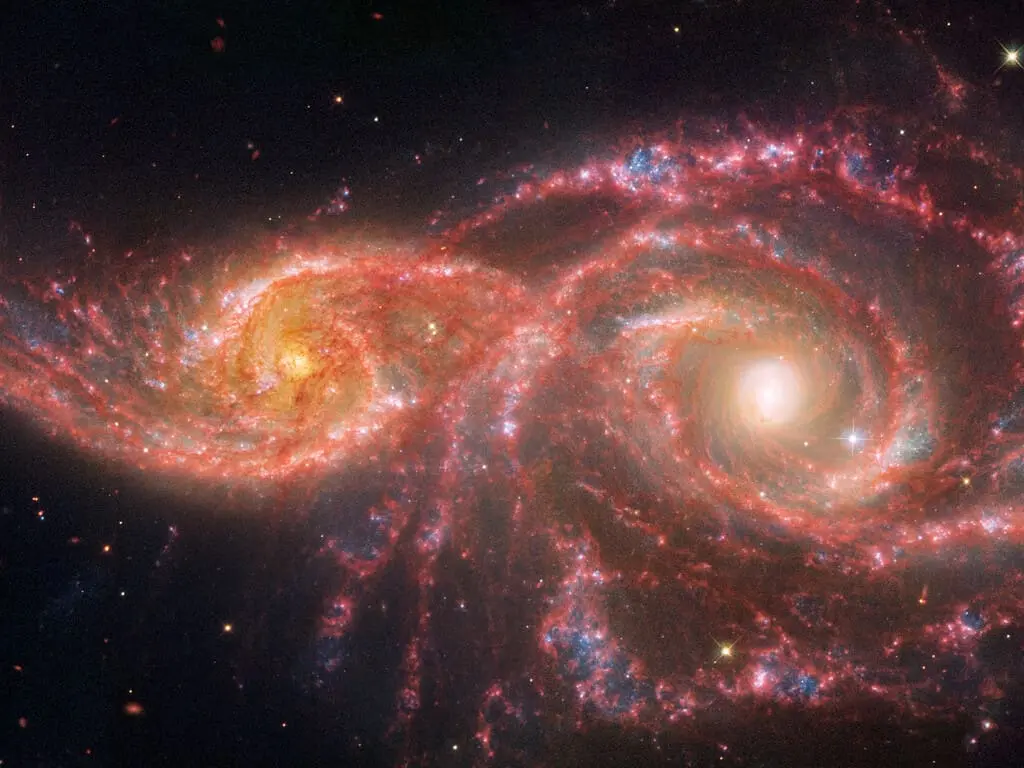
    The European Space Agency (ESA) released new images of the merging galaxy pair IC 2163 and NGC 2207 on October 31, 2024. Captured by both the James Webb Space Telescope and the Hubble Space Telescope, the images show the smaller galaxy IC 2163 interacting with the larger NGC 2207. The collaboration between the two telescopes provides a more complete view, combining infrared and visible light data.

    IC 2163 and NGC 2207 are in the early stages of a galactic merger, with IC 2163 currently shifting behind the larger galaxy. Such interactions, known as galactic cannibalism, are common across the universe. According to the Harvard Center for Astrophysics, roughly 25 percent of galaxies experience mergers at some point in their history.

    The James Webb Space Telescope (JWST) captures infrared light, revealing details invisible to the human eye, while Hubble records visible light. This combination allows scientists to study the structure, star formation, and dust content of merging galaxies in greater detail than ever before.

    Previously, James Webb captured images of another pair of merging galaxies, ARP 142, demonstrating its ability to track dynamic interactions over time. Observing galaxy mergers helps researchers understand how galaxies evolve and grow.

    The IC 2163 and NGC 2207 images highlight both the scale and complexity of galactic interactions. Scientists will continue to monitor these galaxies to learn more about their movement, collision effects, and the broader role of mergers in shaping the universe.

  • NASA Flags Major Air Leak in ISS Russian Module

    NASA Flags Major Air Leak in ISS Russian Module

    NASA has raised concerns over a significant air leak in the Russian segment of the International Space Station (ISS), affecting astronauts including Sunita Williams and Butch Wilmore. The leak, located in the Zvezda service module, was first identified in 2019, and recent measurements show an increased leak rate. NASA has rated the issue as a top safety risk.

    Current assessments indicate that the leak is losing approximately 1.7 kilograms of air per day. This marks a notable increase from earlier measurements. The leak is located in the Service Module Transfer Tunnel, which separates a docking port from the rest of the Zvezda module. This section can be sealed off to limit air loss.

    Temporary repairs have been implemented by NASA and Roscosmos, including sealants and Kapton tape to cover cracks. Astronauts are currently staying on the American side of the ISS near emergency vehicles as a safety precaution. NASA has also coordinated with SpaceX to maintain an evacuation plan if needed.

    The leak highlights the challenges of maintaining the aging ISS, particularly the Zvezda module, which has been in orbit since 2000. With the station planned for retirement by 2030, addressing structural integrity is a priority.

    While the situation does not pose an immediate threat to crew safety, NASA and Roscosmos are actively monitoring and managing the air leak to prevent potential emergencies and ensure the continued safe operation of the ISS.

  • ISRO Announces Gaganyaan Mission Delay to 2026; Preparations Continue for India’s First Human Spaceflight

    ISRO Announces Gaganyaan Mission Delay to 2026; Preparations Continue for India’s First Human Spaceflight

    Dr. S. Somanath, chairman of the Indian Space Research Organisation (ISRO), announced that the Gaganyaan mission, originally scheduled for 2025, has been delayed to 2026. The announcement was made during the Sardar Patel Memorial Lecture at Akashvani (All India Radio), according to Firstpost. Dr. Somanath said the delay reflects ISRO’s careful approach to ensure the safety and success of the mission.

    The mission will carry four Indian astronauts: Prasanth Balakrishnan Nair, Ajit Krishnan, Angad Pratap, and Wing Commander Shubanshu Shukla. Shukla is currently training at the NASA astronaut training center and will join three other astronauts for the Axiom-4 mission to the International Space Station later this year.

    Gaganyaan represents India’s first human spaceflight mission and is a major milestone in the country’s space program. Preparations are ongoing, and ISRO remains committed to completing the mission safely. The announcement coincides with India’s increased investment in space technology, including a budget allocation of Rs 2,104.06 crore for the Chandrayaan-4 mission.

    The Gaganyaan mission reflects India’s growing capabilities in human spaceflight and its contributions to the global space economy. Despite the delay, ISRO continues to train astronauts and develop the necessary technology for a successful launch in 2026.

  • NASA’s SpaceX Crew-8 Returns Safely to Earth After Nearly Eight Months on ISS

    NASA’s SpaceX Crew-8 Returns Safely to Earth After Nearly Eight Months on ISS

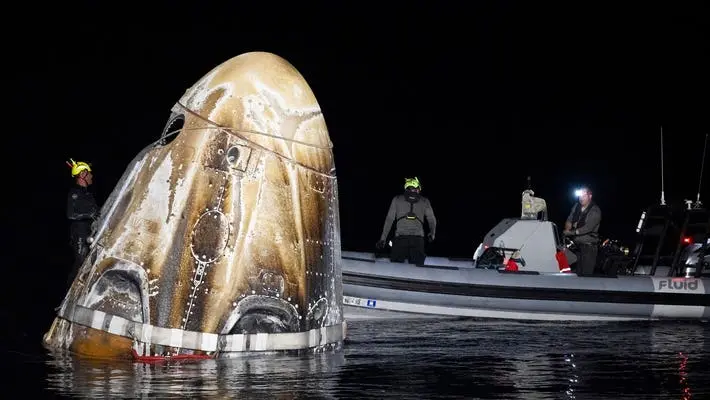
    NASA’s SpaceX Crew-8 astronauts returned to Earth aboard the SpaceX Dragon spacecraft at 3:29 a.m. EDT on October 25, 2024, splashing down off Pensacola, Florida, reported Forbes. The crew included NASA astronauts Matthew Dominick, Michael Barratt, and Jeanette Epps, and Roscosmos cosmonaut Alexander Grebenkin. Recovery teams from NASA and SpaceX secured the spacecraft promptly after landing.

    The astronauts spent nearly eight months aboard the International Space Station, completing research, maintenance, and other mission objectives. The mission, originally planned for two months, was extended due to delays in a Boeing Starliner mission carrying astronauts Sunita Williams and Butch Wilmore.

    During routine medical assessments after splashdown, one astronaut required further evaluation. All four astronauts were taken to a hospital in Pensacola. Three have since been discharged, while the fourth remains under observation in stable condition. NASA has not disclosed the identity or the medical details of the astronaut to protect privacy.

    Crew-8 launched on March 3, 2024, atop a SpaceX Falcon 9 rocket. The mission delivered the astronauts safely to the ISS, where they participated in ongoing research and station maintenance. The extended mission allowed continued support of ISS operations during the Starliner delay.

    The Boeing Starliner spacecraft recently returned uncrewed after docking issues, and NASA now plans to bring Williams and Wilmore back using the upcoming Crew-9 Dragon mission. This adjustment frees up two seats for the next SpaceX flight, which will carry NASA astronaut Nick Hague and Roscosmos astronaut Aleksandr Gorbunov.

    The successful return of Crew-8 demonstrates the continued partnership between NASA and SpaceX, maintaining ISS operations and safely rotating crews despite scheduling challenges and technical delays.

  • James Webb Spots Possible First Brown Dwarfs Beyond the Milky Way in Star Cluster NGC 602

    James Webb Spots Possible First Brown Dwarfs Beyond the Milky Way in Star Cluster NGC 602

    Astronomers using the James Webb Space Telescope (JWST) have identified what may be the first young brown dwarfs ever found outside the Milky Way. The discovery was announced by the European Space Agency (ESA) on October 23.

    The observations targeted NGC 602, a rich young star cluster on the outskirts of the Small Magellanic Cloud, a satellite galaxy about 200,000 light-years away. Webb’s Near-Infrared Camera (NIRCam) captured the detailed data in April 2023 as part of its General Observer program.

    An international team including Peter Zeidler, Elena Sabbi, Elena Manjavacas, and Antonella Nota analyzed the data. Their findings revealed several candidates for brown dwarfs (objects that are too massive to be considered planets but not massive enough to sustain nuclear fusion like stars).

    Brown dwarfs typically range between 13 and 80 times the mass of Jupiter. Until now, all confirmed examples had been found inside the Milky Way. If confirmed, these candidates would mark the first detection of such objects in another galaxy.

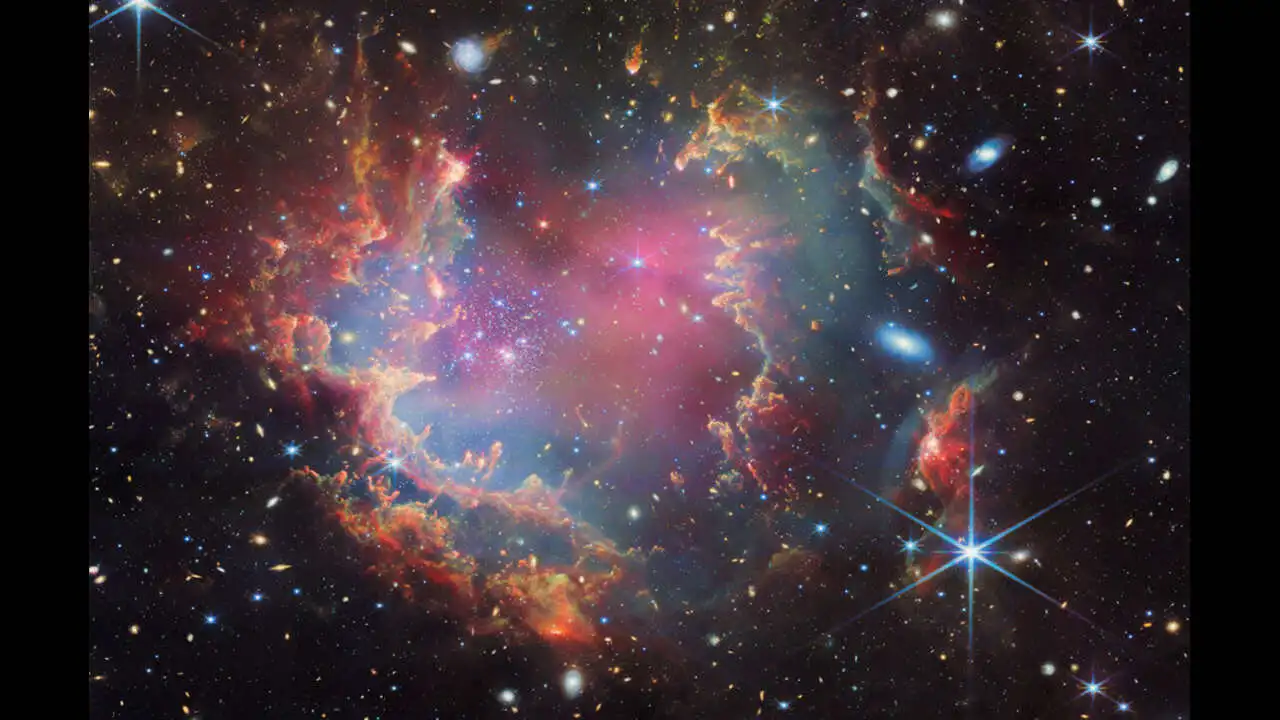
    NGC 602 provides a rare environment for study because its chemical composition resembles that of the early universe. Webb’s imagery shows dark, dense dust clouds, ridges of gas, and signs of active star formation, offering astronomers a chance to trace how stars and substellar objects emerge in different galactic conditions.

    NASA shared Webb’s new image of NGC 602 on X, calling it “rainbows and unicorns, like a middle school binder.” The colorful view shows a crowded region of stars, young stellar objects, and intricate structures of dust and gas, highlighting Webb’s ability to resolve distant clusters in unprecedented detail.

    The telescope has previously delivered sharp images of massive clusters such as Westerlund 1, but NGC 602 stands out for its location beyond our galaxy and the potential breakthrough in identifying brown dwarfs there.